
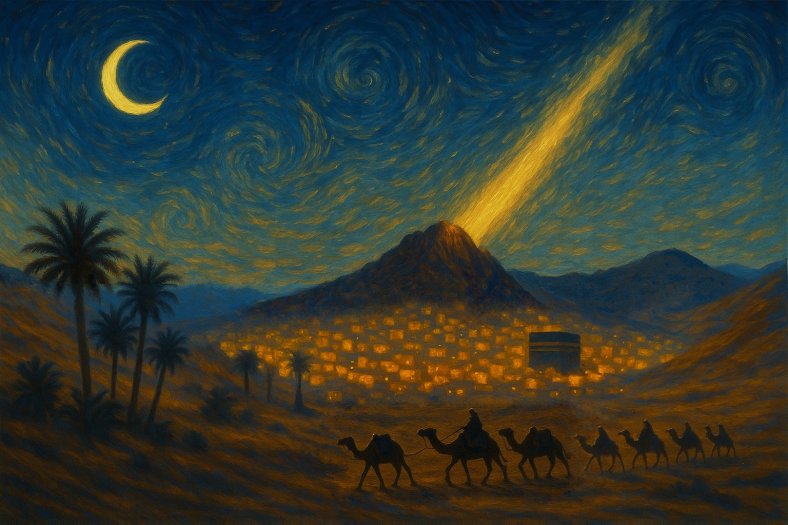
The Relationship Between the Prophetic Mission and the Descent of the Qur’an – The Relationship Between Laylat al-Qadr and the Imam
By Shaykh Haider Hobbollah1
Introduction
Our discussion today will focus on certain aspects of Sūrat al-Qadr, since it is difficult to address all of its exegetical dimensions. Therefore, I will speak briefly on two main themes:
-
How can we reconcile the descent of the Qur’an on Laylat al-Qadr with the fact that the Noble Qur’an was revealed over a span of twenty-three years, and with the fact that the Prophetic mission (biʿthah) took place on the twenty-seventh of Rajab?
-
Is there a relationship between Laylat al-Qadr and the Infallible Imam? And if so, what is this relationship?
I will not present my final opinion here, nor will I delve deeply into the proofs and discussions, since time and space do not permit that. Rather, I will highlight some of the most important key points for reflection and contemplation, and I may indicate certain convictions here and there.
The Relationship Between Laylat al-Qadr, the Mission, and the Descent of the Qur’an
The problem that scholars and researchers have faced here revolves around two questions:
The first question:
If the Qur’an was revealed on Laylat al-Qadr, then this would mean that the Prophet was commissioned (biʿtha) on Laylat al-Qadr, because the descent of the Qur’an upon him—namely the first verses of Sūrat al-ʿAlaq—marks the beginning of his mission. So how can there be a descent of the Qur’an on Laylat al-Qadr in the month of Ramadan, while the mission occurred in Rajab?!
The second question:
What does it mean that the Qur’an was revealed on Laylat al-Qadr, when it was in fact revealed over a period of twenty-three years? The Qur’an was revealed on Laylat al-Qadr, and also in Shaʿbān, and in Rabīʿ al-Awwal, and in various other months. In fact, portions of the Qur’an were revealed in every month over the course of twenty-three years. So why does it say that the Qur’an was revealed on Laylat al-Qadr, as though no revelation descended upon the Prophet outside of Laylat al-Qadr? We know that revelation would descend upon the Prophet on various days throughout the year, not only on Laylat al-Qadr. So why did the Qur’an single out Laylat al-Qadr as the night in which it was revealed?
There is no fundamental problem among Sunnis regarding the first question, because Sunnis generally believe that the mission occurred in the month of Ramadan, not in Rajab. Although there are approximately three weak narrations stating that it occurred in Rajab—and this opinion is attributed to some Sunnis—the overwhelming majority hold that the mission took place in Ramadan. For this reason, they are not compelled to explain the relationship between the descent of the Qur’an in Ramadan and the occurrence of the mission in Rajab.
Some of them also hold that what occurred in Rajab was the Night Journey and Ascension (al-Isrāʾ wa’l-Miʿrāj), not the mission itself, as though some confusion arose whereby certain people thought that the Night Journey and Ascension was the mission, and thus attributed the mission to the month of Rajab. This is the situation among Sunnis.
As for the Twelver Shiʿa, the majority of narrations in their sources—approximately ten reports—affirm that the twenty-seventh of Rajab is the day of the mission. For this reason, they mention certain recommended acts for that day, such as fasting. On this basis, the question arises among them concerning the distinction between the Day of the Mission and the Day of the Descent of the Qur’an.
Thus, the first question is more of a Shiʿi issue than a Sunni one. As for the second question—namely, the descent on Laylat al-Qadr while at the same time over a period of twenty-three years—it concerns both Sunnis and Shiʿa alike.
On this subject there is more than one viewpoint. I will confine myself to two:
The First Viewpoint
This view holds that the Noble Qur’an was revealed in two stages. The first time, it was revealed all at once (in a single, complete descent). The second time, it was revealed in a fragmented manner over twenty-three years. The beginning of the gradual revelation was on the Day of the Mission, while the single, complete descent occurred on Laylat al-Qadr. In this way, the problem is resolved from all angles.
Regarding this single, complete descent which they affirm, there has been disagreement among them, and several opinions have emerged, the most important of which are three:
A – The Qur’an was revealed in its entirety on Laylat al-Qadr to al-Bayt al-Maʿmūr, which has been said to be located in the first heaven, or the third, or the fourth, or the sixth, or the seventh, or even above the seventh heaven. Thereafter, it began to descend gradually from al-Bayt al-Maʿmūr to the earth.
Let us pause briefly at the idea of al-Bayt al-Maʿmūr. The Qur’an mentions al-Bayt al-Maʿmūr (Q 52:4), and it is highly probable that what is meant is the Kaʿbah, which is known as “inhabited” (maʿmūr) in Arab culture. It is also described as “the Ancient House” (al-Bayt al-ʿAtīq). It is called “maʿmūr” because it is populated by its visitors and pilgrims.
However, some narrations among Muslims, attributed to certain Companions and Successors, attempted to claim that al-Bayt al-Maʿmūr is another house parallel to the Kaʿbah, located in one of the heavens, superior to the Kaʿbah, and circumambulated by angels in very large numbers. In this way, the idea of a heavenly house bearing this name was born, and then the notion of the complete descent of the Qur’an to this house was attached to it.
Among the most prominent transmitters who spoke about al-Bayt al-Maʿmūr was Abū Hurayrah. The idea later entered Shiʿi heritage, most likely through Shaykh al-Kulaynī (d. 329 AH) and Shaykh al-Ṣadūq (d. 381 AH), who transmitted in their books al-Kāfī and al-Amālī a narration from Imam Jaʿfar al-Ṣādiq containing the idea of al-Bayt al-Maʿmūr and stating that the Qur’an first descended there.
Al-Ṣadūq affirmed this idea in his theological works, stating that the Qur’an first descended upon al-Bayt al-Maʿmūr, and from there gradually descended to the earth over twenty years. For this reason, Shaykh al-Mufīd (d. 413 AH) criticized him on this point and rejected it, stating that al-Ṣadūq had relied upon only a single narration and that this was incorrect. Despite al-Mufīd’s critique, the idea reappeared and continued in the works of Shaykh al-Ṭūsī (d. 461 AH) and persists up to the present day.
It is worth noting that the narration cited by al-Ṣadūq from Imam al-Ṣādiq in this regard is weak in its chain of transmission.
In any case, this was the first opinion concerning the single, complete descent on Laylat al-Qadr—that it occurred to al-Bayt al-Maʿmūr.
B – It was revealed on Laylat al-Qadr all at once to the lowest heaven (al-samāʾ al-dunyā). This view is reported from Ibn ʿAbbās. Thereafter, it descended gradually over twenty-three years to the earth, beginning from the Day of the Mission.
C – It was revealed—this being the view of a group of contemporary scholars, among them ʿAllāmah al-Ṭabāṭabāʾī—in its general, summary content (not in its detailed form), and in its universal outlines, all at once upon the heart of the Messenger Muḥammad. Accordingly, they distinguished between inzāl al-Qurʾān (the “sending down” of the Qur’an), which they considered to be instantaneous, and tanzīl al-Qurʾān (the “gradual sending down”), which they considered to be progressive. Thus, the Qur’an was sent down instantaneously upon the heart of the Prophet on Laylat al-Qadr, while its detailed, gradual revelation began in Rajab. Al-Ṭabāṭabāʾī relied upon the linguistic distinction between the two terms—inzāl and tanzīl—to reinforce this idea.
In contrast, some scholars—among later figures such as Sayyid Muḥammad Ḥusayn Faḍlallāh and Shaykh Niʿmatullāh Ṣāliḥī Najafābādī, among others—denied the existence of two separate descents of the Noble Qur’an. They argued that the hypothesis of an instantaneous descent is based upon certain very weak narrations, and that the notion of its descent upon the heart of the Prophet is merely an assertion. They further maintained that the distinction between inzāl and tanzīl has no solid foundation in the Arabic language. In Arabic usage, we do not say anzala intending necessarily an instantaneous descent, nor do we say nazzala intending necessarily a gradual descent.
The Second Viewpoint
This view maintains that the Noble Qur’an was revealed on Laylat al-Qadr, and that this was the beginning of its revelation. The Qur’an itself serves as proof for this, and we are able to understand it by interpreting certain verses in light of others.
God the Exalted says: Ḥā Mīm. By the clear Book. Indeed, We sent it down in a blessed night; indeed, We have always been warners. In it every wise matter is determined—by a command from Us; indeed, We have always been sending [messengers]. (Q 44:1–5)
The attached pronoun in His saying “We sent it down” refers back to the previous verse which speaks about “the clear Book.” The verse then speaks about warning and sending, both of which are concepts connected to revelation and prophethood. From this we understand that what was revealed on Laylat al-Qadr is the Qur’an. In this way we can also interpret the opening of Sūrat al-Qadr, since the pronoun there is not explicitly identified.
As for the idea of an instantaneous descent, this view rejects it entirely. The Qur’an’s statement that God sent it down on Laylat al-Qadr does not mean that the entire Qur’an was revealed on that night. Rather, it means that its revelation began on that night. It is like saying, for example, “On 10–10–2000 Egypt supplied Lebanon with gas.” This does not mean that all the gas arrived on that date; it means that the supply began on that date.
As for the Prophetic mission (biʿthah), this view may interpret it in one of two ways:
1. The distinction between the mission and the descent of the Qur’an is that the mission represents the moment when the Prophet was commissioned and sent to the people to convey the religion. It is possible that revelation descended upon the Prophet, but that he was not yet told that he bore the responsibility of delivering a message to the people; that may have occurred later.
This idea may seem strange to some, because they imagine that the descent of revelation upon a person automatically means that God has sent him to the people. This is not correct. Revelation may descend upon a person who is neither a messenger nor a prophet commissioned to the people, as was the case with Lady Maryam (Mary). Therefore, the mere descent of revelation does not in itself mean that the recipient has been commissioned with a public mission.
2. The notion of a specific Day of the Prophetic Mission in Rajab is based on weak narrations, and therefore should not be relied upon.
The conclusion—based on this second viewpoint—is that the Qur’an explicitly states that it was revealed in the month of Ramadan and on Laylat al-Qadr, not in Rajab. Therefore, we adhere to what the Qur’an says and believe that its revelation began there as a gradual revelation, with no other prior descent. At best, we may say that its revelation began in Ramadan, while the command to publicly invite and preach was given in Rajab.
2 – The Relationship Between Laylat al-Qadr and the Imam
It is well known within Shiʿi circles—especially today—that hosts of angels descend upon the Infallible Imam on Laylat al-Qadr and continue doing so until dawn, informing him of all future divine decrees related to the cosmos and existence, so that he becomes a central element in the administration of the affairs of the world. Accordingly, the secret and essence of Laylat al-Qadr is said to be the Infallible Imam. Through this approach, the understanding of Laylat al-Qadr is reformulated in accordance with Shiʿi theological principles, wherein the doctrine of the Imam’s knowledge of the unseen is intertwined with the doctrine of ontological authority (wilāyah takwīniyyah) and the Imam’s authority over the world. For this reason, Sūrat al-Qadr is referred to in some Shiʿi writings as “Sūrat al-Wilāyah.”
The question here is: From where did this understanding arise? And how was this connection inferred between the concept of Laylat al-Qadr in Islam and the doctrine of Imamate?
The answer is that there exists a set of narrations from the Ahl al-Bayt in this regard. In Uṣūl al-Kāfī by Shaykh al-Kulaynī, there is a chapter dedicated to this topic under the title: “Regarding ‘Indeed, We sent it down on Laylat al-Qadr’ and its interpretation.” It presents a collection of narrations, some of which go so far as to claim that Laylat al-Qadr constitutes proof of Imamate. The reasoning is based on the premise that if Laylat al-Qadr recurs every year—and is not merely a single night that occurred and ended during the Prophet’s time, contrary to what many Sunni scholars believe—then this implies that there must be someone upon whom Laylat al-Qadr descends just as it descended upon the Messenger of God. That person, it is said, can only be the Infallible Imam. On this basis, the belief in a firm relationship between Laylat al-Qadr and the Infallible Imam—especially Imam al-Mahdī—became widespread.
In one of these narrations, it is reported from Imam al-Bāqir that he said:
“O community of Shiʿa! Argue by means of Sūrat ‘Indeed, We sent it down,’ and you will prevail. By God, it is the proof of God, Blessed and Exalted, upon creation after the Messenger of God. It is the mistress of your religion, and it is the utmost of our knowledge, O community of Shiʿa…”2
The phrase “you will prevail” (taflajū) means that you will succeed and triumph.
In another narration cited by ʿAlī ibn Ibrāhīm al-Qummī in his Tafsīr—without attributing the statement to any specific Imam and without mentioning any chain of transmission—regarding the verse “The angels and the Spirit descend therein”, it is said: “The angels and the Holy Spirit descend upon the Imam of the time, and they deliver to him what they have written concerning these matters.”3
Al-Kulaynī and others narrate from al-Ḥasan ibn al-ʿAbbās ibn al-Ḥarīsh (or al-Jarīsh), from Abū Jaʿfar al-Thānī, that the Commander of the Faithful said to Ibn ʿAbbās: “Indeed, Laylat al-Qadr occurs every year, and on that night the decree of the year descends, and for that decree there are authorities after the Messenger of God.” Ibn ʿAbbās asked: Who are they? He replied: “I and eleven from my progeny—Imams who are spoken to (muḥaddathūn).”4
Al-Qummī also transmits with his chain to Abū al-Muhājir, from Abū Jaʿfar, who said: “O Abū al-Muhājir, Laylat al-Qadr is not hidden from us; indeed, the angels circulate around us in it…”5
Observations of the Group That Rejects the Idea of a Relationship Between Laylat al-Qadr and the Imam
Those who reject this idea argue that when we review these narrations in al-Kāfī, as well as others in different books, we observe two highly significant points from the perspective of hadith studies:
First:
The overwhelming majority of these narrations are found in only two books: al-Kāfī by al-Kulaynī and Baṣāʾir al-Darajāt by Shaykh al-Ṣaffār. In other words, most of these reports were transmitted either by al-Kulaynī or by al-Ṣaffār.
Second:
Certain names recur frequently in the chains of transmission of these narrations. Among the most prominent are:
A – al-Ḥasan ibn al-ʿAbbās ibn al-Ḥarīsh (al-Jarīsh).
B – Aḥmad ibn Muḥammad al-Sayyārī.
C – Salamah ibn al-Khaṭṭāb.
D – ʿAlī ibn Abī Ḥamzah al-Baṭāʾinī.
When we examine the historical record of these individuals—and indeed most of these narrations pass through them, whether directly or in mursal form—we discover that the first two were among the major extremists (ghulāt) in history and were accused of fabrication. Al-Ṭūsī states regarding Aḥmad ibn Muḥammad al-Sayyārī: “Weak in hadith, corrupt in doctrine, abandoned in transmission, prolific in mursal reports.”6 Al-Najāshī says of al-Ḥasan ibn al-ʿAbbās ibn al-Ḥarīsh: “Very weak. He authored a book entitled ‘Indeed, We sent it down on Laylat al-Qadr,’ and it is a book of poor hadith, with confused wording.”7 As for the third and fourth individuals, they too are deemed weak and are accused in the biographical works.
Accordingly, it is rare to find a narration in this area that does not pass through one of these figures. In al-Kāfī, in the chapter previously mentioned, al-Kulaynī transmits nine narrations, all of them from Ibn al-Ḥarīsh. This may suggest that al-Kulaynī did not find reports connected to this concept—the relationship between Laylat al-Qadr and the Imam—except with this accused extremist, or that he did not adopt the additional reports found in Baṣāʾir al-Darajāt, or that he chose brevity.8
ʿAllāmah al-Majlisī attempted to defend some of these individuals—such as Ibn al-Ḥarīsh—by stating that it appears from the biographical works that the only reason for weakening him was his transmission of these lofty and obscure reports, whose meanings most minds cannot grasp, and that his book was well-known among hadith scholars.9
However, this methodological approach has been discussed extensively in our detailed studies of rijāl. Anyone could authenticate even the weakest accused narrators merely by employing this kind of exonerative reasoning. While we do not deny the theoretical possibility of rehabilitation, nullifying the weakening judgments of early rijāl scholars does not automatically establish a narrator’s reliability. To assume so would be a logical fallacy. Therefore, the weakening judgments of early authorities continue to affect our confidence in Ibn al-Ḥarīsh’s reliability, if not incline us toward suspecting fabrication.
Moreover, Ibn al-Ḥarīsh is virtually unknown in hadith literature except through this small cluster of narrations. He is not a widely recognized transmitter with known teachers, students, geographical transmission networks, or chronological presence in isnād chains that would allow us to trace and evaluate his hadith activity. This point is significant in critical hadith studies.
Additionally, to respond to al-Majlisī specifically: al-Najāshī’s remarks clearly reflect the judgment of a hadith expert, not merely a theologian, as evidenced by his reference to the linguistic structure of Ibn al-Ḥarīsh’s reports and their inconsistency. This is a professional critique concerning the integrity of transmission, unrelated to sectarian affiliation. Further discussion of this point would take us too far afield.
Let us then set aside the chains of transmission and examine the content of these narrations. Are they necessarily correct? Does the Qur’an itself support them? Let us evaluate the substance and argumentative method of these reports.
Sūrat al-Qadr, Sūrat al-Dukhān, and similar passages indicate the descent of the angels and the Spirit on Laylat al-Qadr. However, they do not indicate that these angels encounter any specific Infallible figure or descend upon them, including the Messenger of God—apart from the descent of the Qur’an itself upon him on that night. The verses state that this night—on which God sent down the Noble Qur’an upon His Messenger—is a night filled with descent, and that decisive matters are determined in it. But this does not mean that everything decreed or sent down on that night is connected to the Prophet beyond the revelation of the Book.
It may be that their descent has other functions unknown to us. What, then, is the basis for linking their descent to the existence of an Infallible Imam? Or for claiming that this descent occurs upon the Imam personally? The verses indicate that there are descents from heaven to earth on that night. But how these descents occur, and whether they descend upon a human being or upon the entire created order—this is not specified in the Qur’anic text. If anything, it may be closer to understanding the descent as the initiation of the implementation of divine decrees for that year, assuming Laylat al-Qadr recurs annually.
One might argue that the phrase “Peace it is until the break of dawn” implies that peace is bestowed upon a specific individual—that successive hosts of angels come to greet the Infallible Imam until dawn.
However, this interpretation is linguistically unsound. In Arabic, salām means safety and freedom from harm. The night is described as a night of peace in which God envelops His servants with benevolence through the decrees He sends down to regulate their affairs until the coming year, as though He decrees for them only what is good. There is no indication in the phrase of the aforementioned claim.
Even if we were to assume that the peace mentioned requires someone to whom peace is directed, why should it be restricted to the Imam? The angels may descend to bestow peace and mercy upon all believers and the righteous, including the Imam. What evidence restricts this peace exclusively to him? And what evidence indicates that this peace signifies entrusting him with responsibility for managing the world in the coming year?
The summary of the rejecting group’s position is that the idea of linking Laylat al-Qadr to the Imam arises from narrations, not from the Qur’anic text itself. These narrations suffer from serious problems in their sources, chains of transmission, and linguistic structure. It is sufficient to note that the most important source for them is the book on the interpretation of Sūrat al-Qadr by Ibn al-Ḥarīsh, a figure accused of fabrication and inconsistency in transmission.
As for framing the matter within the doctrine of the Perfect Human (al-insān al-kāmil) and his role as intermediary in divine effusion, this is a foundational dispute. This group does not accept such theories as conclusive. A full discussion belongs elsewhere.
I suffice with this to open the door for reflection and contemplation on these two topics that have been addressed.
Footnotes
- This article — in Arabic — is based on a lecture delivered by Shaykh Haider Hobbollah to a gathering of Muslim students at the University of Cambridge on the occasion of the Nights of Qadr in the blessed month of Ramadan, dated 22–3–2025. Shaykh Hobbollah made revisions and additions so that it would appear in this form in Arabic.
- Al-Kāfī, 1:249. In its chain of transmission appears Ibn al-Ḥarīsh, whom we will discuss shortly.
- Tafsīr al-Qummī, 2:431.
- Al-Kāfī, 1:532–533; and Kamāl al-Dīn, 304–305. In its chain of transmission appears Ibn al-Ḥarīsh, whom we will discuss shortly.
- Tafsīr al-Qummī, 2:290. Abū al-Muhājir is a completely unknown individual about whom we have no information whatsoever.
- Al-Fihrist, p. 66.
- Al-Fihrist, pp. 60–61.
-
It is not inappropriate here to briefly present some of the most important narrations—other than those already mentioned above—and to evaluate their chains of transmission and certain related matters in a very concise manner, as we do not aim at detailed expansion. We exclude narrations that speak generally about the descent of the angels upon the Ahl al-Bayt and their speaking to them without specific reference to Laylat al-Qadr, since our discussion concerns Laylat al-Qadr in particular, not the general notion of angels communicating with them. Some researchers have conflated these two matters, so take note.
The most important narrations here are as follows:
The first narration: The report of Dāwūd ibn Farqad. He said: I asked him about the statement of God, Mighty and Exalted: “Indeed, We sent it down on Laylat al-Qadr; and what will make you know what Laylat al-Qadr is?” He said: “In it is sent down what will occur from year to year—of death or birth.” I said to him: To whom? He replied: “To whom could it be? The people on that night are engaged in prayer, supplication, and petition, while the holder of this command is occupied—the angels descend to him with the matters of the year from sunset until its rising; from every matter, peace it is for him until the break of dawn.” (Baṣāʾir al-Darajāt, p. 240).
It may be critiqued as follows:
First: From the standpoint of its chain of transmission, the narration is sound—except with respect to establishing that the Baṣāʾir in our possession today can definitively be attributed to al-Ṣaffār. This attribution is itself disputed, since we have no direct transmission path to the existing text. This has been acknowledged by Sayyid Muḥammad Bāqir al-Ṣadr, Sayyid Kāẓim al-Ḥāʾirī, and others. Therefore, definitively authenticating this narration requires first confirming the attribution of the extant Baṣāʾir to al-Ṣaffār.
Second: The apparent implication of this narration is that the Ahl al-Bayt do not spend Laylat al-Qadr in supplication and petition; rather, they spend it receiving the angels and the descent of the decree upon them. This contradicts other narrations, such as the report of al-Fuḍayl ibn Yasār—which is considered sound in chain according to Shiʿi hadith scholars and is transmitted through multiple routes from al-Fuḍayl—who said: “Abū Jaʿfar (peace be upon him), when it was the night of the twenty-first or twenty-third, would engage in supplication until the night passed; and when the night passed, he would perform prayer.” (Al-Khiṣāl, p. 519; al-Kāfī, 4:155).
If we assume that these nights are Laylat al-Qadr, and we claim that the Imam does not spend them in devotional vigil but rather in receiving decrees, this would contradict the reliable report of al-Fuḍayl and others like it—unless a harmonizing explanation can be found.
The second narration: The report of ʿAlī ibn Abī Ḥamzah, from Abū al-Ḥasan (peace be upon him), who said: I heard him say: “There is no angel whom God sends down concerning any matter except that he begins with the Imam and presents it to him; and indeed, the coming and going of the angels from God, Blessed and Exalted, is to the holder of this command.” (Al-Kāfī, 1:394; Baṣāʾir al-Darajāt, p. 115).
The indication of this narration is general, as it implies that no matter descends except that it begins with the Imam. This would include their descent on Laylat al-Qadr.
It is critiqued on the grounds that its chain of transmission is weak due to both ʿAlī ibn Abī Ḥamzah al-Baṭāʾinī and Muḥammad ibn Aslam.
The third narration: The report of Muḥammad ibn Ḥumrān, from Abū ʿAbd Allāh (peace be upon him). He said: I said to him: People claim that on the fifteenth night of Shaʿbān lifespans are decreed, provisions are apportioned, and pilgrimage writs are issued. He replied: “We have nothing regarding that. But when it is the nineteenth night of Ramadan, lifespans are written, provisions are apportioned, pilgrimage writs are issued, and God looks upon His creation—no believer remains except that He forgives him, except one who drinks intoxicants. Then when it is the twenty-third night, every wise matter is distinguished and confirmed, then finalized.” I said: To whom, may I be your ransom? He replied: “To your companion (i.e., the Imam); and were it not for that, he would not know what will occur in that year.”
It is critiqued because the chain includes some weak narrators, such as Salamah ibn al-Khaṭṭāb and ʿAbd Allāh ibn al-Qāsim, who is either al-Ḥaḍramī or al-Ḥārithī. If we do not consider them identical, then the latter is a weak fabricator, while the reliability of the former has not been established. One may consult the relevant sources.
However, this narration has another chain, as reported by al-Ṣaffār in Baṣāʾir al-Darajāt, from al-ʿAbbās ibn Maʿrūf, from Saʿdān ibn Muslim, from ʿAbd Allāh ibn Sinān, who said: I asked him about the fifteenth of Shaʿbān. He replied: “I have nothing regarding it. But when it is the nineteenth night of Ramadan, provisions are apportioned, lifespans are written, pilgrimage writs are issued, and God looks upon His servants and forgives them, except one who drinks wine. Then when it is the twenty-third night, every wise matter is distinguished, then completed and carried out.” I said: To whom? He replied: “To your companion; and were it not for that, he would not know.” (Baṣāʾir al-Darajāt, pp. 240–241).
In its chain appears Saʿdān ibn Muslim, whose authentication is based upon Kāmil al-Ziyārāt, Tafsīr al-Qummī, and similar sources.
The fourth narration: The report of ʿUmar ibn Yazīd, who said: I said to Abū ʿAbd Allāh (peace be upon him): What about one who does not affirm what comes to you on Laylat al-Qadr as mentioned, yet does not deny it? He replied: “If the proof has been established against him by one whom he trusts concerning our knowledge, and he does not trust him, then he is a disbeliever. But as for one who has not heard it, he is excused until he hears.” (Baṣāʾir al-Darajāt, p. 244).
It is critiqued as follows:
First: This narration is transmitted solely by al-Ṣaffār in Baṣāʾir al-Darajāt. The issue of the attribution of the book to al-Ṣaffār has already been discussed and need not be repeated. Moreover, Muḥammad ibn al-Ḥusayn ibn Abī al-Khaṭṭāb—who is reliable—narrates this report from Muḥammad ibn ʿAbd Allāh. Upon reviewing the teachers of Ibn Abī al-Khaṭṭāb, we discover that this is either Muḥammad ibn ʿAbd Allāh ibn Hilāl, whose reliability has not been established (even al-Khūʾī initially authenticated him based on Kāmil al-Ziyārāt but later revised his position), or Muḥammad ibn ʿAbd Allāh ibn Zurārah, who is reliable. Since Ibn Abī al-Khaṭṭāb more frequently narrates from Ibn Hilāl, one cannot definitively affirm the soundness of this narration given the uncertainty between a reliable and an unreliable narrator.
Second: The narration does not explain what comes to them on Laylat al-Qadr. It merely affirms that something comes to them on that night. On its own, it cannot clarify the matter; it requires the support of other narrations to establish the intended claim.
The fifth narration: The report of al-Qāsim ibn Yaḥyā, from some of our companions, from Abū ʿAbd Allāh (peace be upon him), who said: ʿAlī ibn Abī Ṭālib (peace be upon him) would often say: We met with the Messenger of God along with al-Taymī and his companion while he was reciting “Indeed, We sent it down on Laylat al-Qadr” in a state of humility and weeping. They would say to him: How intense is your tenderness toward this sūrah! He would reply: I am moved because of what my eyes have seen and my heart has comprehended—and because of what this one after me (meaning ʿAlī, peace be upon him) will see. They would say: And what is it that he will see? He would recite: “The angels and the Spirit descend therein, by the permission of their Lord, with every matter. Peace it is until the break of dawn.” Then he would say: Has anything remained after the statement of the Exalted: ‘every matter’? They would reply: No. He would say: Do you know to whom that descends? They would reply: No, by God, O Messenger of God. He would say: Yes. Will Laylat al-Qadr continue after me? They would say: Yes. He would say: Will the decree descend in it? They would say: Yes. He would say: To whom? They would reply: We do not know. He would then take hold of my head and say: If you do not know, it is this one after me. It is said that they used to distinguish that night after the Messenger of God because of the intense fear that would enter it (i.e., enter them regarding it). (Baṣāʾir al-Darajāt, p. 244).
It is critiqued on the basis that its chain is weak due to its being mursal (having a missing link), as is evident. I do not wish to prolong the analysis of its text, which bears signs of fabrication—especially since it attributes this dialogue to a very early period, namely the lifetime of the Prophet. In any case, it too is transmitted solely by al-Ṣaffār in Baṣāʾir al-Darajāt, and thus the question regarding the authenticity of attributing the book to al-Ṣaffār arises here as well.
The sixth narration: The report of Buraydah, who said: I was sitting with the Messenger of God (peace and blessings be upon him and his family), and ʿAlī (peace be upon him) was with him, when he said: “O ʿAlī, did I not have you witness with me seven occasions? The fifth of them was Laylat al-Qadr; we were singled out by its blessing—it is not for others.” (Baṣāʾir al-Darajāt, p. 242).
It is critiqued as follows:
First: The narration is weak in its chain of transmission. In the version of Baṣāʾir currently available, it reads: “Aḥmad ibn Muḥammad, from ʿAlī ibn al-Ḥakam and others,” whereas al-Majlisī transmits it in Biḥār al-Anwār (94:24) in the following form: “ʿAlī ibn al-Ḥakam or others,” which opens the possibility of multiple manuscript versions. Thus, it is unclear who exactly the narration is transmitted from, resulting in confusion in the chain.
Additionally, in the chain appears Sayf ibn ʿUmayrah narrating from Ḥassān. Upon examining the generation of Sayf ibn ʿUmayrah, we find that this Ḥassān is either Ḥassān al-Mukhtār (Ḥassān ibn Mukhtār), who is a very obscure figure, or Ḥassān ibn Mihrān, who is trustworthy. Both are narrated from by Sayf ibn ʿUmayrah in the Four Books. Given this uncertainty, it is difficult to definitively affirm the soundness of the chain. All of this is aside from the fact that al-Ṣaffār alone transmits this narration, and accepting it depends upon confirming the attribution of the extant Baṣāʾir to him.
Second: The narration does not explain what the blessing of Laylat al-Qadr is by which they were singled out. It merely refers to ʿAlī witnessing Laylat al-Qadr with the Messenger of God, and that its blessing was exclusive to them (peace be upon them). However, what that blessing consists of, and what Imam ʿAlī witnessed with the Messenger of God, is not clarified in the narration. Thus, we would need to combine it with other reports to establish the concept. On its own, it does not fully convey the intended meaning.
There are other narrations as well, over which scholars may differ in evaluating their chains or their content. As we have stated, our discussion here is not based on exhaustive investigation, as the context does not permit it.
- Mirʾāt al-ʿUqūl, 3:61–62.