
The Evolution of Child Educational Studies in the Past Century of the Qom Seminary
By: Hasan Najafī – Assistant Professor, Department of Educational Sciences, Farhangian University, Tehran, Iran1
Translated by Sayyid Ali Imran
Introduction
The seminaries, as centers for the teaching of religious sciences in the Shiʿi tradition, are in the contemporary era especially identified with the Qom Seminary. The modern form of this educational institution was established in the year 1300 SH (1920s) through the efforts of Ayatollah Shaykh ʿAbd al-Karīm Ḥāʾirī. Since that time, it has played a prominent role in the expansion of religious knowledge and in the intellectual and ethical training of students. The educational discourse of the Qom Seminary, grounded in the epistemic foundations of Islam and in the teachings of the Qur’an and ḥadīth, encompasses all stages of human life, from childhood to adulthood. With awareness of contemporary intellectual developments and through critique of Western educational theories, it has contributed to the production of Islamic educational knowledge. Within this discourse, Islamic education during childhood has received particular attention as one of its key axes.
This focus stems from the importance of childhood in shaping religious personality, values, and Islamic identity, as well as from the necessity of religious cultural formation within an Islamic system. Seminary efforts in this regard have manifested in the drafting of educational works, the organization of training courses, and the production of religious content tailored to children’s needs.
The evolution of child educational studies in the Qom Seminary is a complex and multidimensional phenomenon that extends beyond a purely historical inquiry. Examining it allows for a deeper understanding of how perspectives and concerns related to child education have been formed. These perspectives and concerns have been shaped by various intellectual, cultural, and social contexts that have changed over time. A closer look reveals that each historical period, under the influence of scientific advances, social change, and cultural transformations, offers new understandings of the concepts of the “child” and “education.” For example, in some periods children were viewed as dependent on adults, whereas in other periods emphasis was placed on their creative capacities and independence. Such an examination also makes it possible to identify existing strengths and shortcomings.
The present study aims to analyze the evolution of child educational studies in the Qom Seminary over the past century. It seeks, alongside identifying the most significant movements, works, and influential figures, to examine the epistemic, social, and cultural contexts of these transformations. Understanding this trajectory can contribute to a deeper appreciation of the seminary’s role in educating the new generation and may facilitate constructive synergy with the country’s formal educational system.
Findings
Over the past century, the Qom Seminary, while preserving its authenticity, has gradually moved toward the development of child educational studies. This trajectory can be examined across four key periods. This classification is based on the following criteria:
-
Historical and institutional transformations, including major events such as the establishment of the Qom Seminary (1920s ), the victory of the Islamic Revolution (1979), and the founding of specialized research centers (2000s).
-
Epistemic and discursive transformations, marked by a shift from the dominance of traditional discourse toward the critique of modern sciences and the production of indigenous knowledge.
-
Changing conceptions of the child, from viewing the child as a small imitator to understanding the child as a divine trust (amānah) endowed with dignity and spiritual capacities.
-
Development of educational works and activities, progressing from primarily oral instruction toward structured initiatives aimed at guiding growth and development.
First Period: Dominance of the Traditional Model, Oral and Non-Systematic Instruction
In this period, spanning from the founding years until the 1340s SH, religious education for children was carried out largely in an implicit and non-systematic manner, within the framework of the family and the traditional maktabkhāneh, and under the indirect supervision of clerics. For example, in the maktabkhāneh, the content of literature lessons was selected in such a way that it also conveyed religious and moral instruction. The primary emphasis was on teaching the basic rulings of religion, memorization of the Qur’an, and learning religious ethics. Educational resources were mostly oral or derived from general ethical and jurisprudential texts written for adults. We rarely encounter independent works specifically written for children or dedicated to children’s education within the seminary context. In fact, the child was not considered an independent subject of study. The transmission of religious knowledge generally took place through the simplification of religious concepts for young audiences in sermons or in domestic instruction.
The educational works published during this period are as follows. Although they drew upon contemporary knowledge, they were written within a traditional framework:
-
The Child from the Perspective of Heredity and Education (by Muḥammad-Taqī Falsafī, 1341 SH, published by the Islamic Knowledge Dissemination Association);
-
Child Education in the Modern World: A Study of Educational Issues (by Aḥmad Beheshtī, 1348 SH, published by Sahāmī-ye Entešār).
The book The Child from the Perspective of Heredity and Education is a prominent work from a period in which child education was largely pursued within a traditional and non-systematic framework. Drawing upon religious sources, particularly Qur’anic verses and narrations, and written in simple, accessible language, it explains the roles of heredity and upbringing in shaping a child’s personality.
Falsafī emphasizes that “education is the key to a person’s happiness or misery, and faithful parents, through righteous conduct, can raise virtuous children.” He also highlights the role of the divine fiṭrah in education. In the first volume, topics such as the influence of parental faith prior to birth, the importance of the family environment, and the necessity of cultivating moral conscience are discussed. In the second volume, moral virtues such as truthfulness, modesty, and fidelity are examined, and through parables and simple stories, these concepts are rendered understandable for a general audience. Although the book was written within the traditional seminary context and aimed at educating families, one of its main characteristics is the simplification of religious concepts.
The book Child Education in the Modern World attempts to present religious concepts in a practical and accessible language. Beheshtī stresses that “a child’s upbringing must be aligned with his innate disposition and must strengthen reason and emotion alongside religion.” Organized into twenty-seven sections, the book addresses topics such as self-purification, the cultivation of emotion, and the teaching of religious ethics. One interpretation of the book is that religious education in earlier times, though simple and oral, had a deep impact on the child’s soul because of its connection with the innate disposition. In the seventh section, titled “Punishment and Violence Are Not Means of Education”, Beheshtī critiques traditional methods of corporal punishment and argues that love and encouragement are the proper paths for guiding children toward religious values.
He also critiques the modern educational system, maintaining that contemporary schools, by emphasizing rote memorization, have neglected the cultivation of the child’s spirit and emotions. Despite being rooted in Islamic tradition and emphasizing oral and non-systematic instruction directed toward parents and educators, the work offers practical guidance within a religious framework. Its use of concrete examples made it a popular source for religious education in families during that period.
Second Period: Engagement with the Discourse of Modern Education
In this period, extending until the victory of the Islamic Revolution, due to the expansion of modern educational institutions and the development of universities, some seminary students and scholars became acquainted with new concepts in psychology, education, and sociology.
Although this familiarity remained largely peripheral – confined to personal study or limited discussions – early traces of inquiry into child education from a religious perspective began to emerge in certain seminary circles.
For example, in some of his pre-revolutionary lectures, Shaheed Muṭahharī addressed topics such as Islamic education, the role of parents, and comparisons between Islamic upbringing and Western psychology. Publications such as Maktab-e Islām occasionally dealt with issues concerning children.
Among these were articles such as “Wayward Children” (Issue 12, 1343 SH), “The Fundamental Method of Child Education” (Issue 6, 1344 SH) by ʿAbd al-Majīd Rashīdpour, “The Role of Emotions in Child Education” (Issue 10, 1346 SH), “Who Is Responsible for the Education of Children?” (Issue 12, 1353 SH) by Aḥmad Beheshtī, and “The Role of the Family in Raising the Child” (Issue 1, 1350 SH) by Hādī Dūst-Muḥammadī.
The articles published in Maktab-e Islām gradually took on a more academic tone. For instance, in Beheshtī’s 1353 article, by referencing the Seventh Principle of the Declaration of the Rights of the Child, emphasis was placed on the legal dimension of child education, approaching the topic from the perspective of rights and duties.
In another article by Beheshtī (1346 SH), emotion is discussed beyond the narrow framework of psychology and is expanded to encompass anger, resentment, envy, hostility, religious and moral sentiments, as well as the appreciation of beauty and art.
Similarly, in Rashīdpour’s 1343 article, one observes the emergence of a space for presenting and critiquing the views of social scientists. Overall, the dominant outlook during this period was characterized by a critical stance toward modern human sciences, coupled with an emphasis on preserving the boundaries of tradition.
Third Period: Expansion and Systematization with an Explanatory Approach
From the victory of the Islamic Revolution until the early 1380s SH (2000s), with increased attention to Islamic human sciences and the ideological imperatives of the new system, focus on the child and his or her upbringing emerged as part of the broader project of religious cultural formation.
The Islamic Revolution, and especially the imposed war, had a profound impact on educational approaches. During this period, the family, as one of the principal pillars of children’s religious upbringing, redefined its role under the influence of revolutionary values and the culture of sacrifice and martyrdom. Alongside the family and home-based instruction, the prominent role of mosques and religious gatherings must also be noted; they sought to institutionalize concepts such as self-cultivation, resistance, and jihad.
Throughout this period, the two leaders of the Islamic Revolution and prominent contemporary sages of the Qom Seminary played a foundational role in establishing the theoretical underpinnings of children’s religious education. At the head of this intellectual constellation stands Imam Khomeini, who repeatedly emphasized the decisive role of the family in human felicity or misery, and underscored the importance of religious upbringing from the earliest years of childhood.
Following him, Ayatollah Khamenei, with a strategic and civilizational outlook, stressed the central role of the child in the future of the Revolution and the Islamic system. These two leaders not only provided the social and political space necessary for the flourishing of the discourse of Islamic child education but also, through their intellectual guidance, charted the course for seminaries and cultural institutions.
Along this path, contemporary Shiʿi sages, each in their own capacity, contributed to deepening and enriching the theoretical foundations of child education. ʿAllāmah Ṭabāṭabāʾī, in his renowned Tafsīr al-Mīzān, by elaborating on concepts such as fiṭrah, ontological guidance (hidāyah takwīnī), and human dignity, articulated the rational and tawḥīdī foundations of child upbringing. Likewise, ʿAllāmah Muḥammad-Taqī Jaʿfarī, adopting an interdisciplinary approach, addressed in his works the structure of the child’s personality, its relation to will, choice, meaning, and morality, and described the child as a human being in the process of becoming and receptive to meaning.
During this period, a number of seminary works were authored that sought to explicate child education from the perspective of Qur’anic verses, narrations, and Islamic tradition.
The works published during this period include:
-
Child Education from the Islamic Perspective (by ʿAbd al-Majīd Rashīdpour, 1362 SH, published by the Association of Parents and Educators);
-
The Code of Upbringing (Āʾīn-e Tarbiyat) (by Ibrāhīm Amīnī, 1368 SH, published by Nashr-e Islāmī);
-
Imam ʿAlī, Ḥusayn, Sajjād, Bāqir, Kāẓim, Riḍā (a) and Child Upbringing (by ʿAlī Himmat Benārī, 1377–1379 SH, articles published in the monthly Farhang-e Kawthar);
-
The Educational Conduct of the Prophet and the Ahl al-Bayt: Child Upbringing (by ʿAlī Ḥoseynīzādeh, 1380 SH, published by the Seminary and University Research Institute).
The book Child Education from the Islamic Perspective, adopting a thoroughly Islamic outlook and grounded in religious sources, examines the foundations of child upbringing. The author seeks to extract educational principles from the Qur’an and narrations and to articulate them in contemporary language for parents and educators. The central axis of the book is to provide a comprehensive view of the stages of child development, from the pre-birth period to adolescence. Topics such as the right to upbringing, parental responsibility, the role of affection, justice in dealing with children, nurturing faith and morality, and family educational etiquette are presented in a clear and documented manner. The book fundamentally emphasizes the deep connection between religious upbringing and the psychological and social well-being of the child.
The book Āʾīn-e Tarbiyat is one of the widely read works in the field of child upbringing and has gained a special place among families. The late Ayatollah Amīnī, in a simple and practical style, presents key points of religious and moral upbringing in the form of practical guidelines. The book is centered on the role of father and mother in cultivating faith, morality, proper habits, and emotional regulation in the child. Its foundational principle lies in the integration of affection and guidance: religious education must be accompanied by compassion, trust-building, and exemplary parental conduct.
The series of articles titled “Imams ʿAlī, Ḥusayn, Sajjād, Bāqir, Kāẓim, Riḍā (a) and Child Upbringing” is among the works that address topics such as: the importance of raising children; the necessity of beginning upbringing without delay; the ultimate goal of child education; the dimensions of religious upbringing (including teaching prayer, the Qur’an, supplication, and the teachings of the Ahl al-Bayt); social and physical development; key agents in child education from the perspective of Imam ʿAlī (a); creating the groundwork for upbringing; expressing affection toward children; encouraging them; the importance of religious instruction; moral upbringing from the perspective of Imam Ḥusayn (a); the rights of the child; the family and child education; exemplary and practical education, as well as exhortative methods, from the perspective of Imam Sajjād (a); post-birth educational etiquette; the impact of maternal breastfeeding on upbringing; the child’s need for affection; praising righteous children; parental counsel; the importance of family tranquility in education; the formative role of parental and educator conduct; the spiritual upbringing of children (remembrance of God, supplication, and intimate prayer) from the perspective of Imam Bāqir (a); issues such as children and sleeping arrangements; children and responsibility; upbringing from birth to death; the role of travel in child development from the perspective of Imam Kāẓim (a); and the gradual nature of upbringing (choosing a suitable spouse, observing marriage etiquette, care during pregnancy, naming the child, nurturing the child, speaking to and showing affection toward the child, and supervising the child) from the perspective of Imam Riḍā (a).
The book Educational Conduct (Sīrah-ye Tarbiyatī) forms part of a four-volume collection on the educational methods of the Prophet of Islam (p) and the Ahl al-Bayt (a) in raising children. Its principal themes include: love and respect for the child; faith-based and moral education; gradual instruction aligned with the child’s capacities; and attention to the intrinsic dignity of the human being. Drawing upon reliable ḥadīth and historical sources, the book seeks to present clear and effective methods of Islamic upbringing. Its central thesis is that, in the view of the Infallibles (a), child education is not merely an individual or familial duty, but a social and civilizational responsibility.
Fourth Period: Movement Toward the Production of Specialized Knowledge
From 1381 SH to the present, with the establishment of research and educational centers affiliated with the seminary, efforts have been made to found an indigenous scientific discourse in religious child education. ʿAllāmah Miṣbāḥ Yazdī and ʿAllāmah Jawādī Āmulī played influential roles in these developments. Institutions such as the Islamic Education Center of the Qom Seminary, the Research Institute for Islamic Culture and Thought, the Women and Family Research Center, and certain publishing houses managed by seminary scholars, such as Nashr-e Jamāl, have entered into specialized research in the field of religious child education. The organization of conferences such as the “National Conference on Religious Child Education,” the establishment of specialized academic tracks within certain seminary institutions, and the production of scholarly books and articles all signal an effort to attain specialized knowledge in this domain.
It must be noted that although works from earlier periods also explicated child education from the perspective of Qur’anic verses, narrations, and Islamic tradition, in this fourth period, authorship has taken on a more systematic character, accompanied by analysis, innovation, and critique. This development may represent a movement—and even a leap—toward the production of specialized knowledge in the field.
The works published during this period—characterized by jurisprudential, ḥadīth-based, psychological, and context-responsive approaches—include the following:
-
Ḥikmat-Nāmeh-ye Kudak (Wisdom Encyclopedia for Children), by Muḥammad Muḥammadī Rīshahrī (2006, Dār al-Ḥadīth Publications);
-
Tarbiyat al-Ṭifl fī al-Islām (Child Upbringing in Islam), by Muḥammad Muḥammadī Rīshahrī (2007, Dār al-Ḥadīth Publications);
-
Tarbiyat-e Kudak (Child Education), by ʿAlī Ṣafāʾī Ḥāʾerī (2007, Laylat al-Qadr Publications);
-
Religious Education of Children, by Niʿmatullāh Yūsufiyān (2007, Zamzam-e Hidāyat Publications);
-
Family and the Upbringing of Children, by Riḍā Farhādiyān (2009);
-
The Rights of Children in the School of the Ahl al-Bayt (a), by Muḥammad-Jawād Murawwajī Ṭabasī (2010, Būstān-e Ketāb Publications);
-
“Religious Education in Childhood: A Critical Evaluation of the Psychological Approach,” by Maḥmūd Nūzari (2011, published in Islamic Education Quarterly);
-
Educational Rights of the Child in Islam, by Muḥammad-ʿAlī Ḥājī Dehābādī (2012, Seminary and University Research Institute);
-
Religious Upbringing of Children, by Jawād Muḥaddithī (2012, Āstān Quds Razavī Publications);
-
Our Other Me, by Muḥsin ʿAbbāsī Waladī (2013, Āʾīn-e Fiṭrat Publications);
-
“Factors of Emotional Upbringing of Children in the Family: Derived from Ḥadīths,” by ʿAlī Naqī Faqīhī and Ḥasan Najafī (2013, published in Islam and Educational Research);
-
“Teaching Prayer to Children in Islamic Educational Jurisprudence,” by ʿAlī Riḍā Aʿrāfī and Naqī Mūsavī (2013, published in Research in Islamic Education Issues);
-
Child Upbringing with a Jurisprudential Approach, by ʿAlī Riḍā Aʿrāfī (2014, Eshrāq wa ʿIrfān Publications);
-
Legal Rulings on Child Upbringing, by ʿAlī Riḍā Aʿrāfī (2014, Eshrāq wa ʿIrfān Publications);
-
Religious Education of the Child, by Muḥyī al-Dīn Ḥāʾerī Shīrāzī (2016, Maʿārif Publications);
-
Islamic Philosophy: Lessons for Teaching Children, by Mahdī Parvīzī (2016, Research Institute for Islamic Culture and Thought);
-
“Foundations, Principles, and Methods of Responding to Children’s Questions about God,” by Muḥammad Dāvūdī, Zahrā Shaʿbānī, and Rāḥilah Shafīʿī (2016, Educational Sciences from an Islamic Perspective);
-
“The Hereditary Role of the Mother in Child Upbringing from an Islamic Perspective,” by ʿAlī Ḥusaynīzādeh (2016, Islamic Education Quarterly);
-
Children’s Devotional Upbringing in Islam—with Emphasis on Educational Programming, by Mahdī Shokrullāhī (2017, Imam Khomeini Educational and Research Institute);
-
“Factors of Moral Development of Children within the Family Context,” by Ḥasan Būsilīkī (2017, Revelatory Ethics Journal);
-
“A Model of Child Upbringing Based on the Analysis and Interpretation of Sūrat Luqmān,” by ʿAlī Hemmat Benārī (2018, Educational Teachings in Qur’an and Ḥadīth);
-
Principles and Methods of Tawḥīd-Based Child Education, by Muslim Garīvānī (2020, Jamāl Publications);
-
Be a Child with Your Children, by Raḥmat Pūrīzdi (2020, Quds Publications);
-
“A Jurisprudential Study of the Use of Reasoning and Reflection Methods in the Religious Education of Children,” by Majīd Ṭaraqī, Naqī Mūsavī, and Muḥammad Kāẓim Muballigh (2020, Studies in Educational Jurisprudence);
-
“How to Present Doctrinal Issues to Children and Adolescents,” by Muṣṭafā Qāsimī (2020, Level-Three Seminary Thesis);
-
Education and Upbringing in Tafsīr-e Nemūneh, by Nāṣir Makārim Shīrāzī (2021);
-
A Beginning for Flight: Methods of Inviting Children to Prayer, by ʿAlī Riḍā Tarāshiyūn (2020, Maʿārif Publications);
-
Facing Mirrors: Parenting Skills, by ʿAlī Riḍā Tarāshiyūn (2021, Mehrastān Publications);
-
“Design and Validation of a Curriculum Model for Teaching Imamate in Childhood,” by Riḍā Ibrāhīmīniyā, Maḥmūd Nūzari, and Ḥasan Najafī (2021, Maʿrifat Monthly);
-
Moral Education in Childhood, by Ḥasan Najafī and Raḥmat Pūrīzdi (2021, Bāqir al-ʿUlūm Research Center);
-
Play, Child, Upbringing, by ʿAlī Riḍā Afshārī Muqaddam (2021, Jamāl Publications);
-
“The Function of Storytelling in the Religious Education of Children,” by Mujtabā Hāshimīnejād (2021, Level-Three Seminary Thesis);
-
Religious Education in Primary and Secondary School, by Maḥmūd Nūzari (2022, Seminary and University Research Institute);
-
“The Role and Status of the Mother in the Religious Education of the Child—with Emphasis on Connection to God,” by Ṭāhirah Āzarkhsh and Ḥasan Najafī (2022, Child and Family Studies);
-
“Parental Duties in the Emotional Upbringing of Children from a Jurisprudential Perspective, with Emphasis on the First Seven Years,” by Mahdī Karīmkhānī and Muḥammad-Jawād Zāriʿān (2022, Studies in Educational Jurisprudence);
-
Child Upbringing in the Practical Conduct of the Prophet (p), by Muḥammad Riḍā Bīrāmī (2022, Level-Three Seminary Thesis);
-
Sexual Education of Children and Adolescents with an Islamic Approach, by Riḍā Ḥājīpūr (2023, Mīrāth-e Farhīkhtigān Publications);
-
“Principles of Cultivating Moral Virtues in Children Based on the Educational Conduct of Lady Fāṭimah (s),” by Rūḥullāh Shahrīyārī (2023, Applied Ethics Studies);
-
“Parenting in a Mediatized World,” by Ḥasan Būsilīkī (2023, Gender and Family);
-
The Role of Heredity and Environmental Factors in the Religious Upbringing of Children and Adolescents from the Perspective of Islam and Psychology, by Muḥammad Laṭīf Muḥibbī (2024, al-Muṣṭafā Publications);
-
The Child and the Foundations of Islamic Thought, by Muḥammad Muḥsin Mīrmurshidī (2024, Imam Khomeini Educational and Research Institute);
-
“A Model of Religious Upbringing from Birth to Three Years,” by Maḥmūd Nūzari (2024, Islamic Education Quarterly);
-
“A Critical Examination of the Concept of Childhood in the Aristotelian Tradition with Emphasis on the Islamic Perspective,” by Muḥammad Hādī Murawwajī Ṭabasī and ʿAlī Laṭīfī (2025, Research in Teaching Islamic Studies and Education).
The book Ḥikmat-Nāmeh-ye Kudak (Wisdom Encyclopedia for Children), part of the larger Mawsūʿat al-Ḥikmah collection, compiles narrations related to the child and presents the educational outlook of the Qur’an and the Ahl al-Bayt (a). The work is structured around three pillars of sound upbringing: a healthy family, the rights of the child, and the child’s sense of responsibility.
The first section examines the role of heredity, parental nutrition, and a healthy family environment in shaping the child’s destiny. The second section addresses children’s rights, including birth-related etiquette, moral upbringing, and parental supplication for the child. The third section outlines the child’s duties toward himself, his parents, and others.
Adopting a dignity-centered perspective, the book views the child as a developing human being in need of affection, instruction, justice, and encouragement. Topics such as physical affection, play, and dietary etiquette are discussed with reference to authenticated narrations and accompanied by educational analysis.
The book Tarbiyat-e Kudak (Child Education) defines upbringing as the flourishing of the child’s innate potentials, rather than merely the transmission of skills. Beyond love and basic needs, the child requires security, independence, and space for reflection and choice. The author emphasizes cultivating character, freedom, and critical thinking so that the child may develop resilience against environmental harms. Written in an analytical style, the book explores the role of the teacher and Islamic educational methods, examining factors such as affection, encouragement, and imitation. It calls upon educators to accompany the child along the path of growth.
The book Religious Upbringing of Children was compiled to familiarize parents with the principles of religious education and to address certain common questions. It emphasizes the necessity and importance of religious upbringing, its influencing factors, the various dimensions of children’s development, and the role of the family—particularly mothers—in fostering religious identity. Religious upbringing is examined across childhood, adolescence, and youth, and issues such as life etiquette and methods of teaching these skills to children are discussed. The methods and potential pitfalls of religious education also form part of the book’s analysis.
The book Family and the Upbringing of Children examines the role of the family in child development from both psychological and religious perspectives. The author seeks to demonstrate how the family, as a foundational institution prior to formal educational systems, can provide the context for the child’s holistic growth. Topics include emotional, moral, doctrinal, and social education; parent–child relationships; and the role of behavioural modelling. In this view, the family is the “first school of upbringing,” which must, through love, cohesion, and attentiveness to the child’s needs, lay the groundwork for the formation of a healthy personality. Education without the active and purposeful participation of parents is deemed ineffective.
The book Ḥuqūq al-Awlād fī Madrasat Ahl al-Bayt (The Rights of Children in the School of the Ahl al-Bayt) adopts a jurisprudential and ḥadīth-based approach to explaining children’s rights from the perspective of the Ahl al-Bayt (a). Issues such as the right to proper nutrition, religious upbringing, love and respect, a good name, Qur’anic instruction, and sexual education are derived from Shiʿi narrations. The book is grounded in the belief that the child, from the very beginning, is a bearer of rights and that parents are responsible for fulfilling these rights. Not only material rights, but also the child’s spiritual and psychological rights, must be safeguarded.
The article “Religious Education in Childhood” critiques the cognitive-psychological view that religious instruction should be postponed until the stage of abstract thinking. The author argues that this perspective is incompatible with the complex nature of childhood religiosity, reduces the scope of religious development, and offers a superficial interpretation of religious concepts. Furthermore, it does not align with Islamic narrations and may result in negative educational consequences if religious instruction is delayed. The article proposes that religious education should begin alongside the child’s development, in accordance with his cognitive, emotional, and innate capacities, and through appropriate pedagogical methods.
The book Educational Rights of the Child in Islam adopts a jurisprudential–educational approach to explicating children’s rights within the sphere of upbringing. These rights include: the right to affection; the right to doctrinal, moral, and sexual education; the right to learning; and the right to psychological security. According to this work, child upbringing is both a “human and divine right” that must be upheld by parents, educators, and the government. This perspective does not regard upbringing as optional or culturally contingent, but rather as a religious obligation and a fundamental right of the child.
The book Religious Upbringing of Children begins by highlighting the transformative power of love in parental conduct. It then addresses Islamic guidance concerning respectful forms of address, the importance of a good name, and responding to greetings. The author also discusses how children are influenced by external role models, offers practical examples of parental modelling, and examines the process by which children develop attachment to the Ahl al-Bayt (a).
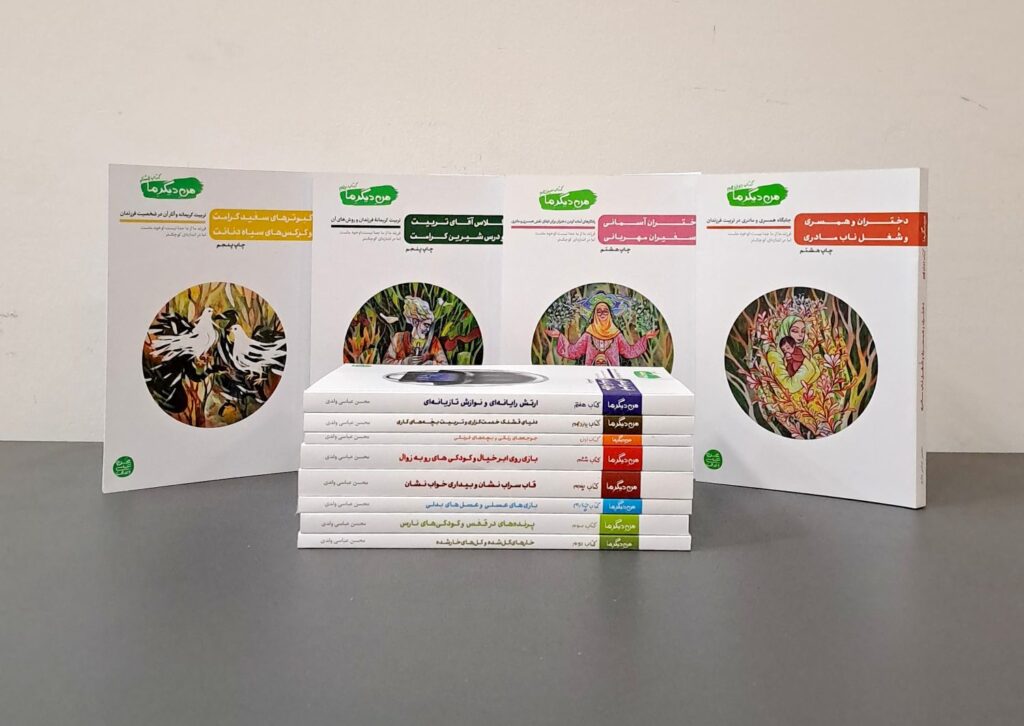
The series Our Other Me consists of thirteen volumes and focuses on parenting skills grounded in religious principles. Written in accessible language, the collection addresses parental concerns ranging from children’s play to the impact of television and digital games. Each volume is devoted to themes such as affection, freedom, independence, and dignified upbringing, and provides practical solutions to everyday parenting challenges. An accompanying supplement titled Play: The Arm of Upbringing, which includes 140 indigenous games, enhances the appeal of the collection.
The article “Factors of Emotional Upbringing of Children in the Family” emphasizes the foundational role of the family in children’s emotional development. It identifies factors such as parental doctrinal harmony, affection, mutual respect, optimism, emotional support, and psychological security as key elements in shaping the child’s personality and fostering receptivity to religious values.
The article “Teaching Prayer to Children in Islamic Educational Jurisprudence” seeks, through reference to religious evidence, to clarify the nature of parental responsibility—whether obligatory or recommended—the appropriate age to begin, and the methods of implementation. According to the article’s findings, teaching obligatory prayers to children is a religious obligation upon parents, whereas teaching supererogatory prayers and reinforcing them within the child’s character is considered recommended.
The book Child Upbringing with a Jurisprudential Approach draws upon Shiʿi jurisprudence to frame child education as an integral aspect of parental religiosity. It analyzes educational duties in doctrinal, devotional, emotional, sexual, and physical domains through a fiqh-based lens. Upbringing, in this view, must be conducted with jurisprudential awareness and within the framework of Islamic law.
The book Legal Rulings on Child Upbringing adopts a problem-centered approach, presenting religious rulings related to parenting in two broad sections: general principles of upbringing and specific domains—doctrinal, devotional, emotional, sexual, and physical. Education is articulated as a structured, jurisprudential matter for parents and educators.
The book Religious Education of the Child adopts a mystical and fiṭrah-centered perspective, viewing religious instruction as extending beyond compulsion and indoctrination. Instead, it is framed as the cultivation of faith-based experiences aligned with the child’s innate disposition. The work emphasizes religious education accompanied by reflection and rationality.
The book Islamic Philosophy: Lessons for Teaching Children presents concepts such as truth, God, and justice—drawing inspiration from the “philosophy for children” movement and adapting it within the framework of Islamic wisdom—in simple language suitable for children. It aims to nurture analytical and inquisitive thinking within a religious framework.
The article “Foundations, Principles, and Methods of Responding to Children’s Questions about God” examines how to address elementary-school children’s questions concerning God. Emphasizing the influence of culture and the abstraction of concepts, it proposes principles such as creating a dynamic environment and methods such as storytelling and gradual dialogue. The article outlines a four-stage model for religious upbringing.
The article “The Hereditary Role of the Mother in Child Upbringing from an Islamic Perspective” draws upon Qur’anic verses and narrations to highlight the mother’s hereditary role in shaping the child’s personality—arguing that it may be even more pronounced than that of the father—and calls for greater attention to this role in Islamic educational policymaking.
The book Children’s Devotional Upbringing in Islam—with Emphasis on Educational Programming offers a staged model for teaching acts of worship (such as prayer, fasting, and supplication), encompassing stages from awareness and interest to continuity. It emphasizes cultivating spiritual understanding and making acts of worship meaningful and appealing for the child.
The article “Factors of Moral Development of Children within the Family Context” identifies constructive parental interaction, a space for moral dialogue, and behavioral modeling as key factors in the development of children’s social morality within the family, with particular emphasis on emotional and reciprocal relationships.
The article “A Model of Child Upbringing Based on the Analysis and Interpretation of Sūrat Luqmān” derives an educational model from Sūrat Luqmān, centered on doctrinal beliefs, acts of worship, and moral virtues. Through principles of persuasion and methods of exhortation and reasoning, it presents the child as a companion in spiritual growth.
The book Principles and Methods of Tawḥīd-Based Child Education explicates monotheistic upbringing on the basis of religious teachings and developmental psychology. It aims to internalize faith and a sense of divine presence in the child through affection and wisdom.
The book Be a Child with Your Children invites parents to understand the child’s world. Drawing upon the conduct of the Ahl al-Bayt and developmental psychology, it emphasizes the role of play, respect for the child’s psychological boundaries, and the avoidance of imposing beliefs in religious education.
The article “A Jurisprudential Study of the Use of Reasoning and Reflection in the Religious Education of Children” argues that rational reflection in religious upbringing is religiously obligatory, since knowledge of God and divine obligations cannot be attained without thought. Drawing upon Qur’anic verses, narrations, and the principle of the correlation between reason and revelation, the authors stress that the family must provide an environment that encourages questioning and deep understanding of religious concepts so that religious education becomes firmly rooted.
The thesis “How to Present Doctrinal Issues to Children and Adolescents” offers a framework for teaching theological concepts to younger age groups. By analyzing developmental characteristics and Islamic foundations, it proposes methods such as analogy, storytelling, and play to communicate religious ideas in a practical manner suited to contemporary needs.
The two-volume work Education and Upbringing in Tafsīr-e Nemūneh addresses themes such as knowledge, instruction, family structure, encouragement and discipline, Islamic etiquette, and obstacles to upbringing. Unlike modern schools of thought that focus on outward behaviour, the Qur’an emphasizes the cultivation of the self (nafs), and its educational model—due to its harmony with human nature—is presented as the most effective approach to teaching and upbringing.
The book A Beginning for Flight provides practical strategies for inviting children to prayer, emphasizing affection, encouragement, and parental modelling. For children under seven, familiarity and play are recommended; for adolescents, friendship and avoidance of coercion are advised. The book includes examples of real-life dialogues.
The book Facing Mirrors presents practical skills for religious and moral upbringing in an accessible language. It emphasizes parental harmony, anger management, addressing stubbornness, and gradual instruction. It also examines the modelling role of parents and gender differences in upbringing.
The article “Design and Validation of a Model for Teaching Imamate to Children” proposes an educational model centered on knowledge, love, and obedience in teaching the concept of Imamate to children. Utilizing storytelling and play, the model is designed to suit the child’s cognitive framework and has been validated by specialists.
The book Moral Education in Childhood recommends methods such as modelling, dialogue, and play for the moral development of preschool and elementary-aged children. Drawing upon religious and educational sources, it views moral education as gradual, indirect, and rooted in reflection and affection.
The book Play, Child, Upbringing presents play as a context for cognitive, emotional, and religious development. Drawing upon religious and psychological sources, it explains various types of educational games and their applications in conveying religious and moral concepts.
The thesis “The Function of Storytelling in the Religious Education of the Child” identifies storytelling as an effective tool for transmitting religious concepts. By analyzing the cognitive and emotional functions of narrative and emphasizing empathy and identification, it offers examples of Qur’anic stories for teaching monotheism and morality.
The book Religious Education in Primary and Secondary School presents a theory of school-based religious education that transforms faith into a lived experience. By designing age-appropriate models for primary and secondary levels, it underscores the role of the teacher and learning environment in cultivating faith.
The article “The Role and Status of the Mother in the Religious Education of the Child” examines the mother’s role in establishing the child’s spiritual connection with God. Through affection, supplication, modelling, dialogue, and the creation of psychological security, the mother is seen as pivotal in fostering tawḥīd-oriented upbringing from early childhood.
The article “Parental Duties in the Emotional Upbringing of Children from a Jurisprudential Perspective” examines the religious obligations of parents in nurturing the emotional development of children during the first seven years of life. Drawing upon narrations, it emphasizes emotional justice, affection, and the avoidance of harshness, and explains the connection between early emotional upbringing and the child’s future religiosity.
The thesis “Child Upbringing in the Practical Conduct of the Prophet (p)” studies the Prophet’s educational conduct in his interactions with children. Affection, honouring the child, playfulness, and gradual instruction are identified as key features of this prophetic model, which offers an emotionally grounded and practical framework for religious upbringing.
The book Sexual Education of Children and Adolescents with an Islamic Approach integrates jurisprudential and psychological foundations to propose guidelines for sexual education. Emphasizing managed dialogue and modesty, it focuses on equipping parents with the necessary tools and strengthening children’s self-esteem.
The article “Principles of Cultivating Moral Virtues in Children Based on the Educational Conduct of Lady Fāṭimah (s)” presents the educational conduct of Lady Fāṭimah as a purposeful system of upbringing. Rooted in monotheistic principles, this system seeks to internalize moral virtues through rational and dignity-centered methods.
The article “Parenting in a Mediatized World” explores contemporary challenges such as the weakening of parental authority and identity formation under media influence. It proposes strategies including awareness-building, selective education, and active parental mediation in order to cultivate religious identity amid media pressures.
The book The Role of Heredity and Environmental Factors in the Religious Upbringing of Children and Adolescents adopts an interdisciplinary approach to examining the influence of heredity and environmental contexts—such as family, school, and peers—on religious development. It conceptualizes religious upbringing as an identity-forming process that requires coherence among environmental influences.
The book The Child and the Foundations of Islamic Thought views the child as an active subject endowed with a divine innate disposition (fiṭrah). Harmonizing Islamic thought with developmental psychology, it explores the theoretical foundations of religious upbringing from an anthropological perspective.
The article “A Model of Religious Upbringing from Birth to Three Years” proposes a framework for nurturing religiosity in infants and toddlers. Through intermediate objectives such as the internalization of religious emotions and through affective, nonverbal methods, it seeks to shape religiosity through lived experience and affection.
The article “A Critical Examination of the Concept of Childhood in the Aristotelian Tradition with Emphasis on the Islamic Perspective” analyzes Aristotle’s understanding of the child as a developing human being and critiques prevalent elements such as determinism and neglect of innate disposition. It provides a foundation for comparing the Islamic conception of childhood with Western philosophical traditions.
Conclusion
The study of the developmental trajectory of child education studies in the Qom Seminary demonstrates the sustained efforts of committed and conscientious scholars to rearticulate the place of the child within the framework of Islamic upbringing. This path began with traditional and oral forms of instruction and, through a deepening and systematic articulation of Islamic foundations, has culminated in the formation of a discourse on child education grounded in reason, innate disposition (fiṭrah), and revelation. This discourse aspires not only to produce specialized knowledge but also to offer a scholarly critique of modern and postmodern educational paradigms.
Within this context, the Islamic Republic of Iran—drawing inspiration from the thought of the Leaders of the Islamic Revolution—has regarded the upbringing of a faithful and righteous generation as one of the pillars of Islamic civilization-building. By placing special emphasis on the family as the primary institution of education, it has facilitated the expansion of the discourse on Islamic child upbringing. In light of this attention, the seminaries, remaining faithful to authentic Islamic sources, have sought to move beyond merely offering moral exhortations and toward designing programs, developing curricula, and presenting structured educational models.
Works such as Āʾīn-e Tarbiyat, Ḥikmat-Nāmeh-ye Kudak, and research in the field of educational jurisprudence testify that the Qom Seminary has not responded passively to contemporary transformations. Rather, guided by religious insight and a sense of divine responsibility, it has undertaken an active and meaningful role in the upbringing of the children of the Muslim community.
Nevertheless, to complete this auspicious path, greater attention must be devoted to articulating a comprehensive intellectual system of the Ahl al-Bayt (a) concerning child upbringing. Shortcomings—such as the absence of fully integrated theoretical models, insufficient linkage with practical educational contexts, and neglect of emerging dimensions of children’s lives—should be addressed internally and through reliance upon Islamic jurisprudence and wisdom.
Undoubtedly, if this course continues, there is reason to hope that child upbringing in the school of the Ahl al-Bayt (a) may become a luminous model for Muslim societies—a model in which the child is not merely a trust from God, but also a foundation for the emergence and realization of the Mahdī-centered society, God willing.