
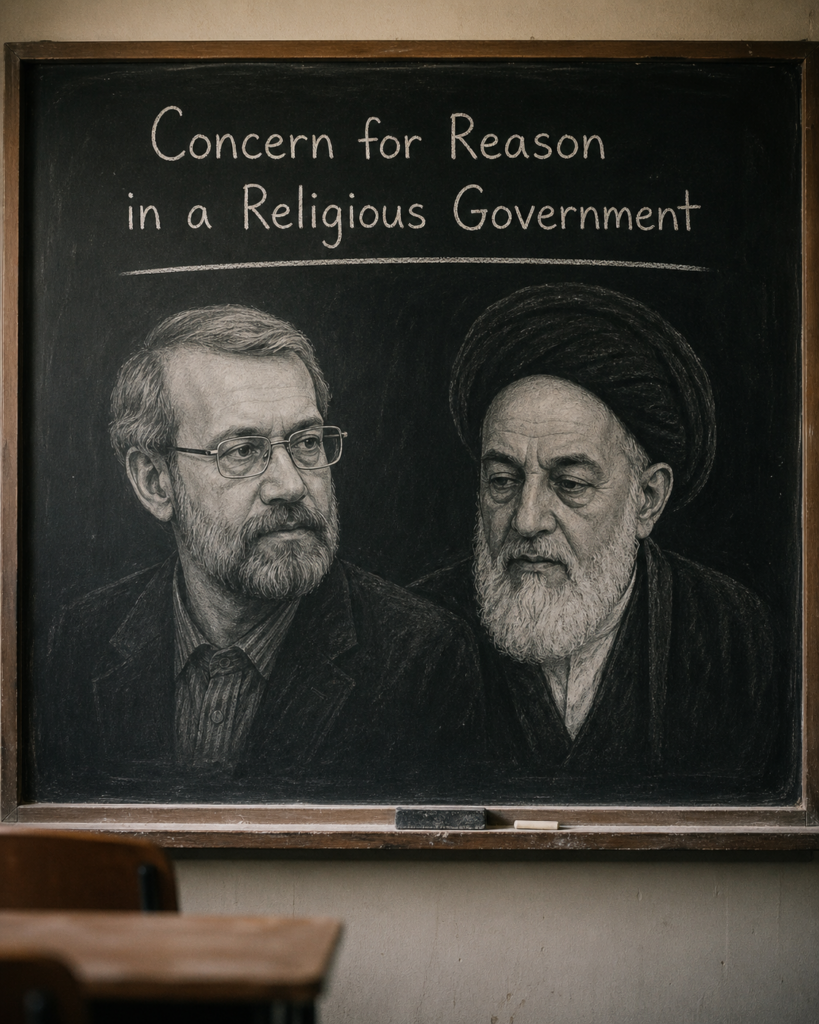
Concern for Reason in a Religious Government
In memory of a thinker who was concerned about the fate of reason within a religious government
By Ustad Mohammad Soroush Mahallati, Translated by Sayyid Ali Imran
In a religious government:
- The devout (religiously committed) are concerned lest the credibility of religion be harmed.
- The advocates of liberty are concerned lest social freedoms be damaged.
- And philosophers are concerned lest the sovereignty of reason and intellect be undermined.
The Philosophical Encounter with a Religious Government
How has a researcher, trained in philosophy at the university level, particularly focused on the thought of Immanuel Kant, having defended a doctoral dissertation on the subject of Kant’s philosophy of mathematics and subsequently authored several works in this field, engaged with the issue of a “religious government”? In the first decade of his political life, he (the martyr Dr. Ali Larijani) appeared primarily as a capable executive administrator. In the middle period, with his presence in the leadership of the legislative branch, certain transformations in his outlook became apparent. However, the final decade of his life revealed that these changes went beyond mere disagreements over executive matters or managerial disputes within the state. Rather, he came to adopt a fundamentally different perspective toward the very concept of a religious government, one that, even if faintly present before, had not been publicly articulated until that time.
During this later period, he engaged in theoretical and foundational discussions on religious governance. In the year 1403 (2024–2025), he published the book Reason and Tranquillity in Governance (ʿAql va Sokūn dar Hokmrānī). This work is significant from two perspectives: First, it presents philosophical reflections on the concept of religious government, emerging from his intellectual and philosophical investigations. Second, it offers concrete reflections drawn from the lived experience of religious governance in Iran, based on his many years of participation at the highest levels of administration.1 In this article, the second aspect has been set aside, and only the first aspect is addressed.
From Popular Imitation to Scholarly Inquiry
His father was a distinguished jurist who studied in the seminary of Najaf and was among the students of Aqa Zia al-Din al-Araqi, even serving as a transcriber of his lectures. Naturally, like other jurists, his approach to the question of governance, like other juridical subjects, was transmitted (naqlī), derived from religious texts, particularly narrations. Within this jurisprudential orientation, even if Ruhollah Khomeini entered the discussion, the primary source of analysis remained the narrations; through reflection upon them, one was expected to extract the problems, principles, and foundations of governance.
Before him, Mirza Hossein Na’ini had ultimately attempted to establish the legitimacy of religious government by appealing to a single narration, namely the maqbūlah of Umar ibn Hanzala, a report whose chain of transmission some jurists had disputed and whose implication others had not accepted. However, the rationally inclined mind of the son, together with his academic formation, separated him from this juridical current. For the issue at hand was entirely rational in nature: neither could one suffice with reliance upon a solitary report (khabar wāḥid), nor could one, as a mere imitator (muqallid), submit uncritically; nor, moreover, could one disregard the entirety of human analytical reflection and accumulated experience concerning governance.
Perhaps had this son remained within the seminary and continued along his father’s path, or even if he had continued his undergraduate studies in the basic sciences at Sharif University of Technology, he would not have encountered such a tension and might have readily accepted the prevailing doctrines of political jurisprudence. Yet his acquaintance and intellectual relationship with the martyr Morteza Motahhari, and his subsequent shift of academic discipline to Western philosophy upon that teacher’s recommendation, gradually unsettled that state of unreflective imitation. Later, with the waning of the distractions of executive responsibilities and the emergence of certain bitter experiences, the inner flame was rekindled and erupted.
A Path Toward the Hidden Truths
How can someone who has spent a lifetime occupying significant governmental posts, and who has repeatedly received appointments from the highest authorities of the system, come to express doubt regarding certain foundational principles of governance, or even hint at disagreement? Especially when such a person may be subject to accusations or even attacks from opponents? If an intellectual figure possessed only philosophical standing, he could articulate his views freely in a work such as Wisdom and Government and accept the consequences. But one who holds a position within the governmental structure and does not wish to sever that connection must find another path for presenting divergent ideas. That path lies in the exposition and analysis of the views of major thinkers.
Thus, in the book Reason and Tranquillity in Governance, the theories of three selected philosophers concerning religious government are examined: Avicenna, Allamah Tabatabai, and Morteza Motahhari. These are philosophers whose depiction and analysis of religious governance are grounded in a rational framework, one that differs, in certain respects, from the dominant jurisprudential reading of the time.
In this work, each perspective is first presented on the basis of direct scholarly sources, with its principal contours analyzed and examined; thereafter, it is subjected to critique. In the first stage, sufficient textual investigation has been conducted, and the philosopher’s theory is articulated with adequate documentation. In the second stage, the effort moves beyond exposition toward critical evaluation and objection.
It is as though the author’s Kantian formation has led him to proceed step by step through processes of affirmation and negation, entering into a kind of dialectical engagement. It is precisely through this engagement that a pathway emerges for understanding his political thought, opening small apertures into that sealed treasury. When he praises certain ideas, rejects others, or emphasizes the importance of particular positions, he is in fact revealing his own intellectual inclinations. By gathering and organizing these indications, one can reconstruct his broader intellectual system, something he himself, due to the political conditions and certain considerations, did not wish to present directly and explicitly, even while he deemed it necessary to draw attention to it.
Chapter One: An Analysis of Avicenna’s Theory
Avicenna regards revelation as the foundation of legislation, and for this reason, he considers sovereignty to belong exclusively to God. But does this mean that societies are governed solely on the basis of divine laws received through revelation?
In a religious society, law operates on two levels. The first is the divine level, namely, the fixed heavenly laws of the Sharia. The second level of law, however, is entrusted to the government and is formulated in accordance with the conditions and exigencies of time. This second level, by its very nature, cannot exist in a fixed and permanent form, because such rigidity would lead to disorder and corruption as circumstances change:
“And no specific, particular rulings should be imposed therein, for their imposition would lead to corruption, since they change with the changing of times, and the imposition of universals in them, with complete precision, is not possible.”2
On this basis, once the Sharia and the fixed divine laws are received, human beings must employ their intellectual faculties to translate those rulings into practical laws suited to their time and context:
“The divisions of practical wisdom are: political wisdom, household wisdom, and ethical wisdom. The origin of these three is derived from the divine Sharia, and the completion of their limits is clarified through it. Thereafter, the theoretical faculty of human beings operates within them, through knowledge of practical laws and by applying those laws to particular cases.”3
However, does this imply that the “head of government,” just as he personally derives and presents religious rulings, also independently legislates customary and variable regulations? From Avicenna’s expressions, it appears that this second domain is entrusted to the people of consultation – those who are among the rational members of society. From here, it becomes clear that the authority of these two types of law – divine and worldly – is not identical, nor do they share a single origin.
In the section on rhetoric (khiṭābah) in al-Shifāʾ, Avicenna explains that the first type pertains to universal rulings within the domain of the Sharia, whereas the second lies within the scope of reason.4 For this reason, he places the second domain in the hands of those qualified for consultation:
“Thus, it must be entrusted to the people of consultation.”5
These discussions are pursued in the book Reason and Tranquillity in Governance, and the author, drawing upon the writings of Avicenna, concludes that he considers highly significant. That conclusion is that the legislative authority (quwwat al-muqannina) possesses independence and does not require validation or authorization from the ḥākim al-sharʿ (religious ruler) for the approval and legitimacy of its enactments. This is regarded as a “notable” point in Avicenna’s thought.
The prominent feature of Avicenna’s political philosophy lies in the position of rationality within governance:
“In ideal governance, although general laws are revealed by God to the Prophet, this portion pertains only to universals. It is the rulers and the rational elites of society who must, on the basis of rationality, organize the second level of legislation in order to realize justice… Thus, from the perspective of this philosopher, two principles constitute the foundational pillars of the legitimacy of government:
- The administration of government must be grounded in divine laws and traditions.
- Governance in all its aspects – especially legislation – must be based on the rationality of the intellectual elite of society.”6
The author, in his analysis of Avicenna’s theory, does not pursue this issue further and pauses at this point. However, in another section of the book, where he examines the theory of Morteza Motahhari, he continues the discussion by raising an important question: if, in a religious government, Islamic rulings form the basis of legislation, and if the opinions of jurists are considered decisive in this domain, do they not also seek to play a role in implementation and in legislating variable, customary matters? And even if we assign to them merely a supervisory role, as Motahhari understood leadership to consist in ideological oversight guiding the general direction of governance7 what solution exists in the case of conflict?
Such a conflict arises when society and its customary institutions do not submit to that supervisory and guiding authority, nor accept its direction.
The author, who in the later years of his life witnessed such tensions within the country, enters this discussion with notable courage and poses the question explicitly: even under the assumption of supervisory oversight, the possibility of conflict between religious and customary institutions remains, how, then, can this conflict be resolved?
Drawing on his own experiences, he explains the problem:
“The difficulty in this theory emerges when the supervisory aspect of leadership is not accepted by customary powers – whether executive or legislative. In such a case, do we not face a dual structure within society? Through the Guardian Council, non-Islamic legislation is prevented; through the establishment of the Expediency Discernment Council, which proposes general policies to the leadership, the necessary orientations toward the higher Islamic ideals, intended by Motahhari, are, in principle, realized. However, the issue lies in practical conflicts at the level of execution, which cannot be resolved in this manner.
Moreover, in the Constitution of the Islamic Republic, certain sectors of governance have been placed under the authority of the walī al-faqīh (contrary, in effect, to Motahhari’s view), and the authority of command is not merely ideological. Perhaps the framers of the Constitution adopted these measures to ensure the compliance of governing bodies across the three branches with the policies of religious leadership, yet these methods have not proven effective in resolving such conflicts.”8
The distinguished author, who in earlier discussions had implicitly critiqued the theoretical foundations of the system, here does so explicitly, describing it, from an analytical standpoint, as internally contradictory, and asserting that the constitutional mechanisms designed to resolve these tensions have not been effective.
According to this perspective, even a minimal form of religious leadership, such as that proposed by Motahhari, ultimately leads the state toward deadlock. The duality between guardianship and representation eventually resolves either into the dominance of guardianship through the elimination of representation, or into the dominance of representation through the elimination of guardianship.
The Role of Rationality in Leadership
The question of selecting a leader is a fundamental issue within a religious system. Can such leadership be entrusted to the choice of the people, or must it necessarily be realized through divine designation (naṣb ilāhī)? And in the latter case, what role, if any, does the consent, satisfaction and will of the people play?
From the perspective of Muslim philosophers such as Al-Farabi and Avicenna, as well as theologians, there is no doubt that so long as an infallible figure such as the Prophet Muhammad is present, or a directly appointed successor of his is available, he alone is qualified for leadership, and there is no place for the selection of another. However, with his absence, governance does not cease; rather, the people must proceed to selection. Naturally, this selection must observe the necessary qualifying conditions.
Avicenna states that the one eligible for this position must possess political independence, sound and authentic intellect, moral virtues, and superior knowledge of the Sharia compared to others. In addition, there must be general agreement among the people regarding his suitability:
“Then it is necessary that the lawgiver impose obedience to whoever succeeds him, and that succession not occur except either by his designation or by the consensus of the people of precedence (ahl al-sābiqa) regarding one whom they publicly affirm before the people to be independent in governance, possessing sound intellect, endowed with noble moral traits such as courage, chastity, and good judgment, and knowledgeable in the Sharia such that none is more knowledgeable than him, an affirmation that is made openly, declared publicly, and agreed upon by the public.”9
In this passage from the Ilāhiyyāt of al-Shifāʾ, Avicenna emphasizes, on the one hand, the recognition and consensus of the elders and experienced figures (ahl al-sābiqa), and on the other hand, he explicitly affirms the role of the people, their public understanding and recognition of the leader’s qualifications. These experts must publicly present the qualified individual before the people so that a general consensus regarding his merit may be formed: “They must publicly affirm before the people that he is independent in governance and possesses sound intellect…”
But what does it mean to insist that the people themselves must arrive at verification of these qualifications in the ruler, even when the experts have already established them?
The distinguished author of the book, whose mind is deeply engaged with the role of experts, proposes that two interpretations can be advanced regarding leadership selection by experts:
- One, that their choice possesses intrinsic authority (mawdhu’iyyat), meaning their judgment is inherently valid;
- The other, that their role is instrumental (ṭarīqiyyat), serving as a means for the people to arrive at recognition.
He closely examines Avicenna’s statement and explicitly clarifies what he calls a “crucial point”: Avicenna supports the second view:
“The important point here is that the opinion of the expert group serves only as a means (ṭarīqiyyat) for determining the successor, and ultimately the people must affirm him. The fact that the elites of society reach consensus on an individual and present him to the people means that those elites, trusted by the people, guide them toward making their own choice.”10
Those familiar with the debates of recent decades concerning the role of experts in leadership selection can readily see the implications of this claim, and how the author, with subtlety, articulates his own position through Avicenna’s framework. In those debates, jurists such as Ayatullah Mohammad Momen Qomi insisted that the Assembly of Experts does not act as representatives of the people; rather, their judgment carries authority by virtue of their expertise alone, independent of popular endorsement. According to this view, even if such experts were formed with minimal or no public vote, their determination would suffice for appointing a leader.
This stands in contrast to those who argued that the judgment of experts, insofar as it is accepted by the people, is effectively the judgment of the people themselves and gains its legitimacy from this instrumental function, an interpretation supported by the statements of Imam Khomeini:
“If the people vote for experts so that they may appoint a just jurist to lead their government, then when those experts designate someone to assume leadership, he thereby becomes accepted by the people and his ruling becomes binding; he is, in effect, the representative chosen by the people.”11
Avicenna introduces an important addendum in the discussion of leadership selection, one that receives particular attention from the author of Reason and Tranquillity in Governance. This addendum opens the possibility for direct public intervention in opposition to a leader selected by experts. Avicenna considers the scenario in which an individual challenges the authority of the leader chosen by the experts, claiming that the incumbent lacks the necessary qualifications while he himself possesses them. If he can substantiate this claim, then he deserves the support of the people. In other words, the people are not bound to support the expert-selected leader; rather, they may directly choose another individual whom they deem more qualified and withdraw their support from the former:
“If the challenger establishes that the one holding the caliphate is unfit and deficient, and that such deficiency is absent in himself, then it is more appropriate for the people of the city to align with him.”12
This view of Avicenna is undoubtedly a high-risk position. Yet the author aligns with it sympathetically and evaluates it as consistent with the rights of individuals:
“In this matter, Avicenna does not confine the people to the choice of a limited elite, and the rights of qualified individuals are not disregarded.”13
In reality, this conclusion follows from the foundational principle of ṭarīqiyyat (instrumentality), which even from a jurisprudential standpoint could be accepted: if the people recognize the error in the experts’ judgment and find the necessary qualifications present in another individual, then the experts’ opinion loses its authority for them.
What is significant, however, is that the author closely scrutinizes these details in Avicenna’s thought, highlighting them as a “crucial point”, and then, after presenting and explicating Avicenna’s argument, provides a philosophical grounding for it. This method of exposition, affirmation, and emphasis reveals the deep concerns of the author’s philosophical mind. One might have expected, instead, that he would critique this addendum, since it legitimizes opposition to the leader selected by experts, as a cause of social disorder and instability. At the very least, he could have omitted this clause from his work altogether. Yet rather than dismissing it, he foregrounds and affirms it, thereby signaling his own intellectual commitments.
The Primacy of Political Rationality
Among all the political discussions that Avicenna presents in a scattered manner throughout his works, one point appears particularly compelling and even inspiring for this distinguished researcher: namely, where Avicenna gives precedence to “intellect and sound political governance” over all other qualifications of a ruler, and is content to assign a merely moderate level to the remaining conditions:
“The most decisive criterion is intellect and good governance; thus, whoever is average in the other qualities but excels in these two… is more worthy.”14
The author’s approving interpretation of this view, after describing it as “extraordinarily significant”, is that intellect and prudential judgment are intrinsic (dhātī) and essential conditions of ideal governance, whereas the other conditions are not intrinsic, and their fulfillment depends on circumstances and feasibility. After translating the above passage from the Ilāhiyyāt of al-Shifāʾ, he writes:
“This point is of utmost importance. For this reason, Avicenna, in outlining the conditions of the successor, begins with political independence and authentic rationality as the essential elements of good governance. From the perspective of this philosopher, what matters most in selecting a ruler is that he surpass others in political insight and rationality. As for other aspects, such as religious knowledge and ethical refinement, even if he possesses them at a moderate level, he is still preferable for leading society. In reality, the fundamental pillars of the successor to the Prophet in administering government are:
First: political independence (skill in governance) and authentic rationality (sound judgment).
Second: the consensus of the people (their selection of him), even if his introduction to them occurs through righteous individuals or the experienced elite (ahl al-sābiqa).
Avicenna’s emphasis on political prudence and rationality constitutes a deeply profound theory.”15
The manner in which this theory is introduced and praised – both at the beginning and the end of the discussion – indicates that the author is deeply impressed by it, even captivated by it, though he does not (or perhaps chooses not to) elaborate upon it further.
If this philosophical approach to governance is compared with the dominant jurisprudential view of leadership, the distance between the underlying frameworks becomes evident. In the prevailing fiqh-based perspective, the foundation of all conditions begins with faqāhah (juridical expertise), and all other qualifications are built upon it. Consequently, the body of experts responsible for selecting leadership is composed exclusively of jurists, and other attributes take on a secondary and minimal role.
By contrast, in this philosophical framework, the central axis is rationality and prudential governance, while faqāhah is regarded as an added advantage rather than the foundational criterion.
It is precisely this prioritization of rationality over other virtues that leads the author to view the theory of Allamah Tabatabai on governance as insufficiently clear. Although Allamah does not explicitly list faqāhah as a condition for leadership, he places qualities such as religious piety (taqwā) and sound judgment alongside one another without establishing a hierarchy among them. In response, the author invokes Avicenna’s position:
“If an individual does not excel in all qualities, then authentic rationality and sound governance remain the primary criteria.”
He considers Avicenna’s theory superior to that of Allamah Tabatabai on the grounds that:
“Avicenna, in his theorizing, prioritizes practicality over idealism.”16
This statement implies that seeking an individual who possesses the most complete set of qualities is, in practice, unattainable. Therefore, in the process of selection and preference, the importance of intellect and prudence outweighs other attributes. One may forgo other qualities in favour of strong rationality and political competence, but one cannot sacrifice these two in favour of other traits.
The practical consequence of this perspective is that even within the institution of experts responsible for selecting leadership, the primary criterion for membership should be intellectual superiority, deeper political understanding, and the ability to evaluate personalities; other qualifications occupy a secondary position.
The diverse discussions of Avicenna on governance, as presented in Reason and Tranquillity in Governance, are numerous and cannot all be detailed here. However, it should be noted that throughout these discussions, the author consistently aligns himself with Avicenna and offers a scholarly defence of his views. In his assessment, Avicenna has succeeded in presenting a model of governance that harmonizes both Sharia and reason, a testament to his foresight and comprehensiveness.17
That said, the author does diverge from Avicenna on certain issues: he disagrees with him on the question of slavery,18 and considers his treatment of dealing with lawbreakers to be in need of further development.19
Even this limited selection of Avicenna’s political ideas, as evaluated by the author, is sufficient to demonstrate the considerable distance between his thought and the official, dominant interpretations prevalent in contemporary society. To complete the discussion, however, the author proceeds to examine Avicenna’s intellectual disagreement with Allama Tabatabai, extracting from these critiques a more complete picture of his own political philosophy.
Chapter Two: An Analysis of the Theory of Allamah Tabatabai
Allama Tabatabai stands among the most distinguished thinkers of the modern era in terms of the comprehensiveness of his mastery over Islamic sciences and his command of both rational (ʿaqlī) and transmitted (naqlī) disciplines. In this period, when the question of Islamic governance drew the attention of jurists, who largely approached it through a transmitted, narrational framework, Allamah examined the issue from a rational perspective. In addition to composing an independent treatise on the subject, he also addressed it in various sections of his other works, including Tafsir al-Mizan, with the same intellectual approach.
Through this rational framework, Allamah did not arrive at the doctrine of wilāyat al-faqīh; rather, he defined religious governance as the implementation of the rulings of Sharia and the use of consultation (shūrā) in governmental decision-making in accordance with the Prophetic tradition. In doing so, he diverged from his teacher Mirza Hossein Na’ini.
Those who were committed to the doctrine of wilāyat al-faqīh could not accept Allamah’s view, and thus some of his students pursued different paths. However, for someone who does not wish to rely on transmitted and narrational premises and instead grounds political thought in the philosophical framework of Avicenna, one would expect that Allamah’s theory should be acceptable. Yet the author of Reason and Tranquillity in Governance, after examining Avicenna’s political thought and turning to Allamah Tabatabai, is unable to accept or endorse his model of religious governance. Rather, he subjects it to critique from multiple angles.
The central axis of these critiques, in the author’s view, is that the right of reason is not adequately fulfilled within this theory. Below is a brief outline of some of these criticisms:
First Critique: Ambiguity of the Theory
Certain aspects of Allamah’s views on religious governance are ambiguous and lack sufficient clarity. For example, although the ruler is said to be chosen by Muslims, it is unclear whether this selection occurs through a democratic process based on popular voting or whether it is determined by societal elites. By contrast, Avicenna explicitly emphasizes the recognition and acceptance of the ruler by the people.
Similarly, Allamah does not specify a hierarchy among the necessary qualifications for leadership. In contrast, Avicenna prioritizes intellect, discernment, and prudence over other attributes. The critic, therefore, characterizes Allamah’s theory as idealistic, one that encounters practical difficulties in application.
Second Critique: The Risk of Benevolent Dictatorship
Allamah Tabatabai considers the sole criterion for establishing laws and regulations to be adherence to the limits of the Sharia and the interests of the Muslim community. Limiting the criteria to these two conditions effectively grants the ruler broad discretion in legislating governmental regulations (outside explicitly defined religious rulings).
However, should the ruler not also be bound to respect the natural rights of citizens and formulate regulations accordingly? Does the ruler have the authority to disregard these rights in the process of governance? Ignoring this dimension opens the possibility of a form of benevolent dictatorship within a religious system.
The critic writes:
“According to the theory of fiṭrah (human nature), Allamah should, in principle, affirm the existence of natural rights for human beings, rights that are acknowledged within the Sharia. Should not the observance of these natural rights be taken into account in drafting the regulations necessary for governing and developing the country? His theory, where the lives and property of the people, in the implementation of the ruler’s policies (albeit within the bounds of the Sharia), lie in the ruler’s control, indicates that he has not sufficiently accounted for the expansion of natural rights in the formulation of governance rules. This could lead to a form of benevolent dictatorship…”20
Third Critique: The Error of Paternalism in Governance
Allamah repeatedly asserts in his works that the ruler’s position within society is analogous to that of a father within a family. Just as a father may make decisions for his household, so too the ruler may make decisions for society. He conceives of the relationship between ruler and citizens as analogous to that between father and family members, and maintains that even a non-infallible ruler possesses such authority.
In his discussions with Henry Corbin, Allama even expresses this relationship in terms of “ownership”:
“The position of the guardian (walī al-amr) in relation to the Islamic com munity is like that of the owner of a house with respect to his property. Just as the owner of a house may, with due regard for the welfare of the household, exercise any form of disposition within his property or establish any arrangements within it… so too the guardian may, with consideration for the public good, make decisions regarding the affairs of Muslims—establish institutions, undertake development, provide equipment, establish relations with allies, engage in war with enemies, or, if appropriate, make peace or conclude non-aggression pacts, and in advancing these matters, seek from Muslims whatever support in life and wealth is required…”21
But does this analogy possess a sound logical foundation? Can it justify granting the ruler authority over the lives and property of citizens, even beyond the bounds of the Sharia, based solely on his own judgment of public interest? The critic rejects this analogy:
“This example is problematic. The authority of a head of household over family members cannot be extended to society at large. In cases where the guardian is the Prophet or an infallible Imam, such authority is justified due to their infallibility and scriptural foundations. But in other cases—where people or rational agents appoint individuals to govern the country—such analogous authority lacks rational justification.”22
Thus, equating the authority of a non-infallible ruler with that of an infallible one is explicitly deemed irrational. Only those powers that can be rationally justified are considered legitimate for a ruler.
Fourth Critique: The Reduction of National Interests
In Allamah Tabatabai’s theory, emphasis is placed on the unity and solidarity of Muslims, and governance is expected to make decisions based on this principle. While this is, in itself, reasonable and acceptable, a difficulty arises in a world where Muslims live across multiple countries with distinct governments. What, then, becomes of “national interests”? Can they be sacrificed for the sake of preserving Islamic unity?
The critic writes:
“In circumstances where adherence to Muslim unity results in the loss of a country’s national interests, which principle takes precedence? This question becomes especially pressing given that Allama defines the boundaries of the Islamic community in terms of belief, not natural or conventional borders. Do these premises imply that national interests are subordinate to the unity of the Islamic ummah? Particularly since he considers notions such as love of homeland to be constructs of modern political thought intended to replace religion…”23
Ultimately, the critic formulates the objection as follows:
“The precedence of national development and national interests, versus the precedence of Islamic unity, are matters of gradation (tashkīk), and no fixed, absolute ruling can be established for them.”24
Fifth Critique: The Rejection of Multiple Islamic States
Allamah Tabatabai defines the boundary of the Islamic community in terms of shared belief, rejecting natural and conventional territorial borders:
“The frontier of the Islamic polity is belief, not natural or conventional boundaries.”25
Within this framework, diversity of ethnicity and nationality can be accommodated under a single political system, for example, through a federal structure in which different regions remain under a central authority. Indeed, even with differences, a unified government is considered possible, and Islam does not prescribe a single fixed form in this regard.26
From this perspective, Allamah effectively rejects the legitimacy of multiple independent Islamic states, viewing such fragmentation as inconsistent with religious principles. Accordingly, the current global reality of multiple Islamic countries lacks a clear religious justification.
The critic, however, disagrees with this conclusion. By distinguishing between the era of the infallible Imam and the present age, he argues:
“In the period of occultation of the infallibles, especially under Allamah’s own theory, where righteous, capable, and politically aware individuals assume governance, what justification exists for unifying Islamic countries despite their vast social and cultural differences? Cooperation among Muslim countries may indeed be beneficial and even necessary, provided it is structured according to the qualities he describes. Otherwise, national interests and national security must remain the primary criteria, since we are not dealing with ideal Islamic governments of the kind that exist under the rule of an infallible leader.”27
Sixth Critique: The Rejection of Patriotism
In Allamah’s theory of religious governance, there is little room for hubb-e watan (patriotism); the Muslim derives his entire identity from religion. Yet Allamah cannot deny that Muslims across different regions possess diverse cultures, shaped by distinct historical, social, and environmental conditions. While they share common beliefs and practices, they also differ in customs, traditions, and moral dispositions. Is Islam intended to sever these human beings from their local attachments, historical traditions, and social identities?
Here too, the critic does not fully align with Allamah. While rejecting extreme nationalism as incompatible with monotheistic thought, he nonetheless considers moderate attachment to one’s homeland and cultural heritage to be legitimate, so long as it does not conflict with a tawḥīdī worldview:
“Love of homeland and human solidarity, when defined within a monotheistic framework, cannot be rejected. Likewise, other social and cultural differences should not – and cannot – be eliminated; rather, within a tawḥīdī theory, one must affirm the principle of ‘unity within diversity.’”28
At this point, the critic once again turns to Avicenna, preferring his view over that of Allamah Tabatabai. He considers Avicenna’s position not only more theoretically robust, but also more practically grounded and therefore more likely to succeed in application:
“Avicenna regards one of the duties of rulers to be the formulation of laws and regulations in accordance with the prevailing customs and cultural norms of society. This theory, in addition to its realism, enhances the effectiveness of such regulations within society.”29
Concluding Reflection
It appears that these critiques of Allamah’s theory of religious governance arise less from purely philosophical reasoning and more from the critic’s practical experiences in politics and state administration. Through his engagement in governance, he had concluded that idealism, if detached from realism, poses a risk to the system. Even philosophers, if they confine themselves to abstract theorizing, risk becoming detached from lived realities, rendering their ideas impractical and devoid of real-world value.
The late Dr. Ali Larijani stands out as one of the rare figures who traversed both domains. Though he began in politics, he did not remain confined to it, striving instead to preserve his intellect and prudence. He had many unspoken reflections, some of which can be traced within the lines of Reason and Tranquillity in Governance. One hopes that, in time, those close to him may bring these unarticulated insights to light.
Footnotes
- See, for example: Reason and Tranquillity in Governance, p. 164: “Unfortunately, in our country, despite the attention given to political parties in the Constitution, parliamentary approvals aimed at granting parties a role in elections have never been endorsed by the Guardian Council.”
- Avicenna, al-Shifāʾ (Metaphysics / al-Ilāhiyyāt), p. 454.
- Avicenna, ʿUyūn al-Ḥikma (Epistles / al-Rasāʾil), p. 30.
- Avicenna, al-Shifāʾ (Rhetoric / al-Khiṭābah), p. 14.
- Avicenna, al-Shifāʾ (Metaphysics / al-Ilāhiyyāt), p. 454.
- Ali Larijani, Reason and Tranquillity in Governance, p. 94.
- See: Morteza Motahhari, The Future of the Islamic Revolution, p. 85.
- Ali Larijani, Reason and Tranquillity in Governance, p. 194.
- Avicenna, al-Shifāʾ (Metaphysics / al-Ilāhiyyāt), p. 451.
- Ali Larijani, Reason and Tranquillity in Governance, p. 96.
- Ruhollah Khomeini, Ṣaḥīfa-ye Imām, vol. 21, p. 371.
- Avicenna, al-Shifāʾ (Metaphysics / al-Ilāhiyyāt), p. 452.
- Ali Larijani, Reason and Tranquillity in Governance, p. 97.
- Avicenna, al-Shifāʾ (Metaphysics / al-Ilāhiyyāt), p. 452.
- Ali Larijani, Reason and Tranquillity in Governance, pp. 97–98.
- Ibid., p. 140.
- Ibid., p. 121.
- Ibid., p. 113.
- Ibid., p. 1.
- Ibid., p. 142.
- Allamah Tabatabai, Shi‘a, p. 97; see also: the same author, Islamic Investigations, vol. 1, p. 133; and the same author, al-Mīzān, vol. 4, p. 121: “Indeed, the ruler’s relation to the domain of his authority is like that of a man to his household; he may resolve and act within it just as the head of a household may exercise authority within his home.”
- Ali Larijani, Reason and Tranquillity in Governance, p. 142.
- Ibid., p. 145.
- Ibid.
- Allamah Tabatabai, al-Mīzān, vol. 4, p. 125.
- Ibid., Islamic Investigations, vol. 1, p. 177.
- Ali Larijani, Reason and Tranquillity in Governance, p. 1.
- Ibid., p. 146.
- Ibid.