
By Rasul Jafariyan1 | Translated by Sayyid Ali Imran
Al-Burhan fi Wujuh al-Bayan, written by Ishaq ibn Ibrahim ibn Sulayman ibn Wahb al-Katib, one of the secretaries and prominent figures of Baghdad in the first half of the fourth Islamic century, is a remarkable and richly substantive work in the field of intellectual history, approached through attention to the science of bayan (rhetoric and elucidation). This Imami Shi‘i author, whose name does not appear even once in the early Shi‘i sources, demonstrates through this work the strength and vitality of rationalist thought in this period, operating under the umbrella of Shi‘i thought and the spirit of tolerance that characterized it. The work clearly deserves to be regarded as one of the finest instructional texts on the science of bayan: a work written with profound attention to epistemology, language, and literature, and ethically grounded in tolerance and reason. It reveals important dimensions of the role of Shi‘ism in the intellectual history of this era.
Al-Burhan fi Wujuh al-Bayan is a literary work in the science of bayan dating to the first half of the fourth Islamic century. It is unique in its structure, innovative in its treatment of rhetoric, and written in a style that is simple, unpretentious, precise, and fluent. It is a text that is largely accessible to a wide readership while remaining articulate and concise.
This work continues a Greek–Islamic tradition concerning the relationship between reason and expression. At the same time, it sustains a Greek scientific legacy while seeking to localize that legacy within Islamic and Arabic culture by extracting precise and comprehensible evidence from the Islamic literary heritage to support its principles. The author situates himself in continuity with Jahiz’s al-Bayan wa al-Tabyin, while also drawing upon the legacy of Aristotle and Plato. At the same time, he makes repeated use of Persian literary culture, frequently citing Ardashir.
It should be noted that this work on bayan is unlike the writings that emerged in this field after the fifth century: works that are often difficult to comprehend, largely abstracted from lived reality, and predominantly scholastic and mental in orientation. Rather, it belongs to a period in which knowledge and the various sciences made serious efforts to proceed in a disciplined and methodical manner, according to their own internal principles, rather than becoming mere mental constructions detached from the real trajectory of scientific development and reduced to exercises in verbal virtuosity.
Here, “bayan” is an interdisciplinary field of knowledge that targets logic, philosophy, ethics, politics, and fundamentally the processes of communication, mutual understanding, and cognition. It seeks to articulate its principles in a highly logical and natural form. In this interpretation, al-Burhan is a work in epistemology and the philosophy of knowledge, a philosophy that, prior to engaging questions of metaphysics, natural philosophy, and other domains, reflects on understanding, address, and linguistic comprehension. It strives to elucidate the language of communication and mutual intelligibility, showing that the logic of discourse is not limited to Aristotelian formal logic and syllogistic reasoning, but rather involves a form of expressive understanding that must attend to all relevant factors during argumentation, not merely cling to rational premises and conclusions. If we accept that Islamic reason is, to a considerable extent, Arabic reason, then this work stands as one of the finest exemplars upon which one may rely.
Although many of the themes discussed in this book, which is certainly a foundational work, were later repeated in subsequent writings, it appears that it was never utilized to the extent it deserved, nor was its scientific method adopted as a model. Nonetheless, in terms of content, and because it originates from a critically important intellectual moment that has reached us unaltered by the stagnation of later periods, it possesses exceptional significance.
It must be said that this aspect of the book, although highly deserving of extensive discussion, is not the subject of the present article and will only be addressed tangentially. What concerns us here is that this work is the legacy of an Imami Shi‘i scholar who possessed extraordinary mastery of the Arabic language, Islamic culture, and hadith and literary texts, and who, while producing a distinguished contribution to the science of bayan, subtly yet clearly demonstrates Shi‘i rationality, understanding, and intellectual discernment grounded in Shi‘i culture. He was a minister from a distinguished family, a secretary and writer, deeply familiar with the prevailing culture, and a devout rationalist.
From this perspective, al-Burhan, though not explicitly, represents a Shi‘i intellectual model whose roots may be traced to the rational Shi‘i schools of Kufa and Baghdad in the second and third centuries. This was a school that, grounded in the rational-religious teachings of the Imams, pursued the acquisition of existing bodies of knowledge and, just as it did in politics and society, adopted the same mode of thought and practice in culture, religion, and theory.
The author belongs to the family of Al Wahb, one of the great ministerial families of Baghdad in the second half of the third century and the first half of the fourth. Among them we know of a radical Shi‘i figure, and also the author of this work, who was a straightforward Imami Shi‘i. Although the author did not intend here to expound Shi‘i doctrines systematically, he presents his perspective wherever he deems it necessary, referencing Shi‘i texts accordingly. He was a Baghdadi from a noble family, endowed with extensive capital in literature, theology, and philosophy, and at the same time a devout Shi‘i committed to the principles and practices of religion and sect. Yet the product of all these dimensions presents him, above all, as a high-ranking rationalist scholar.
From Naqd al-Nathr to al-Burhan fi Wujuh al-Bayan

For the first time in 1933, a book entitled Naqd al-Nathr was published in Egypt on the basis of a manuscript held in the Escorial Library. The author’s name appeared on the work as Abu al-Faraj Qudama ibn Ja‘far al-Baghdadi (d. 337). The edition was prepared by Taha Husayn and Abd al-Hamid al-‘Abbadi and printed by the Egyptian National Library Press.
In his extensive introduction to that book, which was originally a paper he delivered at a major conference in Paris, Taha Husayn discussed the literary importance of the work in the field of bayan. At the same time, he addressed the identity and intellectual inclinations of the author and expressed doubt as to whether the book could genuinely be attributed to Qudama. Based on indications found within the text, Taha Husayn pointed to Shi‘i leanings on the part of the author, something that did not correspond to the known personality and works of Qudama ibn Ja‘far. By contrast, Abd al-Hamid al-‘Abbadi confidently attributed the book to Qudama.
Later, Muhammad Kurd ‘Ali also rejected the attribution of the book to Qudama. Subsequently, in 1949, an article by Ali Hasan Abd al-Qadir was published on the subject. The author of that article had access to the complete version of the book and demonstrated clearly that the work was not by Qudama, since the original author was explicitly named in the text.
Other articles and discussions concerning this important book were written by Muhammad Abd al-Mun‘im al-Khafaji and others, offering varying opinions regarding its authorship. Shawqi Dayf likewise rejected its attribution to Qudama in his own works. These discussions are reviewed in the introduction by Ahmad Matlub to the complete edition of al-Burhan.
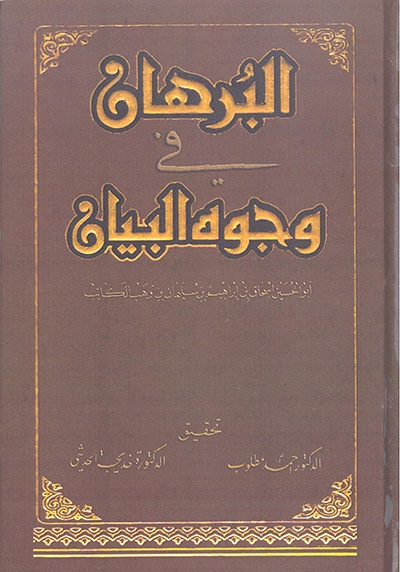
The complete version of the book was later discovered in the Chester Beatty Library in London, consisting of 346 pages, nearly double the length of Naqd al-Nathr as previously published. The edition of Naqd al-Nathr based on the Escorial manuscript had included only part of the work. The printed text of Naqd al-Nathr extended only to page 259, whereas the complete text continues to page 438.
Once the complete manuscript was found, the matter became clear. The book was edited on the basis of two manuscripts by Ahmad Matlub and Khadija al-Hadithi and published in 1967 with the support of the University of Baghdad. The edition was dedicated to Taha Husayn in recognition of his role in introducing the book and for being the first to draw attention to its valuable literary content.
In the critical edition, both manuscripts were used. The complete manuscript was treated as the base text, while the Escorial manuscript, designated by the symbol “S,” was used as the secondary witness. It is evident from the textual references that manuscript “S” is fully Shi‘i and Imami in character, whereas the Chester Beatty manuscript shows alterations in certain devotional phrases or Shi‘i titles.
A crucial point is that with the publication of the complete work, the true title of the book became clear: al-Burhan fi Wujuh al-Bayan. The identity of the author was also clarified as Abu al-Husayn ibn Ibrahim ibn Sulayman ibn Wahb al-Katib. This name appears at the beginning of the work under the heading “al-Bayan al-Rabi‘ al-Kitab” (al-Burhan, p. 313).
The author belonged to the Baghdadi family of Al Wahb, one of the most prominent families of viziers and secretaries in the third and fourth centuries. The editors of the new edition, in addition to providing a detailed argument against attributing the book to Qudama, concluded that the work was composed after the year 335 AH (Introduction, pp. 20–28).
The editors noted that they were unable to find biographical information on the author, Abu al-Husayn Ishaq ibn Ibrahim ibn Sulayman ibn Wahb al-Katib, but they emphasized the considerable fame of the Al Wahb family. They listed the names of several members of this family, some of whom are mentioned by the author himself, with passages cited from their writings. This is noteworthy given that just over a decade after the publication of al-Burhan, a substantial study entitled Al Wahb: One of the Literary Families of the Abbasid Era was written by Yunus Ahmad al-Samarra’i (Baghdad, University of Baghdad, 1979). It should be noted that the Al Wahb family was originally Persian and Christian in origin, but developed within an Arabic cultural environment. Owing to their high level of literary expertise, they entered the fields of vizierate and secretarial administration and remained in these positions for perhaps nearly a century.
In the book Al Wahb, the biographies of several figures from this family are presented, including Sulayman ibn Wahb, the grandfather of the author of al-Burhan, who was among the most prominent viziers and secretaries of the third Islamic century. The work discusses various aspects of his life, including his scholarly and political roles, as well as the hardships, pressures, and imprisonments he endured. He died during his third imprisonment in the year 272 AH in the prison of al-Muwaffaq, the Abbasid prince (Al Wahb, p. 262). His biography occupies pages 227 to 283 of that book, though no information is provided regarding his religious affiliation. Political and literary reports concerning him have been collected from numerous sources, including the works of al-Tabari, Abu al-Faraj al-Isfahani, al-Mas‘udi, and al-Tanukhi.
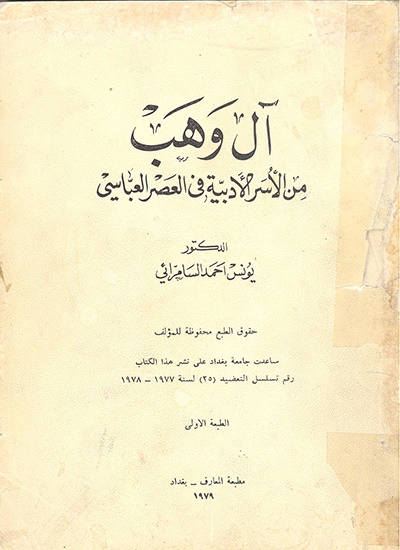
Samarra’i speaks of two sons of Sulayman, named Ubaydallah and Ahmad, and then also mentions Qasim ibn Ubaydallah, collecting reports and examples of their prose and poetry that are scattered throughout literary sources. However, he makes no mention of the father of our author, Ibrahim ibn Sulayman ibn Wahb, which indicates that he found no information about him. Nevertheless, on the basis of al-Burhan, he turns his attention to our author himself, Abu al-Husayn Ishaq ibn Ibrahim ibn Sulayman ibn Wahb, and states that apart from al-Burhan, he found nothing about the author, just as the editors of al-Burhan themselves had found nothing further (Al Wahb, p. 375).
At the very least, within this book, the author mentions three of his own teachers and mentors. The first is Abu al-Hasan Ali ibn Isa ibn Dawud ibn Jarrah al-Baghdadi al-Hasani, vizier to al-Muqtadir, who died in the year 334 (p. 343). The second is Abu al-Hasan Ali ibn Muhammad ibn al-Furat, also one of the great viziers of this period, who died in 312 (p. 358). The third is Abu al-Qasim Ubaydallah ibn Sulayman, who held the vizierate under the Abbasid caliph al-Mu‘tamid for ten years (p. 364). From these indications alone, one can discern his distinguished position in the Baghdad of that period.
According to al-Khafaji, this very book demonstrates the author’s deep scholarly culture, a point also noted by figures such as Taha Husayn and Shawqi Dayf. Al-Khafaji holds that the author possessed a philosophical and rational inclination alongside a broad and expansive religious outlook (Introduction to al-Burhan, p. 17). Even a cursory examination of the book readily reveals this dimension of his thought.
It is striking that despite the extensive discussion provided by the editors concerning al-Burhan, they paid almost no attention to the author’s Shi‘i orientation or to the rationality that permeates the book. Among them, only sporadic references by Taha Husayn or Shawqi Dayf point to the author’s Shi‘i inclinations. This is even though the book is replete with Shi‘i material.
The author of Al Wahb claims that Ishaq, the author of al-Burhan, was the first member of this family to exhibit Shi‘i tendencies. While affirming his Shi‘ism based on the views of Taha Husayn, al-Khafaji, and Shawqi Dayf, he points to a passage in al-Tabari’s history in which, when al-Mu‘tadid sought to publicly institute the cursing of Mu‘awiya, Ubaydallah, the son of Sulayman ibn Wahb, was frightened and dissuaded him from doing so. His son Qasim was later accused of being a Nasibi (Al Wahb, p. 377). Numerous reports of religious laxity concerning this family appear in the sources, which likely supports the view that their Shi‘ism was relatively late and limited in scope. At the same time, it is somewhat difficult to explain how Shi‘i culture appears so deeply embedded in the works of Abu al-Husayn Ishaq ibn Ibrahim without assuming that Shi‘ism had deeper roots within the family.
By the late fourth century, Qadi Abd al-Jabbar (d. 416) counts the Al Wahb family, alongside the families of Al Bastam, the Karkhis, and Al Furat, among the prominent Shi‘i families and viziers of Baghdad. He states that numerous reports transmitted from the Prophet and his Household indicate that the Mahdi will emerge from the West and rule the entire earth from beginning to end, enforcing his authority and judgments in the year 300 AH. This, he explains, is the meaning of the hadith concerning the rising of the sun from the West. Many sermons attributed to the Commander of the Faithful state that his descendant, the Mahdi, will emerge from the West and rule the earth in that year, and that this is recorded in apocalyptic traditions. Envoys from the family of Al Bastam and other Shi‘a were sent to the West, urging him to hasten, declaring that the earth belonged to him, while the caliph in Baghdad at the time was Ja‘far al-Muqtadir, still a child of twelve years, whom they had enthroned, surrounded by his Shi‘i supporters from the families of Al Furat, Al Bastam, Al Qasim ibn Abdallah, Al Abi al-Baghl, the Karkhis, and the Al Nawbakht family (Tathbit Dala’il al-Nubuwwa, vol. 2, p. 600). The family of Al Qasim ibn Ubaydallah refers to this same Al Wahb family.
Professor Hossein Modarressi has provided an account of these families in this context. Among other things, he offers details about the Al Wahb family, or more precisely, the family of Al Qasim ibn Ubaydallah, and its prominent members. They were originally a Christian family that converted to Islam and, over a long period spanning the caliphates from al-Muhtadi to al-Qahir, held high offices of vizierate and secretarial administration. With the exception of Husayn ibn Qasim ibn Ubaydallah, who was accused at the Abbasid court of supporting Shalmaghani and was later exiled to Raqqa and executed in the year 322, Modarressi also mentions Abu al-Husayn Ishaq ibn Ibrahim ibn Sulayman ibn Wahb, the author of al-Burhan, describing him as a “proper Imami Shi‘i, firmly aligned with orthodox Twelver Shi‘ism” (Takmila-yi Maktab dar Farayand-i Takamul, p. 16). According to Modarressi, the earliest reference to al-Kulayni’s book appears in this very work (al-Burhan, p. 398).
In any case, the only source of information we possess about this author is this book itself. Accordingly, the works he mentions as his own within the text constitute the only writings we know of. In addition to al-Burhan, he names four other works: al-Hujja (pp. 89, 91), al-Idah (pp. 89, 90, 271), al-Ta‘abbud (p. 231), and Asrar al-Qur’an (p. 138). Samarra’i, noting this point, reproduces a lengthy introduction discussing these matters (Al Wahb, pp. 377–383).
Thus, the trajectory of this book from its rediscovery to the writing of the present study becomes clear: a work whose importance has been fully recognized, whose true author has been identified, and about which several articles and studies have been written.
Al-Burhan rightly stands as a pillar among works on bayan in its broad, scholarly sense as developed in the third and fourth centuries. It is a work that places speech and expression at its very center and, from every direction, drawing upon the scientific foundations of this discipline in Greek texts, Arabic prose and poetry, authoritative statements, and historical examples, seeks to examine the subject of human understanding.
As stated earlier, the purpose of this article is not to trace the theory of bayan as presented in this book, nor to analyze its structural framework for articulating the foundations of bayan in Islamic thought, an undertaking that would be of great importance. Likewise, an examination of the book’s sources and its approach to evidence and citation would be among the most significant scholarly tasks. Without doubt, this work reflects a period in which discussions of human expression and understanding flourished at the height of Islamic civilization. The author’s intellectual openness, his positive engagement with all available schools of thought and sources, his rational and philosophical orientation, and his mastery of Arabic prose and poetry, which form the foundation of bayan, all enabled him to produce a masterpiece in this field, worthy of being used as an instructional text. These matters, however, lie outside the scope of the present discussion.
What concerns us here are the Shi‘i dimensions of this book, not merely the quotations from the Imams, which we will indeed note, but rather his attention to points in philosophy, theology, and jurisprudence where intersections emerge with questions of knowledge, understanding, and lived philosophy. For example, he discusses taqiyya and how it can function as a mode of understanding that, within the framework of human life and the creation of protective strategies, opens a path forward. Although brief, the inclusion of this discussion within the context of speech and understanding is highly significant.
As previously noted, this book has not yet been confined within the later scholastic frameworks of bayan that reduce it to purely literary and rhetorical concerns. Instead, it understands comprehension and expression as encompassing all dimensions of human life, both literal and figurative. For this reason, it even addresses bureaucratic practice and the ways in which bayan manifests itself there, including how official correspondence conveys meaning.
Here one must go even further and emphasize explicitly that the science of bayan, as presented here, bears no resemblance to what it later became within a narrow specialization of the sciences of meaning and rhetoric. Rather, it represents the epistemic dimension of the human being, through which one seeks to connect with others by means of meanings, words, and all aspects of the surrounding world. This form of knowledge is not merely philosophy or literature; it includes religion and its various dimensions as well. It is this mode of knowledge that laid the foundations of Islamic civilization.
Shi‘i Elements in al-Burhan
The Shi‘i elements in this book that appear without being explicitly framed as sectarian discussions may be traced through three areas:
A. Narrations from the Imams
B. Several theological issues
C. Several juridical and legal-theoretical issues
A. Narrations from the Imams
It is clear that the mere transmission of reports from Imam Ali, and even from some of the other Imams, does not in itself constitute evidence of Shi‘ism. However, when such transmissions are accompanied by particular indicators, one may state with confidence that the author transmits them out of Shi‘i conviction and that, in all likelihood, some of these reports derive exclusively from Imami Shi‘i hadith sources. With respect to what appears in this book, there is very little doubt on this point.
The author cites a considerable number of reports from Imam Amir al-Mu’minin Ali in various contexts. He does not employ the title Amir al-Mu’minin for the early caliphs, reserving it exclusively for Imam Ali, although in a few historical narratives, for example, those concerning the Abbasid caliph al-Amin, the expression is retained when it appears as part of the reported account itself. As noted earlier, the Escorial manuscript preserves Shi‘i devotional expressions in accordance with the original, whereas in the other manuscript these expressions have undergone minor alterations by the copyist.
The existing citations indicate that the author was deeply devoted to Imam Ali and to his eloquent sermons. In one passage, after discussing oratory and literary exhortations, he writes that among those who reach the highest level in balancing brevity and elaboration, concision and pointed expression, and who surpass all others in this domain just as he surpasses them in all his actions, is Amir al-Mu’minin, peace be upon him: “He surpassed all people in this, just as he surpassed them in all his other deeds.” He then adds that Imam Ali possesses famous sermons, including al-Zahra’, al-Gharra’, al-Bayda’, and others that have been transmitted from him and reached us through reliable transmission (p. 204).
In a limited number of cases, hadith are cited with the explicit identification of their speaker. It is possible that other reports introduced with general formulas, such as “it is narrated,” also go back to the Imams, but since the attribution is not specified, they are not included here. For example, in one place the author states: “Reports have reached us continuously that charity repels divine decree and that kindness to parents increases one’s lifespan” (p. 271), without naming the authority behind the statement.
Some of these aphorisms may later have appeared in Nahj al-Balagha, which was compiled nearly eighty years after this book, though others may not. This matter requires further investigation, as does the verification of the authenticity of these reports. It is noteworthy that in the index of proper names in the book, the name Ali ibn Abi Talib appears on only a single page.
The pages on which statements from Imam Amir al-Mu’minin Ali are cited include the following:
-
p. 53: “Our master Ali, peace be upon him, said: The enmity of the ignorant toward knowledge is proportional to the benefit he derives from it.”
-
p. 63: “Amir al-Mu’minin, peace be upon him, said: A person is hidden beneath his tongue; when he speaks, he is revealed.”
-
p. 65: “Amir al-Mu’minin, peace be upon him, said: Whoever speaks excessively, errs excessively.”
-
p. 95: The author notes that Amir al-Mu’minin derived legal rulings in cases where evidence was lacking and contending claimants disputed one another, and then cites several examples of his judicial decisions.
-
p. 138: “Amir al-Mu’minin, peace be upon him, said: There is not a single banner that will emerge until the Day of Resurrection except that I know its leader and its caller.”
-
p. 164: A statement from one of his sermons: “Where are those who strove, exerted effort, amassed and counted, advanced and fortified, built and erected?”
-
pp. 198–199: Selected aphoristic statements of Amir al-Mu’minin on wisdom, including:
“A person is hidden beneath his tongue”;
“The worth of every person is what he excels in”;
“Know the truth and you will know its people”;
“Knowledge is the lost property of the believer”;
“The richest of people is the one with intellect, and the poorest is the one with foolishness”;
“This world is a passage to an abode of permanence, and people in it are of two types: one who sells himself and frees it, and one who sells himself and destroys it”;
“If you gain power over your enemy, make forgiveness your gratitude for that power”;
“Patience is a mount that never stumbles and a sword that never dulls”;
“Cities are built through love of homelands”;
“Ingratitude for blessings is baseness, and the companionship of a fool is misfortune”;
“Following desire blocks guidance”;
“A usurped stone in a house is a pledge of its ruin”;
“One who gains victory through sin has not truly triumphed”;
“He who overcomes by evil is himself defeated.” -
p. 219: A report in which the Prophet entrusts Amir al-Mu’minin with a task and explains that the present witness sees what the absent does not, entrusting him because of his confidence in his judgment, while not extending the same trust to others.
-
p. 224: “Amir al-Mu’minin said to Ibn al-Kawwa’: Ask in order to understand, not in order to be contentious.”
-
p. 236: “Amir al-Mu’minin said to al-Harith ibn Hawt: O Harith, the matter has been confused for you. Truth is not known by men; rather, know the truth and you will know its people.”
-
p. 238: “Amir al-Mu’minin said: The position of patience in relation to faith is like the position of the head in relation to the body; there is no faith for one who has no patience.”
-
p. 248: “Amir al-Mu’minin said: Whoever is known for something is recognized by it; whoever laughs excessively loses dignity; whoever jokes is taken lightly.”
-
p. 256: “Amir al-Mu’minin said: Seize opportunities, for they pass like passing clouds.”
-
p. 280: “Amir al-Mu’minin said: Ingratitude for blessings is baseness, and the companionship of a fool is misfortune.”
-
p. 261: “It is narrated from Amir al-Mu’minin: The right of a scholar is that one should not overwhelm him with questions to the point of annoyance, nor tug at his garment.”
-
p. 287: “Amir al-Mu’minin said: The incapable person is one who fails to make friends, and more incapable than him is one who loses those he has made; the best of friends are those with the fewest faults and the greatest harmony.”
-
p. 291: “Amir al-Mu’minin said: Whoever’s speech is gentle becomes deserving of love.”
-
p. 300: “Amir al-Mu’minin said: God, Mighty and Exalted, did not approve that the Imams judge in distant corners of the land while being restrained, neither commanding nor forbidding.”
-
p. 306: “Amir al-Mu’minin said: He who overcomes by evil is defeated.”
-
p. 363: On the distribution of the public treasury, after describing the practice of the Prophet and noting that only Imam Ali followed it, restoring matters to what they had been in the time of the Prophet. The author adds that after him they returned to the practice of Umar.
-
p. 387: After recounting Umar’s actions toward the Arab Christians of Banu Taghlib, a statement from Imam Ali is cited: “I have an opinion regarding them, if I were free to act upon it.”
-
pp. 403–404: A long report from Amir al-Mu’minin stating that governance is unavoidable, whether righteous or corrupt, and explaining the functions of even an unjust authority.
-
p. 406: “Amir al-Mu’minin said: The stance of an elder in battle is more admirable to me than the presence of a youth.”
-
p. 408: “Amir al-Mu’minin said: Few are those who waste an opportunity once it has been made possible for them and delay it until it passes, only to later encounter something similar.”
-
p. 422: It is narrated from Amir al-Mu’minin that he sought refuge in God from a people who, when united, could not govern, and when divided, could not be recognized.
In all of the above instances, the expression “peace be upon him” is consistently used, whereas neither the title Amir al-Mu’minin nor the formula “peace be upon him” is applied to the caliphs (see pp. 378, 384, 395). Although the Imami Shi‘i orientation of the author is evident throughout the book, the occurrence of three instances in which the phrases “may God be pleased with him” or “may God’s pleasure be upon him” are applied to caliphs should be attributed to the Sunni copyist of the manuscript, who, according to the colophon, completed the copy in the year 677. The author’s closing benediction reads: “We ask Him to send blessings upon Muhammad, all of His messengers and their households, and upon all believing men and women.” The copyist, however, wrote: “May God send blessings upon our master Muhammad, his family, and his Companions, and grant them peace” (pp. 437–438).
One additional point regarding Imam Ali deserves mention. Under the term Shurta al-Khamis, the author explains that they were those who stood with Amir al-Mu’minin. Because they openly declared their loyalty to him, and since shurta in his interpretation means declaration and sign, they were given this name. Khamis means army. These were the individuals within the larger army who openly declared their allegiance to him in battle and thus became distinguished banners in that cause (pp. 393–394).
Narrations from Other Imams
From Imam al-Sadiq (a):
-
p. 55: It is narrated from Abu Abdallah, peace be upon him, that he said to Hisham: God, Mighty and Exalted, has two proofs: an outward proof and an inward proof. The outward proof is the messengers, and the inward proof is the intellect.
And from him, peace be upon him: The proof of God over the servants is the Prophet, and the proof between the servants and God is the intellect.
-
p. 58: It is narrated from al-Sadiq, peace be upon him, in a statement of his: Everything has an indicator, and the indicator of intellect is reflection, and the indicator of reflection is silence.
-
p. 274: It is narrated from al-Sadiq, peace be upon him, that he said: The sciences have locks, and their keys are questioning.
-
p. 277: It is narrated from “the two Sadiqs,” peace be upon them: There is no religion for the one who has no taqiyya.
(Here the editor has written “peace be upon them,” and from the fact that in the index of proper names he did not record the name of Imam Ja‘far al-Sadiq on this page, it is clear that he did not recognize that the Shi‘i expression “the two Sadiqs” refers to Imam al-Baqir and Imam al-Sadiq, peace be upon them. In the index, which is in any case highly inaccurate, he does list “Imam Ja‘far ibn Muhammad al-Sadiq” under the entry “Sadiq,” presumably because the author, following Imami Shi‘i convention, uses formulations such as “it is narrated from al-Sadiq” or “it is narrated from Abu Abdallah.”)
-
p. 298: It is narrated from “the two Sadiqs,” peace be upon them: Reviewing knowledge together is a good act of worship. (Here too, the editor has written “peace be upon them.”)
-
p. 307: It is narrated from “the two Sadiqs,” peace be upon them: May God have mercy on the one who endears us to people by relating from us what they can recognize.
A narration from Imam Ali ibn al-Husayn:
-
p. 65: It is narrated from our master Ali ibn al-Husayn, peace be upon him: Silence regarding what does not concern you is better than speaking about it, and speaking about what does concern you is better than remaining silent about it.
In one instance, without naming the Imam, a statement appears that resembles what is transmitted in Shi‘i narrations concerning taqiyya:
-
p. 277: “And the scholar, peace be upon him, said: Taqiyya is my religion and the religion of my forefathers.”
In another instance, he transmits a hadith from the Prophet, but through Shi‘i transmission, and this qualification is noteworthy:
-
p. 189: “For this meaning, the Messenger of God, peace be upon him, said in a hadith transmitted from him by the Shi‘a: We, the community of prophets, have been commanded to speak to people according to the measure of their intellects.”
B. Theological Issues
We have repeatedly noted that the subject of the book is the science of bayan. When the author turns to other subjects, it is by way of illustration or through constructing a conceptual linkage. At times, however, a theological issue may relate to bayan by virtue of the conceptual premises of the discussion itself. In this respect, the book contains examples in which a theological question is necessarily presented through a Shi‘i lens.
Some theological issues are also dual in character, in the sense that they function both as matters of theology and as matters discussed within jurisprudence. These are contested legal issues which, due to their close connection to sectarian identity, have taken on an aspect of theology, even if not in the technical sense of the term.
1. Bada’
Among the theological topics related to divine unity, the book mentions bada’ only incidentally, and in highly concise fashion, in connection with the broader discussion of bayan. The doctrine of bada’ is among the most difficult concepts to which the Shi‘a subscribe, and one that others find difficult to tolerate. The author is aware of this, and in a brief reference attempts to offer an interpretation of it that would be acceptable.
He begins with the topic of abrogation of rulings. Abrogation itself raises difficulties, but because the Quran explicitly affirms it, it has been widely accepted. Abrogation in rulings means that one legal ruling is replaced by another. But abrogation in reports is not meaningful, because if a report undergoes transformation and replacement, it ceases to be a report, unless there is a condition or exception involved. Even reports about the future follow the same logic.
“Moses reported that if they obeyed him in entering the Holy Land, they would enter it. But when they opposed him, God forbade entry to them, and no one entered. The people of Jonah were promised punishment if they did not repent. But when they repented, the punishment was lifted.” In such cases, there is indeed a report, yet when its condition is not fulfilled, the promised outcome does not occur.
At this critical point, the author turns to bada’ and states that what the Shi‘a believe regarding bada’ is precisely this meaning, despite the ugliness of the term and the harshness it produces upon hearing it: “And to this meaning the Shi‘a go in bada’, despite the offensiveness of this expression and the repulsiveness of its sound in the ears” (p. 118).
2. Imamate
In his discussion of imamate, in connection with a section entitled “al-tawaddud” or “al-mawadda,” which he presents as something by which all affairs are rectified, in contrast to “al-‘adawa,” by which everything is corrupted, he cites Quranic verses that call to affection and classifies this affection into two types: “the affection of protection in religion” and “the affection of benefit in worldly life.” Regarding the first, he writes that the affection connected to protection in religion is the same as wilayah, “which God, Exalted is He, has made obligatory upon His believing servants toward their Imams and their brethren,” and then cites the verse: “Your wali is only God, His Messenger, and those who believe” (pp. 290–291). It is clear that he speaks by allusion, yet the depth of the meaning remains evident.
In his discussion of “report” and its division into three categories, he introduces as the second category “the reports of the messengers,” and immediately adds: “and those who run in their course among the Imams, for whom proofs and rational evidences have been established among people of intellect regarding their truthfulness and their infallibility, and for whom miracles have appeared which cannot permissibly be produced by any kind of trickery.” He then offers an explanation of miracle and emphasizes that their reports are affirmed and are, in reality, authoritative proof. He again uses the phrase “the prophets and the Imams” in the subsequent line, affirming the probative authority of their speech (p. 89).
He likewise uses the term “the infallibles” (p. 90), a distinctly Shi‘i expression, while referring the detailed discussion to his own works al-Idah and al-Hujja (pp. 89–90).
With respect to placing “the prophets and the Imams” together, another instance occurs in al-Burhan when he discusses concision. Among other things, he refers to concise expressions in religion, including admonitions, practices, and exhortations, and notes that the statements of the prophets and the Imams are likewise of this kind: “Therefore you will not see in the hadith transmitted from the Messenger, peace be upon him, and from the Imams, peace be upon them, anything lengthy; rather it comes in the utmost brevity and concision” (p. 195).
Elsewhere, he writes: “Every report that has come by tawatur from the general public, or tawatur from the elite, or that is heard from the prophets and the Imams, all of this yields knowledge” (p. 101). We will note that he uses the terms “general public” and “elite” with this meaning elsewhere as well.
Regarding the pairing “the Messenger and the Imams” and “the prophets and the Imams,” which indicates in the author’s view that they stand on a single plane with respect to obedience, there is a passage in this book where, apparently due to a misreading, “for the leaders and the Imams” appears, though “for the Messenger” is intended. The line reads: “Reverence for the leaders and the Imams is among what God has commanded, as He says: O you who believe, do not raise your voices above the voice of the Prophet” (p. 260). Given that the verse addresses the Prophet, the author’s intended reference is clearly to the Messenger, not to “leaders.”
His belief regarding the Imams and their knowledge is reflected in another passage as well. Under the entry “al-ramz” (symbolic indication), he defines it and notes that Plato employed symbolic expression more than anyone else. Symbolic expression also appears in the Quran, for example through oaths or references such as fig and olive, dawn, the charging steeds, time, the sun, and similar instances. God, he says, has made the Imams, in whom the knowledge of the Quran has been deposited, aware of these symbols: “He has made known their knowledge to the Imams in whom the knowledge of the Quran is entrusted.” He then cites as evidence the statement of Amir al-Mu’minin, peace be upon him: “There is not a banner that will emerge until the Day of Resurrection except that we know its leader and its caller and where it will finally settle, in Paradise or Hell.” He continues: “These symbols are the secrets of the family of Muhammad, and whoever among those vested with authority derives them will come to know them.” He adds that he has discussed these matters in his book Asrar al-Qur’an (p. 138).
C. Juridical Issues
1. The jurisprudence of alms (zakat), blood money (diyat), and legal penalties (hudud)
Among the legal discussions he addresses incidentally is zakat. Following his method, he presents the basic rulings only in outline and generally does not mention differences of opinion. Concerning zakat he writes: “As for alms, among the Shi‘a it is obligatory only in seven categories …” (p. 378). Concerning the zakat on dirhams he also writes: “Among the Shi‘a, for two hundred dirhams, if there is an increase beyond it, there is no additional obligation beyond the five dirhams until it reaches two hundred and forty dirhams, at which point it becomes six dirhams” (p. 379).
Regarding the measure of a sa‘, he writes that the people of the Hijaz consider it five ratls, the Iraqis three ratls, and that “among the Shi‘a it is nine ratls.” He then emphasizes that what he has stated regarding zakat and its amounts is based on the Shi‘i view: “We have mentioned the position of the Shi‘a regarding what zakat is obligatory upon them in these matters” (p. 382).
On the distribution of spoils he states that a mounted soldier receives two shares and an infantryman one share, “according to the school of the Hijazis and the Shi‘a” (p. 383).
In the discussion of protected non-Muslims (ahl al-dhimma), he notes the difference between Umar’s treatment of the Arab Christians of Banu Taghlib and his treatment of other Christians, and then adds an interesting parenthetical sentence: “And Amir al-Mu’minin, peace be upon him, used to say: I have an opinion regarding them, if I were to have leisure to address them.” That is, “I have a legal view concerning them, if the time comes” (p. 387).
In the section on hudud he writes: “There is no cutting for the embezzler or the treacherous,” meaning that the hand of one who commits embezzlement or breaches trust is not cut. He then adds: if a man’s hand is cut for theft, then in a subsequent theft his left foot is cut. If he steals again, “it is not cut according to the view of the Shi‘a”; rather, nothing further is amputated, and he is given life imprisonment (p. 395).
In the section on blood money, within a discussion of compensation for various bodily parts, including fingers, and the differences of opinion that exist, he writes: “The Shi‘a assign blood money for fingers and teeth in accordance with the degree of benefit, and thus they give preference to some over others.” He then says that he does not retain the detailed breakdown of these views: “I do not preserve its details.” He refers the reader to books written on blood money, among them works “compiled by al-Kulayni, by Husayn ibn Sa‘id, and others” (p. 398). This reference to al-Kulayni is chronologically close to the author, and in the phrasing of Dr. Modarressi, it may be among the earliest references in the literature to al-Kulayni’s book.
2. Taqiyya
One example of a discussion that is both theological and juridical is taqiyya. The author of al-Burhan, however, introduces it from the perspective of the science of bayan, and asks what place taqiyya has within that discipline. To articulate a matter “in bayan” under taqiyya has its own particular considerations.
It should be noted that while taqiyya in its basic form is a rational strategy that nearly all human beings employ, in its theological and juridical framing the Shi‘a emphasize it more than other Islamic groups, while other schools do not formally accept it. Here the author of al-Burhan treats the matter carefully from the angle of bayan, grounding it explicitly in his Shi‘i outlook. Indeed, among the Shi‘i principles on which he relies in this book, one may say that he emphasizes taqiyya most frequently and in multiple contexts.
In one passage, when he reaches the problem of contradictory reports concerning a single matter, he says: if reports from trustworthy transmitters reach you that both command and forbid a given action, and there is no one in the chain accused of weak retention or error, and there is no other kind of discrepancy of the sort previously discussed, and if these are among the narrations of the Shi‘a from the Imams, peace be upon them, then we know that the Imams do not simultaneously command a thing and its opposite, because they are wise, and contradictory speech does not issue from the wise. In that case, knowledge is restricted to one conclusion: the cause of the discrepancy is that one of the two answers was issued as taqiyya: “The cause of the disagreement in that is only that one of the two responses was issued by way of taqiyya.” What is taqiyya here? He answers: “Taqiyya pertains only to what contradicts the legal opinions of the ‘amma.” He continues that they have instructed us in such cases to act upon what opposes the fatwas and practice of the ‘amma: “Therefore they counseled … that when their transmitted reports contradict one another, we should act in accordance with what opposes the fatwa of the ‘amma and its practice.” But in cases where a report is transmitted and we do not know its basis, we suspend judgment and consign it to the one who knows it, and we do not affirm or deny it until the matter becomes clear. This is what they commanded us, saying: “A matter whose guidance becomes clear to you, follow it; a matter whose error becomes clear to you, avoid it; and a matter that becomes ambiguous to you, consign it to the one who knows it” (p. 108).
In another passage, he defines “mu‘arada” in speech as a kind of matching of two statements on equal terms, like exchanging goods of equal value in sale and purchase. This type of mu‘arada is used in taqiyya, when the addressee is someone from whose harm we fear, and he is outwardly satisfied with what we say, while no explicit lie is employed. An example is that a figure from the Abbasid state once asked someone: What is your view of black clothing? He replied: “Is there any light except in blackness?” The questioner was satisfied, but the respondent meant the light of the eye, which is located in the blackness within it. Another example is attributed to Shurayh: he left the presence of Abd al-Malik while the latter was near death. When asked what news he had, he said: “I left him while he was commanding and forbidding.” What he meant was that Abd al-Malik was commanding regarding a testament and forbidding wailing and lamentation. The author then cites in support of this approach the statement of the Prophet: “The head of intellect after faith is to deal tactfully with people.” Another example of this kind of mu‘arada, or taqiyya, is the statement of Joseph’s messenger: “O caravan, you are thieves.” He did not mean theft of the measure, but rather the “theft” of Joseph from his father (pp. 118–119). He then notes the Quran’s severe condemnation of lying, and treats cases in which it is permitted on the basis of certain narrations (p. 120). Elsewhere he again returns to mu‘arada in speech and writes: “A person may employ it under taqiyya such that through this speech he exits the category of lying by the sharing of the name” (p. 148).
The discussion of taqiyya clearly interests him, and he addresses it again in another place. There he speaks plainly of taqiyya in relation to sultans, and writes that taqiyya and tactful accommodation with a ruler or chief serve to avert harm from them, to win them over, and to contend with one who occupies a position superior to yours. If you remain silent before such a person, he grows bolder against you, and your silence strengthens him against you. He believes that in such cases one may cite the verse, “Whoever aggresses against you, aggress against him in the like of what he aggressed against you,” and the verse, “Whoever defends himself after having been wronged, there is no blame upon them.” He then writes that this kind of response, namely acting with taqiyya, causes the very basis of his harassment to be cut off and restrains him from repeating his conduct by a similar response: “This is what is correct in confronting one whose state is such, because in confronting him there is a cutting off of the source of his harm, and a deterrence to him from repeating it by the like of his act” (p. 258). This may be among the earliest instances of citing these verses for taqiyya and reasoning in this style.
In another place, he links the duty of commanding right and forbidding wrong to taqiyya. He says that a person should not command right and forbid wrong to someone with whom he has enmity, someone whose power he fears, and from whom he has no hope that his words will be accepted. Such action is foolishness on the part of the doer. It is like admonishing a deaf man, or addressing a dead person who cannot benefit, and like provoking a wild beast to anger or awakening a viper. In such a case, the one who commands and forbids will suffer an affliction from this class that he cannot endure. For this reason, the people of religion, virtue, wisdom, and intellect employed taqiyya, commanded it, and God and His Messenger permitted it. He then cites, in the context of commanding right and forbidding wrong while avoiding danger, one report from the Prophet and two statements from the Successors Hasan and Sufyan. The prophetic report is noteworthy: he says to Abu Tha‘laba: “Goodness, O Abu Tha‘laba. Command right and forbid wrong. But when you see a worldly life preferred, avarice obeyed, and every possessor of an opinion admiring his own opinion, then attend to yourself.” He then connects this to taqiyya and transmits two reports: “It is narrated from the two Sadiqs, peace be upon them: There is no religion for the one who has no taqiyya. And the scholar, peace be upon him, said: Taqiyya is my religion and the religion of my forefathers” (p. 277).
The final place where he discusses taqiyya is after citing the verse, “The believers are allies of one another.” He mentions the corresponding rule of guarding oneself against the danger of unbelievers and opponents. A person should have a sense of loyalty toward believers, but not toward opponents. Under taqiyya, he should not disclose his true stance toward opponents lest they harm him: “and it is prohibited toward opponents except in the state of taqiyya.” He then cites the verse of taqiyya: “Let not the believers take the unbelievers as allies instead of the believers. Whoever does that has nothing to do with God in any way, unless you guard yourselves from them in prudence” (p. 291).
3. Cooperation with oppressors and the view of the two Sadiqs (a)
A portion of this book belongs to political ethics and the practice of governance. The importance of bureaucratic secretarial work and vizierate is highlighted here, and its connection to bayan is evident from the author’s standpoint. In this section, however, the political discussion is presented in more serious terms. The question of the vizier, the criteria for selecting a vizier, his conduct with the caliph, and the issues that arise between them form the central axis.
The author holds that the vizier who is chosen should possess adab, wisdom, intellect, and experience. He should also come from a house of leadership, because this contributes to the soundness of governance. He even believes in a kind of hereditary influence: “For the veins cause the tree to grow; rarely does a root become good without its branch becoming good.” If the origin and lineage are sound, the branch will be sound as well.
These discussions continue until he reaches the point relevant to us. In his view, the vizier must be grateful for the blessing God has granted him, namely that after the sultan he occupies the highest rank. Therefore, he must be trustworthy and deliver the trust to its rightful owner, which in this context is the sultan.
At this point he raises an important question: if a vizier does not believe in the legitimacy of the sultan’s imamate and caliphate, must he still be trustworthy and fulfill his obligations toward him? In other words, when he regards the sultan as a “usurper,” what should he do: “If he is among those who do not believe in the imamate of his sultan and sees him as a usurper of what is in his hand,” how should he behave?
He argues that this should not prevent him from sincere counsel to the sultan, that is, offering guidance and directing affairs toward his benefit. In reality, there is no necessary linkage between his belief and his performance of duty: “His holding that belief does not permit him to deceive him, nor does it license him to abandon sincere counsel in any circumstance.” He has accepted the office of vizierate and has agreed to participate in the affairs of rule. Therefore, he must act appropriately with respect to this blessing that has come to him.
If one compares accepting the vizierate with properly discharging the trust, the acceptance of the vizierate is clearly the graver offense that he has already undertaken. Therefore, once he has accepted it, he has no right to neglect the duties of the office. God has commanded the rendering of trusts, and that command is general and cannot be restricted except by an explicit statement from God.
He then cites reports from the Household and writes: “It is narrated from the two Sadiqs, peace be upon them, in what indicates that the command in this matter is general, namely their statement: Render the trust, even to the killers of the children of the prophets.”
Another point, among the precise elements of Imami Shi‘i realism, is that in the absence of “just Imams,” there must nevertheless be a “sultan,” because otherwise people will devour one another. An unjust ruler is like constant rain: it harms buildings and prevents travel, yet it also contributes to greater production and increased provision. Here he cites the statement of Imam Ali, peace be upon him, that people must have governance, righteous or wicked. He was asked: we understand the righteous, but what about the wicked? He replied: it is by means of him that one fights the enemy, collects revenue, and restrains the hand of the oppressor (p. 403).
Thus, he presents here the Imami Shi‘i position regarding unjust governance and cooperation with it, a point that in that period was also treated and debated within juristic writings.
4. Two usuli discussions: solitary report (khabar al-wahid) and abrogation (naskh)
In this book, he also touches incidentally on a few usuli discussions connected to language and indications, which are more “scientific” in character than sectarian. After discussing mutawatir reports and the reports of prophets and the infallibles, he calls the third category of reports “the mutawatir of the khassa,” meaning reports for which a particular group has established tawatur.
It appears, though he does not state explicitly, that he means the probativity of reports that are mutawatir within the Shi‘a. He supports this by noting Quranic affirmation of a point through appeal to the speech of “the scholars of the Children of Israel,” and the claim that God “made the knowledge of the scholars, who are the khassa, a proof over the ‘amma” (p. 90). It seems that he is employing the terms khassa and ‘amma in the sense in which they were used in the literature of that period, for example in Ibn al-Nadim’s Fihrist, where they were applied to Shi‘a and Sunni.
On solitary reports he shows a distinct strictness. After discussing tawatur and the reports of prophets, which are accepted through demonstration and miracle, as well as the mutawatir of the khassa, he turns to what he calls “reports of assent,” namely reports transmitted by one or two individuals, which neither reach tawatur nor belong to “reports of the infallibles,” and are therefore treated as solitary reports. In his view, solitary reports are not acceptable in the foundations of religion, in which all people stand equal. But people need them in their transactions and correspondence, and therefore one must give attention there to the report of someone toward whom one has good opinion and who is not notorious for depravity.
He then mentions the disagreement of the community over solitary reports and, while noting that the Prophet, peace be upon him, paid attention to such reports, he refers more detailed discussion to his book al-Hujja (pp. 90–91).
He also has a discussion of abrogation. He explains it as meaning that something was unlawful and then becomes lawful, or the reverse; or that something was obligatory and its obligation is lifted, or the reverse. Some people know the first ruling and are unaware of the abrogation, and so they act according to what they know. Others know the abrogation and act accordingly. This produces disagreement between them.
He offers as an example wiping over footwear: the Shi‘a believe that wiping over footwear has been abrogated, while the ‘amma remain upon the earlier ruling. Mut‘a is similar: the ‘amma claim it has been abrogated, “while the Shi‘a remain upon the earlier ruling” (p. 231). Here he states his view clearly, and his use of the term ‘amma is another indicator of the point we have noted at least twice previously.
5. Takfir
Another topic he addresses, again as a consequence of the broader discussion of bayan, is takfir. Here, he treats the aspect of takfir that pertains to using words in their proper places. His discussion is not juridical in the sense of a Shi‘i or Sunni legal doctrine, but rather linguistic, concerned with understanding and misunderstanding.
He introduces this within the discussion of “jadal,” one of the major topics in logic and bayan. After discussing the principles of debate, methods of refutation, and the necessary responses at each stage of disputation, he turns to another point: certain groups, such as theologians, have their own technical vocabulary, for example quantity, quality, whatness (mahiyya), latency, generation, part, leap, and the like.
If a theologian uses such terms with someone who does not know them, he is mistaken and far from correct. Ancient philosophers and logicians are similar: if they speak to theologians of this era and the people of this language, employing their own terminology will not be appropriate. Worse still is for someone to address the general public using the language of specialists, or for an urban person to speak to a Bedouin in the idiom of the city.
Among the terms of ancient philosophers and logicians are syllogismos, hyle, and categoriae. If one speaks with these terms to a theologian, he will not understand them without explanation and interpretation. This results in obscurity, constriction, and placing things outside their proper positions. If one must speak with them, one should convey the same concepts but translate them into terms familiar to the audience, for example using “qarina” instead of syllogismos, “matter” instead of hyle, and “categories” instead of categoriae, and so forth.
He then states that speaking with someone unfamiliar with theology and the circumstances and terminology of theologians and disputants is a kind of ignorance and error.
From this linguistic analysis, he proceeds to the point that “the rabble,” “the common folk,” and those unacquainted with theology, when they hear words with which they have no prior familiarity and do not grasp their meanings, may come to believe that the speakers of such words are unbelievers and that their blood is lawful. As evidence, he notes that some of the lowest of the common people testified that Khalil ibn Ahmad and his companions were heretics, simply because they heard them speaking about “the genera of prosody.” They heard words they did not understand and suspected heresy. Khalil even composed a poem about this, which the author cites (pp. 243–245).
In the chapter on jihad, when discussing Muslim bandits and related cases, he speaks of the necessity of fighting them and the permissibility for the Imam of the time to kill, crucify, or amputate hands and feet. Yet he says that because the two testimonies are something shared between them and the Muslims, it is not permissible to enslave them or to marry their women: “because the testimony and the outward form of the religion unites us and them.” He speaks similarly regarding rebels (bughat) (p. 409).
6. Unity and the jama‘a (the community)
Two points should be borne in mind regarding the author’s inclination toward political reflection. The first is that he belongs to a family which, like certain other Imami Shi‘i families, was continuously present within government and held high offices and ranks. These were people who, from the beginning of the Abbasid revolution, remained within the state apparatus due to the Shi‘i-leaning tendencies associated with that political moment. Later, when Abbasid politics and Shi‘i identity diverged more sharply, they nonetheless remained, more or less, within the corridors of power, though privately committed to Shi‘ism. From a juristic perspective, the Imams permitted such groups to remain within official politics in order to defend the interests of the Shi‘a. At times, however, they were caught in the liabilities of political life, most of which had little to do with their Shi‘ism as such, and more to do with the rise and fall of viziers and their networks, the confiscation of property, and similar dynamics.
At the same time, since the author comes from a prominent family associated with secretarial and vizierial service, it is natural that he should hold a generally affirmative view of the state, governance, and the jama‘a. Such experience, taken as a whole, appears to have formed him in a manner that leads him to speak in favor of unity and communal cohesion; he has no interest in conflict, rebellion, or adopting an oppositional posture toward government. We will trace this discussion through selected examples of his outlook without explicitly attributing them to Shi‘ism, though, as noted earlier, the teachings of the Imams clearly exercised their own influence upon such individuals and families.
One theme that draws his attention is sectarian and religious disagreement, which he regards as blameworthy. He writes that it is incumbent upon the vizier to instruct the populace, after restraining them, to avoid discord in religion, partisanship, and the undermining of consensus: “It befits the vizier to command the subjects, after preventing them, to refrain from differences in religion, prejudice, and violating the consensus of the word, and to seek unity of intent and mutual concord among themselves.” He then cites the verses: “Hold fast, all together, to the rope of God, and do not become divided,” and “Do not be like those who split and differed” (Al ‘Imran 3:103, 105).
He further emphasizes the concept of the jama‘a, grounding it around a “leader” (ra’is). The foundation of leadership, in his framing, is obedience; the foundation of obedience is the Shari‘a. If there is disagreement about the person from whom that Shari‘a is taken, then those who follow will fall into discord (pp. 424–425). He also stresses the notion of tawaddud, cultivating amicable relations, between the vizier and the general populace, and regards its realization as completing the vizier’s leadership on the one hand, and, on the other, as contributing to the reform of public morals, stabilizing the temperament of the people, focusing them on the pursuit of their interests, and preventing them from being drawn into distractions and peripheral preoccupations (p. 425).

Sayyid Ali studied in the seminary of Qom from 2012 to 2021, while also concurrently obtaining a M.A in Islamic Studies from the Islamic College of London in 2018. In the seminary he engaged in the study of legal theory, jurisprudence and philosophy, eventually attending the advanced kharij of Usul and Fiqh in 2018. He completed his Masters of Education at the University of Toronto in 2025 and is the head of a private faith-based school in Toronto, as well as an instructor at the Mufid Seminary.
