
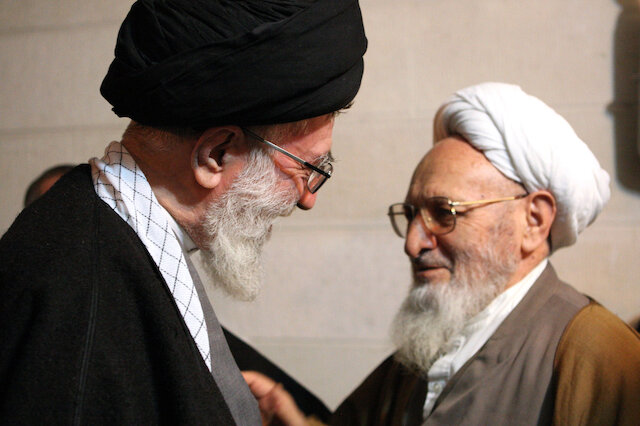
Two works of Ayatullah Hasanzadeh Amuli (1927–2021) – perhaps best considered part of the kashkul (miscellany) genre – are Hazar o Yik Nukteh (A Thousand and One Points) and Hazar o Yik Kalameh (A Thousand and One Words). I would often read through them at night before bed, coming across different gems along the way. One time, a teacher of mine mentioned a treatise on the Arabic language and its lexicons that Ayatullah Hasanzadeh Amuli had written, published within Hazar o Yik Kalameh (vol. 3, pg. 308). I can no longer recall which teacher it was, but this must have been around 2015 or 2016 — may Allah bless them for guiding us toward lesser-known works like this during our studies. I began translating the treatise then, but never finished it. Tonight, I finally managed to complete it and have published it below. The treatise was originally written in 1964, and later revised and republished in 1994.
A Precious Treatise on the Compilation of the Arabic Lexicon
From Hazār-o Yek Kalameh (“A Thousand and One Words”)
by Hasan Ḥasanzadeh Amuli
This is a precious, brief treatise on the compilation of the Arabic lexicon:
بسم الله الرحمن الرحيم
O God, You who distinguished mankind with the jewel of speech, and honoured him with the nobility of knowledge and culture — the best of words, which is the key to every difficulty and by which the lock upon the mouth is opened, is Your glorious Name and the praise and glorification of Your Majestic Essence. Blessings be upon the souls of all Your messengers, especially upon the Seal of the Prophets, whom You sent with the most eloquent of tongues and whom You chose with the best of Books, and upon his Household, each of whom is an interpreter of the true word.
Defining the Science of Lexicography and Its Benefit
The science of lexicography, in any language, consists of knowing and grasping the meanings of that language’s words. Its benefit lies in attaining and arriving at the sciences and truths particular to that language. Hence, whichever nation possesses greater knowledge and civilization, its language spreads quickly and reaches everyone, because others — since the weak must necessarily imitate the strong to attain their level of perfection — are compelled to learn their language, which is, in effect, knowing their vocabulary.
For example, until the rise of Greek civilization, no nation had reached their level.
Great scholars arose from that land, and in various scholarly disciplines — the arts of philosophy, mathematics, and so on — they authored many beneficial books and gained considerable fame throughout the world, so that it was not long before the Greek language became the scientific language of the world, and others devoted themselves to learning their language to grasp their sciences and knowledge, and wrote books in it; even the followers of Jesus (a) wrote his Gospel in the Greek language — and indeed the word “Injīl” (Gospel) is itself a Greek word meaning “bearer of good tidings” — even though their own original language, and that of Jesus, was Hebrew. For a thousand years Greek was the international language, current throughout the world, until the Prophet of Islam, the Seal of the Prophets, Muhammad ibn ‘Abdullah (p), arose in the land of Arabia and brought his heavenly Book, the Qur’an, in Arabic, from Almighty God, and the state of the world was transformed.
When the Qur’an appeared, it opened a door of every science before the world, and in every respect brought forth a fresh discourse superior to Greek thought and loftier than their ideas — a discourse that settled beautifully in hearts, so that scholars submitted before it, and gave their full effort to learning the Qur’an and understanding its words and meanings, until gradually the science of recitation (qirā’ah) emerged. And in order to preserve the correct construction of sentences and guard against error in inflection (i‘rāb), morphological structure (binā’), and correctness or defectiveness of letters, they wrote works on syntax (naḥw) and morphology (ṣarf). And in order to understand the meanings of the Qur’an, the need arose for lexicography, history, geography, theology, philosophy, and jurisprudence, and the like. And in order to determine the direction of prayer for various lands and to distinguish the prayer times, discussion of astronomy, the stars, and the mathematical sciences arose. And so on, before long, that heavenly Book had reached everyone, those sciences became needed by all, the Arabic language became the scientific language of the world, and the more than thousand-year-old Greek language fell into the slumber of silence.
A Discourse on the Arabic Language
The Arabic language, in eloquence (faṣāḥah), rhetorical excellence (balāghah), sweetness, and refinement, has reached a level that no other language attains. It is so distinctive that, through the addition or omission of a single vowel-mark or letter in a word, or through variations in the manner of combining and composing words — such as placing one word before or after another within a sentence — a variety of different meanings result; for this language possesses, more than other languages, principles of rhetoric and eloquence particular to itself, and if such devices were applied in another language they would be vain and useless and would not convey that meaning.
This aspect, that different meanings arise from the manner of combining individual words, is what the scholars of rhetoric call the sciences of ma‘ānī (semantics) and bayān (eloquent expression). The discussion of this aspect is distinct from the discussion of individual vocabulary items, for with individual words the aim is simply to know their individual meanings, whereas in the ordering and combining of words according to context, other subtleties arise which must be acquired and learnt from the particular usage of that people and their contexts of speech.
And just as knowledge of the coinage of individual vocabulary requires, for any nation, direct hearing from that nation, so too knowledge of the states and qualities of sentences and compound expressions requires direct hearing; otherwise, from knowledge of vocabulary alone one cannot grasp the eloquence of that language.
In this age, some scholars of legal theory have taken a contrary position, holding that this second category does not require coinage and direct hearing, but that mere knowledge of individual words suffices — such that if someone becomes acquainted with the coinage of a nation’s individual words, he would have no need, in understanding the manner of composition, for knowledge of usage and direct hearing, and could derive the intended meanings himself.
However, this is a view that has not been carefully considered, and its proponent has erred gravely; and the correctness of what we say is not hidden from one who is well informed.
For example, a man once said to ‘Īsā ibn ‘Umar — a master of the Arabic language, well acquainted with the qualities of its composition — that he perceived repetition in Arabic speech, since the three sentences «زيد قائم، إنّ زيدا قائم، إنّ زيدا لقائم» all carried the same meaning. ‘Īsā ibn ‘Umar replied that this was not so; rather, each carries a specific meaning that the others do not convey. The first, «زيد قائم» (“Zayd is standing”), is used for one whose mind is empty of any prior notion on the matter. The second, «إنّ زيدا قائم» (“Indeed Zayd is standing”), is used for one who has heard of Zayd’s standing but denies that it is attributable to him. The third is used for one whose denial is stronger than the second’s, and who insists more firmly upon it. Thus, according to the variation in circumstances, the implication of the sentences likewise varies. This discussion was also raised by al-Khaṭīb [al-Qazwīnī], in the section on al-isnād al-muṭawwal.
How I recall that spring of life and season of youth, when we used to study al-Ma‘ānī al-Muṭawwal in the Jāmi‘ Mosque of Amol, in the blessed presence of our great teacher, the enlightened elder, Hujjat al-Islam Hajj Shaykh Ahmad E’temadi Masha’i (may God’s mercy be upon him), and the discussion on al-isnād al-muṭawwal had reached the point mentioned above, namely:
و إن كان المخاطب منكرا للحكم حاكما بخلافه وجب توكيده بحسب الإنكار قوة و ضعفا، فكلّما ازداد في الانكار زيد في التأكيد كما قال الله تعالى حكاية عن رسل عيسى (عليه السلام) إذ كذّبوا في المرة الاولى: إنا اليكم مرسلون مؤكّدا بإنّ و اسميّة الجملة؛ و في المرة الثانية: ربّنا يعلم إنا إليكم لمرسلون مؤكدا بالقسم، و إنّ، و اللام، و اسميّة الجملة؛ لمبالغة المخاطبين في الإنكار حيث قالوا: ما أَنْتُمْ إِلَّا بَشَرٌ مِثْلُنا وَ ما أَنْزَلَ الرَّحْمنُ مِنْ شَيْءٍ إِنْ أَنْتُمْ إِلَّا تَكْذِبُونَ.
The upshot of this is that God, glory be to Him, relates in the noble Surat Ya-Sin, from verse fourteen onward, the story of the messengers of the Prophet Jesus (p) sent to Antioch: the people of Antioch first denied those messengers — فكذبوهما — and the messengers, in response to their denial, said: «إِنَّا إِلَيْكُمْ مُرْسَلُونَ» (“Indeed we are sent to you”); and the second time, when the people of Antioch intensified their denial, saying «قالُوا ما أَنْتُمْ إِلَّا بَشَرٌ مِثْلُنا» (“They said: you are nothing but men like ourselves…”), the messengers likewise intensified their affirmation, saying: «رَبُّنا يَعْلَمُ إِنَّا إِلَيْكُمْ لَمُرْسَلُونَ» (“Our Lord knows that we are indeed sent to you”).
The point is that our late teacher, E’temādī, in order to make the matter clear, said:
“Whenever you wish to inform someone whose mind is empty of any prior notion, do not bring in a particle of emphasis, and do not make the sentence emphatic; for example, say: «زيد قائم».”
“And if he denies your report and does not accept it, then make the report emphatic and say: «إنّ زيدا قائم». If he still persists in denial, intensify the emphasis further and say: «إنّ زيدا لقائم». And if he still turns away and refuses to accept the report, intensify the emphasis yet further and say: «و اللّه إنّ زيدا لقائم».”
We said: ‘Hajji Aqa, and if he still denies and does not accept — what then should we do?’ He grew animated and said: ‘One who does not accept even after swearing by the Name of God must simply be turned away from.’
Continuing the discussion, following the account of our teacher, we say: since knowledge of the states and qualities of sentences and compound expressions, like knowledge of the coinage of a nation’s individual vocabulary, requires direct hearing from that nation, the levels of discourse among the literary masters of every language vary — some elevated, others lowly. On this point, how well the poet has said:
در بيان و در فصاحت كى بود يكسان سخن
گرچه گوينده بود چون جاحظ و چون اصمعى
در كلام ايزد بيچون كه وحى منزل است
كى بود تبّت يدا مانند يا ارض ابلعى
In clarity and eloquence, can speech ever be equal —
even if the speaker were like al-Jāḥiẓ or al-Aṣma‘ī
In the speech of the Sovereign beyond compare, which is revealed inspiration —
can “تَبَّتْ يَدَا” ever be like “يَا أَرْضُ ابْلَعِي”?
And the Arabic language, in its perfection and completeness, is likewise a vast ocean; no language has ever been found of this breadth and standing, just as the Noble Prophet (p) said: «أوتيت جوامع الكلام و اختصر لي الكلام اختصارا» (“I have been given comprehensive speech, and speech has been made concise for me”).
We observe many long sermons and Arabic odes by literary masters, some composed entirely of undotted letters, others entirely of dotted letters, and some in which not even a single letter alif is used — and each nonetheless conveys its meaning perfectly.
Sawāṭi‘ al-Ilhām is the title of a complete commentary on the Noble Qur’an, composed by Abu al-Fayd Faydi in Arabic, which, like ordinary books, still conveys meaning fully. The book Asās al-Uṣūl is a complete work on the discipline of legal theory and, as its name suggests, is undotted.
Mulamma‘ al-Ṭuhūr by Tuhuri Hamadani comprises 3,636 lines of Arabic and Persian poetry, all without dots, and all rhyming in mīm — amounting, in effect, to a single ode in mīm rhyme.
Sayyid ‘Alīkhan Madani, in his book Anwār al-Badī‘, includes several long odes in which the rhyme-word of each ode’s verses is a single word, and that same word yields a distinct meaning in every verse.
There is a sermon attributed to the Commander of the Faithful, Imam ‘Ali (a), several pages long, in which, from beginning to end, not a single letter alif is used:
قيل اجتمع اصحاب محمد (صلى الله عليه و آله و سلّم) فتذاكروا أيّ الحروف أدخل في الكلام؟ و أجمعوا أنّ الألف أكثر دخولا من سائر الحروف، فقام أمير المؤمنين (عليه السلام) و خطب بديهة هذه الخطبة المونقة و هي: حمدت من عظمت منته، و سبغت نعمته، و سبقت غضبه رحمته …
That is: it is said that a number of the Companions of Muḥammad (p) had gathered, and the discussion turned to which letter occurs most often in speech. They all agreed it was the letter alif. Then the Commander of the Faithful arose and delivered, extemporaneously, this wondrous sermon without a single alif.
من از مفصّل اين نكته مجملى گفتم
تو خود حديث مفصّل بخوان از اين مجمل
“I have spoken but a summary of this detailed point —
read for yourself the fuller account from this summary.”
The Cause of the Origin and Compilation of Arabic Lexicons
Since the ordinances of Islam and its sciences are founded upon the Qur’an and Hadith, both in the Arabic tongue, and since the Arabs, after the rise of Islam, mixed with non-Arabs (the ‘Ajam) in the course of conquering lands, propagating the faith, and spreading the divine teachings and ordinances — and since the languages and vocabularies of the non-Arabs found their way into Arabic — there was a fear that, through this mixing, the original, pure Arabic language, along with its eloquence and rhetorical excellence, would over time be forgotten, and that the door to understanding the Qur’an and Hadith would be closed to people. Therefore, in the first instance, knowledge of Arabic vocabulary — distinguishing words denoting essences (dhawāt) from those denoting meanings and events (ma‘ānī wa aḥdāth), clarifying words denoting persons, and distinct, synonymous, and homonymous terms, and most importantly of all, distinguishing genuinely Arabic (aṣīl) words from borrowed (dakhīl) ones — became of paramount importance, for knowledge of this is the key to all the other sciences of the Qur’an and Hadith, and without it their understanding cannot be attained. For this reason, some scholars in the early period of Islam girded themselves with determination in this matter and endured hardships in order to serve the culture of religion and the Islamic community — especially since their concern was with the language of the most eloquent and articulate Arabs, whose excellence of speech was universally acknowledged, and not with the speech of all Arabs indiscriminately.
For example, they relied upon the speech and vocabulary of Quraysh, the most eloquent of dialects owing to their remoteness from non-Arab lands and their lack of intermixing with them; and then upon the dialects of the tribes of Thaqif, Hudhayl, Khuza‘ah, Banu Kinanah, Ghatafan, Banu Asad, Banu Tamim, Qays Ghaylan, and the like, who had no social intercourse with other peoples, and whose original, unaltered and uncorrupted language they regarded as authoritative; whereas they placed no reliance on the dialects of the tribes of Rabi‘ah, Lakhm, Judham, Ghassan, Iyad, Quda‘ah, the Arabs of Yemen, Hamdan, and Khawlan of Azd, who had intermingled with the Persians, Byzantines, Abyssinians, Zanj, and other peoples.
Al-Jawharī says at the beginning of al-Ṣiḥāḥ:
… فانى قد أودعت هذا الكتاب ما صحّ عندي من هذه اللغة التى شرّف الله منزلتها، و جعل علم الدين و الدنيا منوطا بمعرفتها … بعد تحصيلها بالعراق رواية و اتقانها دراية، و مشافهتي بها العرب العاربة في ديارهم بالبادية، و لم آل في ذلك نصحا و لا ادّخرت وسعا …
Al-Jawharī, in al-Ṣiḥāḥ, cites roughly five thousand lines of verse by genuine Arab poets as evidence for the meanings of words. I do not recall where I read that al-Jawharī spent some twenty years among the genuine Arabs (al-‘Arab al-‘āribah), striving to gather authentic Arabic vocabulary. In the biographical works, he is described as a rarity of his age and a wonder of his time in learning, perspicacity, and acumen. Al-Jawharī was the first to arrange Arabic vocabulary in alphabetical order.
This great man, in pursuit of his noble cultural goal, after extensive travel through towns and villages into the scorching desert of Arabia, conceived the idea that perhaps he could devise a means — an invention for flight — to fly from place to place, just as, before him, a means of flight had existed for the Prophet Solomon (p), and indeed, according to the testimony of history, for some people of his own era as well — until, through his lofty thinking and intellectual genius, he invented a device for flight; but at the time of testing it, an accident of falling befell him and caused his death. And others, instead of pursuing that lofty vision of such a genius of the age and completing his invented device so as to bring it to a successful result — as others, after several centuries, indeed achieved — attributed the man to derangement of the intellect, saying:
انّه تغيّر عقله و عمل دفّتين و شدّهما كالجناحين و قال: أريد أن أطير و قفز به من علو فهلك.
That is: derangement befell him, and he bound two boards together like two wings, and said, ‘I wish to fly,’ and leapt from a height, and died.
Let us return to the subject of our discussion:
The practice of the commentators of the Noble Qur’an has likewise followed this praiseworthy method, namely, that in establishing the meaning of a Qur’anic word they rely upon a verse of a genuine Arab poet, as is evident in al-Tibyān of Shaykh al-Tusi, Majma‘ al-Bayān of al-Tabrisi, the commentary of Abū al-Futūḥ Rāzī, al-Kashshāf of al-Zamakhsharī, and other authoritative commentaries.
Likewise, in works of jurisprudence, particularly by earlier jurists, we see many instances of such citation in various contexts. Literary scholars, too, followed the same practice. For example, al-Taftāzānī, in the section on the musnad ilayh in al-Muṭawwal, rejected the statement of Muhammad ibn Isma‘il al-Tha‘alibi in this verse, concerning the precedence of the particle of emphasis over the term emphasised:
بنيت بها قبل المحاق بليلة — فكان محاقا كلّه ذلك الشهر
…even though al-Tha‘alibi was a literary figure of great renown, and the author of valuable works such as Yatīmat al-Dahr, Fiqh al-Lughah, Siḥr al-Balāghah, and Sirr al-Adab, among others; and, in the words of al-Damīrī in Ḥayāt al-Ḥayawān, he was “the foremost of authors and leading figure among writers.” And indeed al-Taftazani is correct — the reason being that al-Tha‘alibi was originally from Nishapur, and in the grammar of any people’s language, one must refer to the most eloquent speakers of that language and rely upon their sayings, so that it may serve as authoritative evidence for others.
Attention to the Poetry of the Eloquent Arabs
Since discussion of Qur’anic and Hadith vocabulary — particularly the obscure and difficult terms of both — became a matter of concern among Muslims, and since, as we have said, the language of any people must be evidenced from the speech of its most eloquent members, this became one of the chief motivations for collecting the poetry of the eloquent Arabs, such as the “wandering king” Imru’ al-Qays, al-A‘shi, Zuhayr, ‘Antarah, Labid ibn Rabi‘ah, ‘Adi ibn Zayd, al-Nabighah, Tarafah, ‘Abid ibn al-Abras, Umayyah ibn Abi al-Salt, and others like them.
Al-Suyuti, in al-Itqān fī ‘Ulūm al-Qur’ān (Egyptian edition, 1st printing, vol. 1, p. 121) — a valuable book on its subject — raises a discussion from Ibn al-Anbari, namely that the Companions and the Successors, in clarifying the obscure passages of the Qur’an, relied heavily on the poetry of Arab poets and cited it as evidence; but a group disapproved of this, saying: ‘In this practice you have made poetry the basis of the Qur’an — how can it be permissible to cite poetry as evidence for the meanings of Qur’anic words, when poetry is condemned in the Qur’an and Hadith?’
Ibn al-Anbari, in response, said that they had erred gravely, and that what they supposed — that poetry had been made the basis of the Qur’an — was mistaken; rather, since the Qur’an was revealed in the clear Arabic tongue, its obscure vocabulary is clarified by means of the speech of the eloquent masters of that language.
Ibn al-Anbari then cites, in support, the practice of Ibn ‘Abbas, who said:
الشعر ديوان العرب فإذا خفي علينا الحرف من القرآن الذي أنزله بلغة العرب رجعنا إلى ديوانها فالتمسنا معرفة ذلك منه.
Again, Ibn ‘Abbas said: «إذا سألتمونى عن غريب القرآن فالتمسوه في الشعر فإنّ الشعر ديوان العرب» (“If you ask me about the obscure vocabulary of the Qur’an, seek it in poetry, for poetry is the register of the Arabs”).
Al-Suyuti then recounts a conversation between a man named Nafi‘ ibn al-Azraq and Ibn ‘Abbas, in which that man asked Ibn ‘Abbas about nearly two hundred Qur’anic words, and Ibn ‘Abbas answered every one of them by citing eloquent poetry as evidence. For example, he asked him the meaning of wasīlah in the Noble Qur’an — «وَ ابْتَغُوا إِلَيْهِ الْوَسِيلَةَ» (“and seek the means of approach to Him”). Ibn ‘Abbas said: wasīlah means ‘need’ (ḥājah). The man asked whether wasīlah had been used in this sense in Arabic. He said yes — had the man not heard the words of ‘Antarah (Dīwān ‘Antarah ibn Shaddād, Beirut edition, p. 96):
إنّ الرجال لهم إليك وسيلة — إن يأخذوك تكحّلي و تخضّبي
Islam therefore owes an immense debt to the poets of the pre-Islamic age, for those long-dead men have in truth been given life through the sacred breaths of the Noble Qur’an; by virtue of the divine verses, their poetry has been inscribed upon the page of time, and they have been granted great importance — otherwise they would have been consigned to oblivion, erased and effaced.
Lexicons and Their Authors
The first person, by the testimony of history, who devoted himself to collecting Arabic vocabulary, and who outstripped all his peers and contemporaries in this, is al-Khalil ibn Ahmad al-Farahidi, who composed Kitāb al-‘Ayn in that lexicon.
Al-Khalil was also the first to invent the science of prosody (‘arūḍ) and to bring it from potentiality into actuality, and he was himself a skilled poet. It is said that his father was the first person, after the Noble Prophet (p), to be named Ahmad.
Al-Khalil arranged Kitāb al-‘Ayn according to the letters of the alphabet, relying in their arrangement upon the points of articulation (makhārij al-ḥurūf) — that is, he began with the guttural letters (ḥurūf al-ḥalq), then the palatal letters (ḥurūf al-ḥanak), then the letters of the molars (ḥurūf al-aḍrās), then the labial letters (ḥurūf al-shafah); and he placed the weak letters (ḥurūf al-‘illah) last, in the following detailed order:
ع ح ه خ غ ق ك ج ش ص ض س ر ط د ت ظ ذ ث ز ل ن ف ب م و ا ى.
The practice of earlier scholars in naming their compositions was to name the book after whichever word or term it opened with; hence, since al-Khalil’s lexicon began with the letter ‘ayn, he named it Kitāb al-‘Ayn. He died in the year 170 AH at the age of seventy-four.
After al-Khalil, scholars one after another exerted great effort in completing, refining, and gathering evidentiary citations for Arabic vocabulary, until the turn came to Abu Nasr Isma‘il ibn Hammad al-Jawhari al-Farabi. This man spent a great deal of time in the Hijaz and the lands of Rabi‘ah and Mudar, hearing Arabic vocabulary directly from native speakers, and, as we have mentioned, he himself recounts this at the beginning of his book; he wrote al-Ṣiḥāḥ.
After al-Jawhari, Jamal al-Din al-Qurashī, Abu al-Fadl Muhammad ibn ‘Umar ibn Khalid, abridged al-Ṣiḥāḥ and translated it into Persian, and devised symbols to indicate the six categories of the bare trilateral verb, naming it al-Ṣurāḥ min al-Ṣiḥāḥ, known popularly as Ṣurāḥ al-Lughah, which, like al-Ṣiḥāḥ, has been printed several times.
Al-Ṣiḥāḥ was also abridged by Muhammad ibn Abi Bakr ibn ‘Abd al-Qadir al-Razi (d. 666 AH), who named it Mukhtār al-Ṣiḥāḥ, printed in Beirut.
Likewise, notable scholars undertook this weighty task — advancing knowledge of Arabic vocabulary and language, and completing, refining, and gathering evidentiary citations for it — and wrote many precious and valuable books clarifying the obscure vocabulary of the Qur’an (gharīb al-Qur’ān) and of Hadith (gharīb al-ḥadīth), whose worth is appreciated by any careful researcher engaged in understanding Hadith and Qur’an, who recognises the great service these eminent scholars rendered to learning, and what claim they have upon scholarship and scholars.
Among this series of valuable works is Gharīb al-Ḥadīth by Abu ‘Ubayd Qasim ibn Sallam al-Harawi (d. 224 AH), printed in four volumes in Hyderabad Deccan, India.
And Gharīb al-Ḥadīth by ‘Abdullah ibn Muslim ibn Qutaybah, known as Ibn Qutaybah al-Dīnawarī (d. 276 AH), printed in three volumes in Iraq.
And al-Fā’iq fī Gharīb al-Ḥadīth by Jar Allah Mahmud al-Zamakhshari (d. 583 AH), printed in four volumes in Egypt.
And al-Nihāyah fī Gharīb al-Ḥadīth wa-l-Athar, known as al-Nihāyah al-Athīriyyah, composed by Mubarak ibn al-Athir al-Jazari (d. 606 AH).
Ibn al-Athir, in the preface to his noble book al-Nihāyah, offers a very valuable discussion on the history and sequence of works on gharīb al-ḥadīth, together with mention of their authors and periods — a discussion of great importance in its field and of great use to the thorough researcher.
It would indeed have been fitting to translate this into Persian and include it in this booklet; however, we content ourselves with having mentioned it this much, and refer the esteemed researcher to that source. A manuscript abridgment of Ibn al-Athir’s al-Nihāyah, titled al-Durr al-Nathīr, composed in 907 AH and copied in 1054 AH, is present in this humble one’s modest library. The copy is complete, in wazīrī format, on Samarkand paper, comprising 394 pages.
After al-Jawharī, the author of al-Ṣiḥāḥ, the turn came to Ibn Manzur, the author of Lisān al-‘Arab. This great man likewise took great pains in citing evidentiary verses for vocabulary and in gathering and arranging them, and in the organization of the lexicon adopted the method of al-Ṣiḥāḥ. After him, the erudite scholar Muhammad ibn Ya‘qub al-Shirazi, known as al-Firuzabadi, wrote al-Qāmūs al-Muḥīṭ on Arabic lexicography, a work relied upon by scholars in understanding the meanings of Arabic words.
The author of al-Qāmūs relies heavily on al-Jawharī’s al-Ṣiḥāḥ, noting its errors and mistakes in the course of presenting the vocabulary; and other researchers in Arabic lexicography have likewise judged many meanings in al-Ṣiḥāḥ to be corrupted or erroneous.
And since al-Firuzabadi’s al-Qāmūs reached such a level of currency that it became available to and needed by everyone, some scholars wrote commentaries upon it, and others translated it into Persian:
Al-Zabidi (Muhammad Murtada al-Husayni al-Wasiti al-Zabidi) wrote a very extensive commentary on al-Qāmūs, noting many of its errors, and supported his preferred readings with Arabic proverbs and poetry; he named this commentary Tāj al-‘Arūs min Jawāhir al-Qāmūs, which has been printed repeatedly.
Yahya ibn Shafi‘ Qazwīnī translated al-Qāmūs into Persian, and translated it very well, discharging the task admirably; he raised numerous objections against al-Fīruzabadi, and sometimes defended al-Jawharī’s al-Ṣiḥāḥ, finding fault with the author of al-Qāmūs.
Likewise, ‘Abd al-Rahim ibn ‘Abd al-Karim Safipur translated al-Firuzabadi’s al-Qāmūs into Persian, and translated it well, naming it Muntahā al-Arab fī Lughat al-‘Arab. At the beginning of it he says:
“… for a long while it had occurred to this insignificant one, Mirza ‘Abd al-Rahim ibn ‘Abd al-Karim Safipuri, that the vocabulary of al-Qāmūs should be rendered in the Persian language; and since the solving of al-Qāmūs’s vocabulary, given its comprehensiveness, concision of expression, and abundance of benefits compared to other books, held by far the highest merit, it remained fixed in mind that the vocabulary should be compiled by way of a fluent Persian translation, in a manner from which everyone could benefit. Whatever meaning or lexical root was not found in al-Qāmūs was drawn from the previously mentioned books (Ṣiḥāḥ al-Lughāt, Shams al-‘Ulūm, Nihāyat al-Jazarī, Majma‘ al-Biḥār, Dīwān al-Adab, Ḥayāt al-Ḥayawān, Tāj al-Asāmī, Tāj al-Maṣādir of al-Bayhaqi, al-Muhadhdhab, al-Muzhir, and al-Maghrib) and added in its proper place; and since this composition, by virtue of its arrangement of terms and abundance of meanings and vocabulary, constituted a distinct work, it was named Muntahā al-Arab fī Lughat al-‘Arab…”
Although Qazwini’s translation of al-Qāmūs is, in several respects, better, clearer, and more eloquent than Muntahā al-Arab, nevertheless Muntahā al-Arab, owing to the excellent method by which its vocabulary is arranged — which makes consultation easier and simpler — overtook it and gained wider currency. Both translations have been printed repeatedly.
We have set down these few Arabic lexicons by way of example; otherwise, the authentic works of Arabic lexicography, in whose gathering and compilation great labour has been expended, are numerous. Among them is Jamharat al-Lughah by Ibn Durayd (Muhammad ibn al-Hasan ibn Durayd, d. 321 AH), a contemporary of al-Jawhari, the author of al-Ṣiḥāḥ — for al-Jawhari’s date of death has been given variously as between 333 and 400 AH. Al-Jamharah was printed in four large-format volumes in Hyderabad, Deccan. In a work on the biography of Shaykh al-Ra’is Abu ‘Ali [Ibn] Sina, I have seen it noted that the lexicon with which he was most closely associated was Ibn Durayd’s Jamharah.
Among them, too, is Tahdhīb al-Lughah by al-Azhari (Abu Mansur Muhammad ibn Ahmad al-Azhari, d. 370 AH), printed in fifteen volumes in Egypt.
And among them is Maqāyīs al-Lughah, composed by Ibn Faris (Abu al-Hasan Ahmad ibn Faris ibn Zakariyya, d. 395 AH), printed in six volumes in Egypt.
And among them is al-Muḥkam wa-l-Muḥīṭ al-A‘ẓam fī al-Lughah, composed by ‘Ali ibn Isma‘il ibn Sidah (d. 458 AH), printed in seven volumes in Egypt.
And there are dozens of other valuable works, large and small, which earlier scholars composed in gathering, organizing, and compiling Arabic vocabulary, the obscure vocabulary of the Qur’an, and the obscure vocabulary of Hadith — works whose toil, given the conditions and means of livelihood of those scholars, seems difficult even to imagine, and indeed leaves one astonished. And were we to set down in writing everything of their printed and manuscript lexical works that we possess, we would need to compose an entire booklet.
We have mentioned, regarding al-Zabidi in Tāj al-‘Arūs, that he supported his preferred readings with Arabic proverbs and poetry; indeed the books written in explanation of Arab proverbs play a full role in understanding many scholarly expressions and topics, and are truly among the instruments of research for the religious scholar.
The books of authentic Arabic proverbs with which this writer is acquainted, which he possesses and makes use of, are: Majma‘ al-Amthāl by al-Maydani (Abu al-Fadl Ahmad ibn Muhammad al-Nīshaburi al-Maydani, d. 518 AH), much sought after in Iran, printed there in a large-format lithographic edition known as the Nasiri printing.
And another is Jamharat al-Amthāl by Abu Hilal al-‘Askarī (Abu Hilal al-Hasan ibn ‘Abdullah ibn Sahl al-‘Askarī, d. 390 AH), printed in Bombay.
And another is Faṣl al-Maqāl, a commentary on Kitāb al-Amthāl by Abu ‘Ubayd al-Bakrī, one of the sources of al-Maydani’s Majma‘ al-Amthāl, printed in Beirut.
And another is Thimār al-Qulūb fī al-Muḍāf wa-l-Mansūb, composed by al-Tha‘alibi (Abu Mansur ‘Abd al-Malik ibn Muhammad ibn Isma‘il al-Tha‘alibi al-Nīshaburi, d. 429 AH), printed in Cairo. And another is al-Wasīṭ fī al-Amthāl, composed by al-Wahidi (Abu al-Hasan ‘Ali ibn Ahmad ibn Muhammad al-Wahidi, d. 468 AH), printed in Kuwait.
The four foundational works of adab, namely, al-Bayān wa-l-Tabyīn by al-Jahiz, al-Amālī by Abu ‘Ali al-Qali, Adab al-Kātib by Ibn Qutaybah, and al-Kāmil by al-Mubarrad, called “the four imams of the books of adab” — are of great importance to any researcher in Arabic literature.
I wrote this precious and valuable brief treatise on the compilation of Arabic vocabulary more than thirty years ago, and now, with the addition of certain points, I have arranged and composed it in this present form.
And their final call will be: praise be to God, Lord of the Worlds.
End of Jumādā II, 1415 AH / 13 Āzar 1373 SH (4 December 1994)
Qom — Hasan Hasanzadeh Amuli