
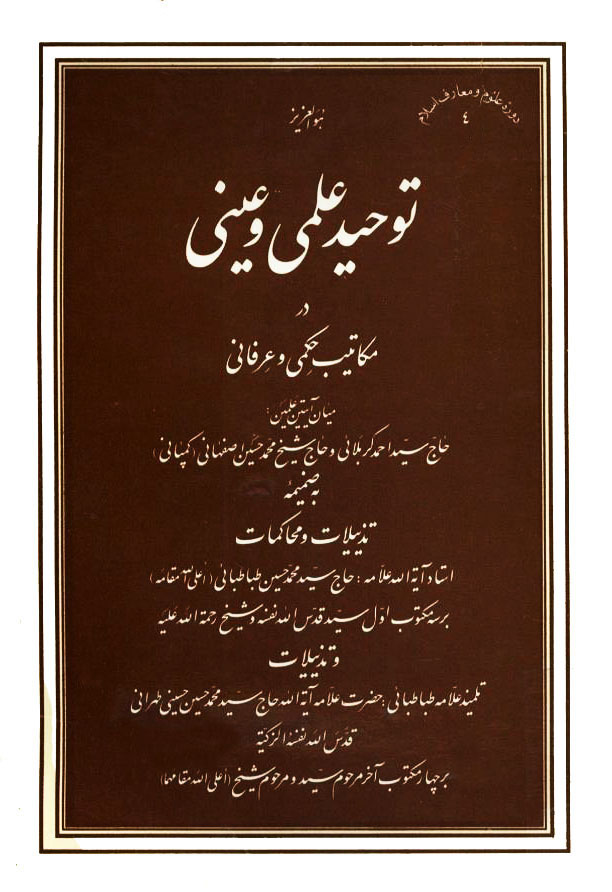
Fourth lecture by Ustad Soroush Mahallati on this treatise written by ʿAllamah Tabataba’i.
In the Name of God, the Most Compassionate, the Most Merciful
All praise belongs to God, Lord of the worlds. May God’s blessings be upon our Master and Prophet, Muhammad, and his Pure Family.
Our discussion concerned the correspondence that took place, in the recent century, between a philosopher and a gnostic. Shaykh Muhammad Husayn Isfahani represents the philosophers, while Sayyid Ahmad Karbala’i, in contrast to him, represents the gnostics, and ʿAllamah Tabataba’i has his arbitrations on these correspondences and discussions. Well, at the outset we discussed the first letter, which was from the late Isfahani, and then it was the turn of the appendix that the late ʿAllamah wrote on that first letter.
ʿAllamah’s appendix on this first letter is relatively lengthy, and in it he has entered into a foundational issue, because the essential disagreement in this discussion revolves around the relation between unity (waḥdat) and multiplicity (kathrat): whether unity governs the system of existence, or multiplicity governs it, or whether both unity and multiplicity are somehow intermixed within it. Although Muhaqqiq Isfahani, in his first letter, when explaining the limitedness of beings that gives rise to multiplicity, did not explicitly enter into the discussion of tashkīk (gradation) in existence, ʿAllamah nevertheless explained that Isfahani had, in fact, entered the discussion on the basis of two philosophical foundations: one is the principiality of existence (aṣālat al-wujūd), and the other is gradation in the levels of existence (tashkīk). And of course the theory of gradation is meant precisely to explain and justify multiplicity within the system of existence. For this reason, ʿAllamah concentrated the discussion on this very issue of tashkīk in existence.
Now, there is a point here that I must remind my dear friends of. The discussion of tashkīk in existence, within Transcendent Philosophy (al-Ḥikmah al-Mutaʿāliyah), has a long precedent. Sadr al-Mutaʾallihin pursued this discussion in his various works, and after him the followers of Sadra pursued it as well. From this, we cannot say that ʿAllamah Tabataba’i originated this theory. But in fairness, ʿAllamah’s own contribution to this issue should not be overlooked, because ʿAllamah Tabataba’i possesses precision and reflections on the matter of tashkīk that are not to be found in the works of his predecessors, and he attaches great importance to this issue of existence possessing levels — of course, with an interpretation of his own. In this first appendix to Isfahani’s letter, he pursues the matter with great precision and subtlety, and indeed he had already pursued this very topic in his earlier works, such as his marginal notes (ḥawāshī) on al-Asfār. We will, God willing, discuss the entirety of his material together, side by side.
But so that we may become more familiar with the atmosphere of this discussion, and thereby better grasp the late ʿAllamah’s views, I will, before turning to ʿAllamah’s appendix on the first letter, present a more general discussion of tashkīk from ʿAllamah’s own perspective.
In the first volume of al-Asfār, chapter five, page 45 — a chapter in which Sadra opens a discussion on how each existence becomes specified and distinguished from another existence — ʿAllamah has a marginal note. That particular note, however, is not the important one. There is another marginal note, at the end of the first volume of al-Asfār, which carries real weight, and both notes relate to the discussion of tashkīk. ʿAllamah made the discussion of tashkīk into a kind of corridor meant to bring us gradually into the world of unity, in such a way that, having passed through this corridor, we would feel no aversion toward the position that the people of gnosis hold when they speak of unity — a position that, at first glance, appears surprising and difficult to accept. But tashkīk is a corridor that gradually brings us into the world of unity, gradually dissolving multiplicities and thinning them out.
In this marginal note on page 45 of the first volume, he states the following: if the levels of existence are assumed to be arranged one above another, moving from a weak level to an intense one, and from the intense to the more intense, then every lower level, relative to what is above it, possesses a limitation. Now, pay close attention: when we speak of the limitedness of some share of a being’s existence, this arises from a comparison made between that being and a higher being — a comparison in which we see that a certain reality exists at the higher rank that does not exist at the lower rank, and this lower one is thereby faced with limitation, since it lacks some of the perfections present in the higher rank.
Consider, for instance, students studying across different grades: the higher the grade, the greater the level of knowledge. The student in the lower grade lacks some of the perfections possessed by the student in the higher grade, and it is this lack of certain existential perfections that we express by the word “limitation” (maḥdūdiyyah). But what, in the first place, is a limit (ḥadd)? At first glance, one imagines that some other thing is added onto an existential matter, thereby producing a limit for it — rather than recognizing that the existential matter is simply deficient in itself, relative to what is complete, and lacking relative to the higher level, and that this very lack is what generates the limit. In reality, our intellect abstracts the limit from precisely this comparison. So: when the lower is compared with the higher, we see a shortfall — we observe that the higher possesses things the lower does not. But what of the higher? If it too is compared with something above itself, it likewise turns out to have a shortfall and a lack. What exists at the third level does not exist at the second. Yet if this second level is considered without any regard to the third, then here no limit is abstracted at all — because a limit arises only from the lack of a higher level. We must therefore first suppose a higher level, in order to become aware of a lack, and only then abstract limitation from that lack.
Thus: the first level, being lower, when compared to the second level, is seen to lack some of the second level’s perfections, and is therefore limited. But if the second level is not compared with anything above itself, then only its possessions are seen — the perfection it has is what comes into view — while its lacks do not show themselves. And when its lacks do not show themselves, no limit is abstracted there. And when no limit is abstracted, what stands opposite is precisely absoluteness (iṭlāq). So we say: every lower level, relative to its higher level, possesses a limit; and conversely, every higher level, relative to its lower level, possesses absoluteness. And the higher these levels rise, the more their perfections increase — their share of existence grows greater, while, conversely, their aspects of deficiency and lack diminish. Existential absoluteness, existential breadth, existential expansion, and perfections all increase further and further, rising higher and higher, until a point is reached where perfection attains its uttermost degree and becomes infinite, such that no higher level can even be supposed. There, absoluteness becomes absolute in an unqualified sense. The lower levels possessed only relative absolutenesses, whereas there, absoluteness is absolute absoluteness, and no trace of a limit can be conceived at all — except that we say: the limit of that highest level is precisely that it has no limit. Its very limit is that it is limitless. Now, negating a limit is itself, in form, a negative act — but the negation of a negation (salb al-salb) amounts to affirmation. That is: it is pure reality, sheer and simple, nothing more.
The text of the late ʿAllamah’s note, on page 45 of volume one, reads:
“These levels, if assumed to be graded from the weak to the intense, and from the intense to the more intense, then every lower level would be limited relative to what is higher than it.”
Why is this so? “Because it lacks some of the perfection belonging to the higher [level], without the reverse being true” — meaning we cannot say that the higher level lacks some of the perfections of the lower level; that would contradict the very assumption that the higher includes the lower’s perfection as well as more.
So: the higher level possesses absoluteness — existential absoluteness, existential breadth — relative to the lower level, and it possesses the entirety of the lower level’s perfection. The lower and inferior level, meanwhile, possesses limitations relative to the higher: it has possessions and, compared with what stands above it, also has non-possessions. Bear in mind, however, that to say it “has non-possessions” is an abstracted expression (taʿbīr-i intizāʿī), not a claim that the non-possession itself has any real, positive referent.
“And [each] lower level would be limited relative to the higher, and every higher level would be limited relative to what is higher than it, and so on” — until where? — “until it terminates, on the ascending side, at an absolute level, unlimited” — that is, a level possessing no existential limit whatsoever, one that enjoys the ultimate degree of absoluteness. That highest of the high levels has no limit at all, because a limit arises only from comparison with something higher, and represents lack and non-possession. That highest of levels lacks nothing whatsoever — it is pure being; negation and affirmation cannot be combined there.
“And it has no limit except that it has no limit.” Its limit is that it has no limit; its definition is that it cannot be defined. It lacks no perfection at all; it is not composed of possession and lack; it is the very reality itself — sheer reality, pure perfection — except that it is considered under the aspect of bi-sharṭ lā (“with the exclusion of anything else”). Now let me recall the two considerations one can apply to that pure reality. If it is considered bi-sharṭ lā, this means the highest level stands opposed to the levels below it, as one level among levels — the highest, in relation to what is below it. But if it is considered lā bi-sharṭ (“unconditioned”), then that reality encompasses all the levels at once, and is not opposed to any other level. Keep this in mind, for it must be raised again later in its proper place: that the reality of being admits of two such considerations. One consideration is bi-sharṭ lā, whereby that reality stands opposed to these manifestations, opposed to these theophanies, such that it is other than them. And at other times, that same reality is considered as the reality that has spread the very canopy of being over all things and encompasses every existent — by that face of which it is said, “wherever you turn, there is His face” — where it stands opposed to nothing, being with everything and in everything. This is the reality considered under the aspect of lā bi-sharṭ.
ʿAllamah’s own words, at the close of this passage, read:
“And this is the meaning of their statement that it has no limit except that it has no limit.” Its limit is that it has no limit; its definition is that it is indefinable; it lacks no perfection whatsoever; it is not composed of possession and lack; it is the very reality itself — pure reality, sheer perfection — except that it is considered under the aspect of bi-sharṭ lā. And the pure reality, so considered under bi-sharṭ lā, is [treated as] one level standing opposed to the levels below it — for it is [in that consideration] one among the levels. This is so, of course, only if that same one reality is considered bi-sharṭ lā; but if it is instead considered lā bi-sharṭ, then it encompasses all the levels together at once. That reality is then not restricted to the first level, or the second, third, or fourth — it is a reality that encompasses and includes every level, “and would not be a level standing opposed to the other levels.”
This, in summary, is the discussion of tashkīk among the levels that the late ʿAllamah, may God’s good pleasure rest upon him, presented here.
As for the second passage where ʿAllamah takes up this discussion — and all of this, remember, is merely an introduction meant to give us a better grasp of unity and multiplicity within the system of existence — it occurs in this same first volume of al-Asfār, on page 432. There he states:
“And among what must be known is that the well-known tashkīk — namely, tashkīk by excellence (tashkīk bi’l-faḍl) — is realized only by assuming an instance, among the instances of a given reality, that comprises, of that reality’s perfection, what another instance lacks.”
That is: every instance that has a share of existence possesses a perfection, a portion of the reality, that some other instance of existence lacks; and when we compare these instances with one another across the different levels, we must bear in mind — as we said in the previous session — that the reality of existence is a simple matter. This reality is simple; every instance is the reality of existence, simply so. One cannot say that composition exists within it, because if you claimed there were composition, the composing element would have to fall outside the essential reality of existence, and would be something else — but what could that “something else” possibly be? What, other than the reality of existence, could stand as a part alongside the reality of existence? Is there anything else at all? No, there is not.
After making this point, ʿAllamah continues: “Rather, that entails, firstly… secondly… thirdly… and fourthly…” — these being the corollaries he derives here from this foundation of tashkīk.
The first point he draws as a conclusion is this: when we consider two instances of one reality together, the strong and intense instance possesses everything the weak instance possesses, without the reverse being true — that is, the weak level does not possess everything the strong level possesses. And so, within this system of being, as we ascend — higher, and higher, and higher still — beings continually gain in perfection along this course, rising, expanding in being, gaining in absoluteness, until a point is reached where nothing higher can even be supposed, and that highest level, the highest of all levels, possesses the entire perfection of every level below it. The perfections of the lower levels were always accompanied by deficiency, by lack, by limit; there, at the highest level, this is not so — there is only perfection itself, pure and simple.
He states: “Firstly, that one of the two instances — the intense one — is inclusive [of the qualities of the other], while the other, the weak one, is not, without the reverse being true.”
This is the first point. A second matter is then raised here, concerning “relation” (iḍāfah): we compare the lower level with the higher, and the higher with the lower. This relation is an existential relation, meaning the lower level is, so to speak, an existential effusion of the higher level — not a categorial relation, the kind of relation that belongs among the Aristotelian categories. That latter kind pertains to quiddities. In general, the divisions made among the categories — substance, accident, and the rest — are divisions within quiddity; whereas the relation under discussion here is an existential relation, not a quidditative one.
“And secondly: that the weak level, in its very essence, is related and compared to the intense level, and this is in no way a categorial relation, for that belongs to the genus of quiddities.”
As for the third point, it is this: the intellect abstracts, from every weak level, the lack — the non-existence — of the higher level. It is not that this weak level is, in reality, composed of existence and non-existence, of possessions and non-possessions. It possesses what it possesses; but once these possessions turn out to be limited possessions — meaning it necessarily lacks certain things — the intellect then abstracts, from this very shortfall in its possessions, the notion that it lacks the higher level. Existence and non-existence, after all, cannot really be combined with one another.
“And thirdly: the intellect’s abstraction, from the weak level, of the non-existence — the absence — of the perfection of the intense level, even though the existential reality, in its very essence, repels non-existence.”
There is also a fourth point, but it does not concern our present discussion.
Now, the late ʿAllamah Tabataba’i, in this first appendix to the letter of his esteemed teacher Isfahani, has set out these very points in a list-like and extremely condensed manner. And how I wish that what the late Martyr Mutahhari did for the text of Uṣūl al-Falsafah wa Rawish-i Riʾālīsm — adding his own footnotes to explain and expand upon that terse philosophical text of ʿAllamah Tabataba’i — had likewise been done for this text. Why do I say this? Because the brevity, concision, and terseness of ʿAllamah Tabataba’i’s appendices far exceeds that of the text of Uṣūl al-Falsafah. Here he has stated his points in a far more compressed, telegraphic manner, and the text is in real need of further explanation and elaboration. A great scholar and thinker such as Martyr Mutahhari would truly be needed to properly explicate this text and resolve its condensed ambiguities. For now, we are reading it only to the extent our own modest capacity allows.
We had reached the following point in our previous discussion: ʿAllamah states that, yes, beings possess an existential limit within the graded levels — and from here it becomes clear… I mentioned in the previous session that he draws eight conclusions in the course of this discussion. These eight conclusions fall into two groups. The first group consists of four conclusions and corollaries drawn from the discussion of the existential limit found in beings across the graded levels — these are the first four. The next four conclusions and corollaries concern the quiddative limit (ḥadd māhawī). First he discusses the existential limit; then he discusses what the quiddative limit actually is. This is because, as you will recall, in the text of his first letter, the late Muhaqqiq Isfahani had proposed that we possess existential limits, quiddative limits, and privative limits (ḥudūd ʿadamiyyah) — a threefold division regarding limits. ʿAllamah takes up the existential limits, which relate to this very discussion of tashkīk; he takes up the quiddative limits, which we do not have the opportunity to enter into today; and he later points out that the third category, the privative limits, is mistaken, and that we possess nothing beyond these two kinds of limit that could be called a privative one.
Since the existential limits — that is, the limitations found within the being of existents — form the very foundation of the discussion of tashkīk, ʿAllamah draws out several points from them.
The first point, the first corollary he draws, is this: what does the expression “existential limit” actually mean? An existential limit expresses a privative aspect within the very depth of existence. That is: this being is situated at a particular level — for existence has graded levels, say, level two, lying between level one and level three. Is what is situated at level two an instance of existence, or is it not? Yes — it possesses a share of being, a share of realization; it is a reality; it is, therefore, an instance of existence. This much is a genuine fact. But because this existence, situated between level one and level three, possesses the perfection of level one while lacking the perfection of level three, can we then say that this level two is an instance of non-existence? What could it even mean to call it “an instance of non-existence”? It is an instance of existence — but what would it mean for it to be an instance of non-existence? The point is this: given the limitation it possesses, just as it is endowed with certain perfections, it is also deprived of certain perfections. Indeed, whatever possesses reality is an instance of existence, not an instance of non-existence — a thing cannot be simultaneously an instance of existence and an instance of non-existence. But it is a limited instance of existence. And once an instance of existence is recognized as limited, the intellect abstracts from this the further notion that it is also, in a sense, an instance of certain non-possessions: just as it possesses certain things, it also lacks certain things — and this is purely an abstraction of the intellect.
This is the first point. And from here it becomes clear that the existential limit is a privative aspect within existence — meaning that, just as the intellect finds the lower level to be an instance of existence, it likewise regards it as, in a certain sense, an instance of non-existence, even though, in external reality, nothing exists there but existence as the sole instance.
As for the next point, the second: just as we read in the marginal note on al-Asfār, ʿAllamah explained there that a higher level possesses no limit relative to a lower one, because a limit arises only from lacks — and one becomes aware of a lack only by directly perceiving something higher, by seeing that the higher possesses something the lower does not. So: whenever we consider a level of existence in relation to something higher than it, a limit comes into view — a lack, a shortfall, a deficiency. And whenever we consider the higher level only in relation to what lies below it, no limit comes into view at all; no shortfall, no deficiency, no lack is noticed. Hence their second conclusion: from here it becomes clear that a higher level has no limit relative to a lower one, even though it may indeed have a limit relative to something above it. That is: in the realm of actual reality (maqām-i thubūt), since there truly is a level higher than it, and above that one a level higher still, then, in the realm of reality, all of these levels do possess limits. But if the lack is not brought into consideration, the intellect naturally abstracts no limit at all — for every such abstraction proceeds strictly from the side of the intellect, which simply beholds the given measure of existence present before it, and nothing beyond.
As for the third conclusion, the third point: the higher level possesses that very shared reality common to both the higher and the lower — the level of the reality shared among all the levels of existence exists in it. Yet, in this state, it does not carry the restrictions of the lower level; it possesses the perfection itself, but since that perfection, at the lower level, comes bound up with lacks, the higher level does not necessarily carry those lacks along with it. We therefore negate that limit from the higher level; and this very negation of a negation becomes — what? Affirmation. And by this route we arrive at that highest stage, which is pure existence, one for which no limit whatsoever can be conceived.
From here it becomes clear that the higher level is nothing other than the very reality shared between the higher and the lower, and that the limit which appears to attach to it, when its status as a level is preserved, is simply that shared reality itself. But then what is the limit belonging to the higher level as such? Given that it is higher, the limit considered for it is simply that it is not the lower level — meaning it does not carry the lack of perfection, the aforementioned absence; it does not have those lower limitations. And since the negation of a negation is an affirmation, we negate this non-existence from it: it does not lack; it is not deprived of the shortfalls. What does this mean? It means we are thereby affirming its possessions. Since negation of negation amounts to affirmation, the meaning of the expression is this: the higher level is pure and sheer existence, considered without regard to the lower level — so that its limit, if it has one at all, would be precisely the absence of a limit.
As for the fourth and final point in this section: that higher level, which possesses absoluteness — if we suppose something higher still above it, its absoluteness carries on rising, until it reaches a point where the absoluteness is pure and unqualified, and it is there, if anywhere, that Oneness (aḥadiyyah) occurs. From here it becomes clear that the highest of all levels — the highest among the levels of existence and being, the level that is the highest level — is the highest degree of absoluteness. For the levels below it also possessed a certain absoluteness, but theirs was a relative absoluteness: absolute only in relation to what lay beneath them, while a level above them could still be supposed, relative to which they would no longer be absolute. But that level which is, in truth, the highest, is the highest degree of absoluteness — the level above which no further level can be supposed, meaning it is the existence of the totality of perfections; the existence of this very perfection is the highest degree of absoluteness, having no limit but this: that it has no limit. If we may express it so — that having no limit is itself its limit — this expression is, of course, a loose one, and what is truly meant is that it is pure existence, sheer and unmixed reality, which is none other than the Oneness of the Essence.
These are the four points that the late ʿAllamah has here set out with the utmost brevity, drawn as conclusions from the discussion of tashkīk as it applies to existence. Now, God willing, in our next session we must take up the discussion of the quiddative limit, and compare what distinguishes the existential limit from the quiddative limit — for these beings, all of them, possess quiddative limits as well. What, then, is a quiddative limit?
May God send blessings and peace upon our master and prophet, Muhammad, and his pure family.