
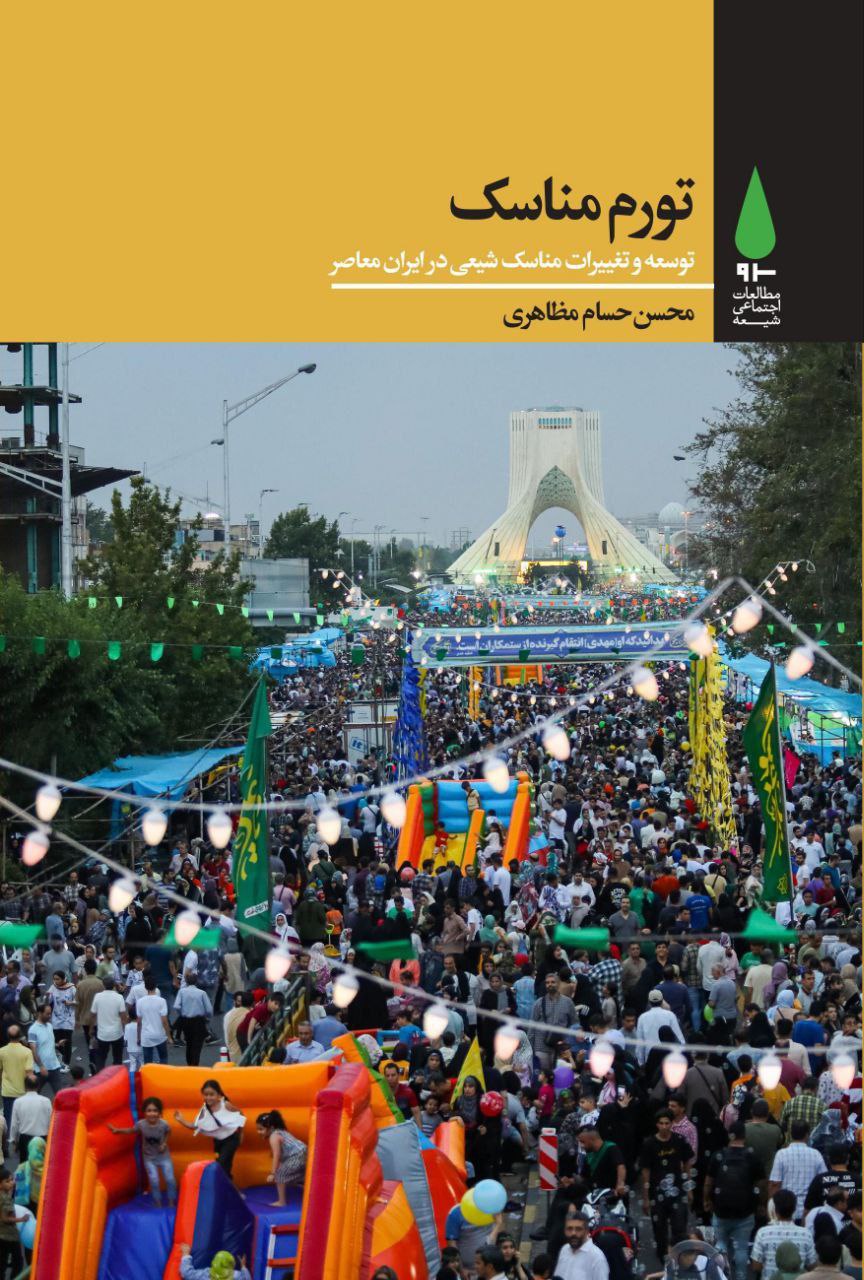
Mohsen Hesam Mazaheri is an Iranian sociologist who has been pursuing a long-term research program on the study of Shi‘i rituals. Recently, he has published a new book called Ritual Inflation (Tavarrum-e Manāsik – تورم مناسک), an example of his precise conceptualization emerging from a sustained, long-term research program. Previously I have published some of Mazaheri’s articles (here, here and here) before. In one of The Dictations videos, I also showcased a series of books he wrote on the history of Muharram lectures in Iran over the last century (see timestamp here). Below is a synopsis of the book Ritual Inflation by the author himself:
Ritual Inflation is a compelling and research-based book that is the result of years of study and reflection by Mohsen Hesam Mazaheri on Shi‘i rituals and ceremonies. In this work, the author seeks—through an analytical and sociological lens—to examine the phenomenon of the expansion and proliferation of religious rituals and to explore its cultural, historical, and social dimensions.
This book deserves to be discussed, debated, and critically examined in academic and scholarly circles. The issue it raises is not confined merely to the field of religious studies; rather, it is directly connected to cultural policymaking, social transformations, and the future of religious life in society.
Moreover, the attention of cultural policymakers to the findings and analyses presented in this work could contribute to more thoughtful decision-making in the management of religious rituals and the strengthening of their cultural and social functions. Undoubtedly, critical dialogue surrounding this book can help advance the research literature in ritual studies and foster a more precise understanding of the relationship between religion and society in contemporary Iran.
Below, I am sharing a translation of Mazaheri’s recent post explaining a bit more context regarding the book along with the breakdown of it, that may benefit the readers:
🔸 A Book Not Only About Rituals — But About Iran 🔸
“Ritual hypertrophy” and later “ritual inflation” are terms I coined to describe and analyze certain trends in the transformation of religiosity in contemporary Iran. For more than a decade, I have used these concepts in my writings and lectures on the subject.
The reception of these terms — which at times was accompanied by incomplete or even incorrect interpretations — motivated me to write a book aimed at systematically formulating this concept. In fact, the book Ritual Inflation (along with another book that contains theoretical discussions on the concept of ritual and Shi‘i identity politics, which was banned) is the outcome of more than two decades of study and reflection on rituals and ceremonial practices.
The writing of this book was completed in the winter of 2023 (1402 SH). After several months of delay during review by the Ministry of Culture and Islamic Guidance, it was ultimately banned. Following extensive follow-up, negotiations, and the cooperation of some senior officials (particularly within the Cultural Deputy), and after accepting numerous deletions, the ban was eventually lifted after several months.
Structure of the Book
The book is organized into eight chapters:
Chapter 1 examines the nature of rituals, their typology, and their place within Islamic and Shi‘i culture.
Chapter 2 presents available statistical data regarding the state of rituals in Iran — from official recorded data to estimated figures from national surveys. In this chapter, I have attempted to compile and synthesize all credible statistical data available in prior sources, documents, and studies.
Chapter 3 addresses the causes and contexts of ritual inflation. At the outset, I explain that this phenomenon is not monocausal; rather, it is the product of a convergence of multiple factors, grouped into four main categories:
Social factors: urbanization, changes in urban fabric, youth population waves, and increased social presence of women.
Political factors: the fall of Saddam, expansion of political rituals, the emergence of ISIS, and regional rivalry with Saudi Arabia.
Media factors: satellite television, the spread of smartphones, and the rise of social media.
Religious factors: multiplicity of religious authorities (marājiʿ), expansion of Shi‘i sacred sites, competition among Shi‘i currents, growth of eulogists (maddāḥs), elevation of their status, and the transformation of rituals into a cultural industry.
Chapters 4 and 5 list major instances of the growth and expansion of rituals in contemporary Iran, providing brief historical backgrounds for each — from newly emerging rituals to newly institutionalized commemorative occasions.
Chapter 6 examines broader trends in ritual inflation, including:
The decline of Islamic rituals,
The conceptual expansion of ritual space,
Feminization,
“Arbaeen-ization,”
Quantification and massification,
Celebrity-centeredness,
Leisure-ization and touristic transformation.
Chapter 7 explores the most significant consequences of ritual inflation, which I argue include:
Intensification of identity (sectarian) competition,
Functional disruption of rituals,
Disruption of everyday life,
Secularization of rituals,
Massification of society,
Polarization of religion.
Finally, the concluding chapter argues that the rapid expansion of rituals in contemporary Iran has not been limited to religious ceremonies. In a more limited sphere, it has also included secular, national (Iranian), and imported rituals — such as the expansion of Yalda celebrations or the spread of events like Black Friday and Valentine’s Day.
I describe this condition as a “clash of identities” and the “ritualization of Iranian society,” and I attempt to analyze its social implications.
Beyond Religion: A Study of Iranian Society
Thus, Ritual Inflation is not merely a study of a religious category, but more broadly an inquiry into Iran and Iranian society itself. As I explain in the final chapters, my main motivation for addressing this issue concerns the social consequences and risks that the unchecked expansion of Shi‘i rituals poses — both for society and for the religious institution itself.
Regrettably, the book’s publication coincided with the very situation I had warned about: the deepening of identity fractures in society, instability in the position of religion, and intensifying polarization — in which the role of religious forces and institutions cannot be denied.
I do not know where the rapid and extensive transformations we are currently experiencing will lead. Nor do I know to what extent books like this can be beneficial and not resemble “a remedy after Sohrab’s death.” Yet I hope that the trajectory of change will ultimately move toward the preservation, resilience, and flourishing of Iranian society.
It appears that we stand at the threshold of a new chapter in the life of the religious institution within Iranian society. Perhaps in this new phase of reconfiguration, raising and reflecting upon the kinds of questions addressed in this book may prove meaningful.

Sayyid Ali studied in the seminary of Qom from 2012 to 2021, while also concurrently obtaining a M.A in Islamic Studies from the Islamic College of London in 2018. In the seminary he engaged in the study of legal theory, jurisprudence and philosophy, eventually attending the advanced kharij of Usul and Fiqh in 2018. He completed his Masters of Education at the University of Toronto in 2025 and is the head of a private faith-based school in Toronto, as well as an instructor at the Mufid Seminary.
