
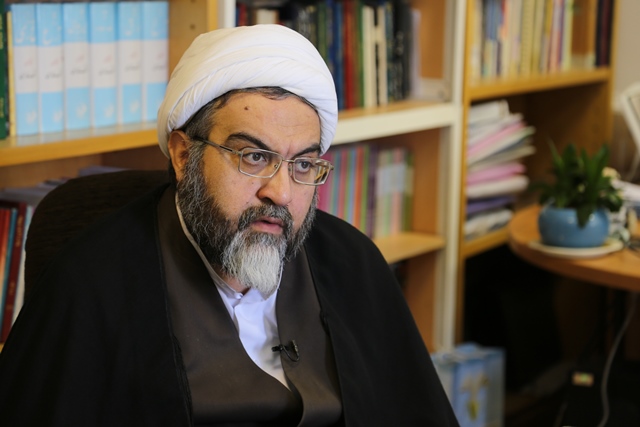
By Ustad Muhammad Taqi Sobhani | Translated by Sayyid Ali Imran
Teachings of Tawhid — Lesson 1
The Importance of the Discussion of Tawhid
The discussion of Tawhid from the perspective of the Noble Qur’an and the Sunnah of the Ahl al-Bayt (a) occupies a special place. To clarify the importance of this subject, reference is made to a sermon of Amir al-Mu’minin (a), in which he states:
“The beginning of religion is knowing Him, and the perfection of knowing Him is affirming Him, and the perfection of affirming Him is professing His Oneness, and the perfection of professing His Oneness is sincerity (ikhlas) toward Him, and the perfection of sincerity toward Him is negating the attributes from Him, for every attribute testifies that it is other than that which is described, and every describer (of Him) is coupled (with what is described)… Whoever attributes qualities to Allah has coupled Him (with something else), and whoever couples Him has made Him two, and whoever makes Him two has divided Him into parts, and whoever divides Him into parts is ignorant of Him, and whoever is ignorant of Him has pointed at Him, and whoever points at Him has bound Him with limits, and whoever bounds Him has numbered Him…” (Nahj al-Balagha, ed. Subhi al-Salih, p. 39)
In this sermon, Amir al-Mu’minin (a) states that the beginning of religion is knowing God. The perfection of knowing God consists in the summit and pinnacle of affirmation, which is Tawhid. Tawhid itself has degrees, the highest of which is sincerity (ikhlas). Sincerity,1 too, has degrees, the most perfect of which is the negation of attributes from God the Exalted, because an attribute is other than the described, and everything that has attributes is other than what is attribute-less.
Likewise, in accordance with the command of the Noble Prophet (p), who said: “Say: there is no god but Allah, and you will be successful”2 (that is, say that there is no object of worship other than Allah, so that you may attain salvation), this speech points to the importance of Tawhid as the foundation of religious knowledge. Without knowledge (ma’rifah), no religious knowledge takes shape; without Tawhid, no act or moral system results in salvation. All divine truths and the whole of religious life return to the subject of Tawhid, and the exposition of the Ahl al-Bayt (a) in this domain is incomparable and unparalleled.
Tawhid in the Teachings of the Qur’an and the Sunnah
What is meant here is the Tawhid that is presented by the Qur’an and expressed in the words of the Infallibles (a). The goal is to explain the system of tawhidic knowledge based on the statements of the Ahl al-Bayt (a). In this regard, the first question that arises is this: can Tawhid be known solely through the path of revelation (wahi)? Some raise the objection that knowing Tawhid solely through the Qur’an entails “circularity” (dawr). In order to answer this question, one must first examine the sources of tawhidic knowledge, so as to show that true knowledge of Tawhid must be obtained through revelation, and that this is not the only path — nor is that path itself problematic.
Epistemology of Tawhidic Knowledge
In epistemology, the discussion focuses on explaining the method of Tawhid. The main question here is: how can one attain the divine truths? In answering this question, we must say — based on the soundest and most precise view, and after a lengthy historical dispute — that four approaches have been proposed. Among these, three of the most well-known approaches will be discussed below, followed by an examination of the way of the prophets.
1. The Rationalists
Philosophers and many thinkers hold that reason (‘aql) alone is the path to intellectual and revelatory knowledge. In this view, reason is not merely a necessary source but is regarded as the only credible source. The argument of this group is that using any other source alongside revelation entails “circularity” (dawr). They also consider intuition (shuhud) unreliable, on the grounds that it is a personal matter, lacks intersubjective verifiability (i.e., is not common among minds), and is prone to error. Therefore, reason is introduced as the only source relied upon, since it is a matter shared among all minds.
2. The Intuitionists
This group holds that reason is insufficient for grasping tawhidic truths, because divine truths surpass the capacity of the intellect. They say that God has placed in human beings a faculty called the heart, or intuition (shuhud), through which divine truths can be discovered. The intuitionists believe that unveiling (kashf) the divine truths is possible through witnessing (shuhud) — the same intuition (shuhud) they claim is a path superior to theorization.
3. The Traditionists / Textualists
The traditionists (hadith-followers) believe that no human faculty can attain divine truths; the only way is that God Himself introduces Himself through the path of revelation and the prophets. Without divine self-introduction, no one can gain access to these truths.
The School Method of the Divine Prophets
The question that arises is: which of these methods has been accepted in the school of the prophets? Or is it a combination of them that is endorsed? In answering this, we say that in the school of the divine prophets, all three sources operate together in a complementary manner. Without the presence of these three sources alongside one another, correct tawhidic knowledge is not possible. The fundamental flaws of the purely human methods are their one-dimensionality: some accept only reason and set aside revelation and fitrah (innate nature); others rely only on shuhud (intuition) or place exclusive emphasis on revelation. In the Noble Qur’an, and in the practice of the prophets and the Shi’a scholars, three sources are found at the root of the text for grasping tawhidic knowledge, explained as follows:
- Reason (‘aql)
- Innate nature (fitrah): an innate and God-given knowledge that is sometimes expressed as “the heart,” and differs from the erroneous Sufi conception of shuhud.
- Revelation (wahi): knowledge that is conveyed to human beings through the prophets and Imams (a).
These three sources of knowledge are all necessary and complement one another; without any one of them, the epistemology of Tawhid would be deficient.
The Presence of These Sources in the Verses and Narrations
a) Reason in the Verses and Narrations
In numerous places, the Noble Qur’an introduces reason as a means of knowing God. In the Qur’an, God has pointed to a general rule concerning the general basis of knowledge and has stated the general foundation of knowledge (and likewise the knowledge of God) to rest upon reason:
1. Surah al-Nahl, verse 78
“And Allah has brought you out from the wombs of your mothers not knowing anything, and He made for you hearing, and sight, and hearts (af’idah), that you may give thanks.”
In this verse, God states that a human being, at birth, knows nothing, and that God has given him three instruments — hearing, sight, and the heart (fu’ad) — through which he may attain knowledge. Reason (‘aql) is discussed in detail in works of epistemology, and from the Qur’anic perspective, reason is the fu’ad, since hearing and sight, too, serve the fu’ad. What is meant by fu’ad in the Qur’an is that faculty which perceives realities beyond mere sense-objects, that which perceives beyond sensory data. Indeed, it has come in the Noble Qur’an that even the vision of the Prophet (p) and his perception of the realities beyond, occurred by means of the fu’ad. In verse 11 of Surah al-Najm we read: “The heart did not lie about what it saw.”
2. Surah al-Isra’, verse 36
“And do not follow that of which you have no knowledge. Indeed, the hearing, the sight, and the heart (fu’ad) — about all of these you will be questioned.”
This verse likewise introduces hearing, sight, and the fu’ad as instruments of knowledge and stresses that outside these three instruments, nothing is regarded as reliable relative to our sources of knowledge; this raises an epistemological question that will be addressed later.
Likewise, verses in which it is stated, “that you may reflect (tatafakkarun)” and “that you may reason (ta’qilun),” emphasize the role of reason in knowledge. The Ahl al-Bayt (a) too, in the narrations, have emphasized the role and scope of reason in knowing God with precision. Therefore, there is no doubt that reason is one of the sources and foundations of true knowledge of God (ma’rifat Allah) in the school of the Ahl al-Bayt (a).
This view stands opposed to a strand of Christian thinking — especially influenced by Paul (who was under the influence of Greek ideas) — as its source, which promoted and held the principle of fideism, believing that faith takes precedence over rational understanding. In contrast, the Qur’anic school emphasizes that one must first know God with reason and only then affirm and believe in Him. The clear example of this approach is the rational argument of the Prophet Abraham as the father of the monotheists. Therefore, it is not correct that our school considers reason to be at odds with knowledge. Hence, those enlightened intellectuals who come along and, relying on a few verses or Mu’tazilite-influenced doubts, attempt to attribute fideism to Islam and reduce reflection on the Qur’an and the Ahl al-Bayt in the field of tawhidic knowledge to a matter of custom (though this requires further explanation, which will be addressed in future sessions).
b) Innate Nature (Fitrah) in the Verses and Narrations
The Noble Qur’an, in the field of tawhidic knowledge, does not confine itself to reason alone and emphasizes that God has placed an innate knowledge (ma’rifat-i fitri) in the deepest layers of human existence. This knowledge has been mixed together with the creation of the human being and forms the basis of the knowledge of God — provided this fitrah is not covered over as an obstacle to a genuine (true) knowledge does not occur. The verse below points to this subject:
Surah al-Rum, verse 30
“So direct your face toward the religion, inclining to truth (hanifan). [This is] the innate nature (fitrah) of Allah upon which He has created mankind. No change should there be in the creation of Allah. That is the correct religion, but most of the people do not know.”
In this noble verse, there are several key points:
- Establishing “the face” toward religion is contingent upon divine fitrah. If one desires religion and piety, one must establish one’s face toward the religion of hanif.
- The religion of hanif (a special kind of creation) is that which God has created and made; there is no room for acquisition or artificiality in it.
- All of humankind has been created with this particular creation — not only a specific group of believers.
- Fitrah is of a kind of creation that does not change with anything.
Likewise, we find in the narrations that this fitrah brings about a deep heartfelt knowledge of God the Exalted. The narrations of the Ahl al-Bayt (a) clarify that if this fitrah did not exist, the knowledge of God would not occur even in a precise and personal sense.
So, in summary, it must be said that in this verse God states that true religiosity relates back to fitrah. Fitrah is a particular kind of creation that all human beings have been created upon based on it. This fitrah is unchangeable and is not under the influence of desires or environment. Religion in its correct form (qayyim) is the same as fitri religion, which most people are unaware of. The narrations of the Ahl al-Bayt (a) also emphasize that knowledge of God without fitrah is impossible. It has come in a narration: “Were it not for that, no one would know who his Creator and Sustainer is”² (that is, were there no fitrah, no one would know his Creator).3
So, it must be said that fitrah, too, is one path to arriving at the knowledge of the Exalted God, and it is not the case that this is the only path there is. Rather, from the perspective of the school of the Ahl al-Bayt (a), this path is necessary — indeed, even if fitri knowledge were absent, the path of reason alone would not bring us to knowledge of the Exalted God.
Differences Between Fitrah and Reason
Fitrah and reason have differences that may be summarized as follows:
1. The Necessity (Idtirar) of Fitrah versus the Acquired Nature (Iktisab) of Reason
Fitral knowledge is God-given and necessary (idtirari), whereas reason requires acquisition (iktisab) and effort. The narrations emphasize that rational knowledge is obtained through the pursuit of proofs and does not take shape passively. The essence of fitri knowledge is necessary, God-created, and even its awakening is within the hand of God — although it is correct that a set of preliminaries must be gone through by means of it, its knowledge is achieved through us, though it is not within our choice.
2. The Universal Nature of Rational Knowledge versus the Particular Nature of Fitri Knowledge
Rational knowledge leads to universal knowledge of God, whereas fitri knowledge is a personal encounter with God.
A comparable example is given: it is as though someone speaks to us of a particular person, saying that there is a scholar in a certain field who is very ethical, very well-versed in lessons, and so on… and we form a picture of these matters here. But suppose you personally take that person’s hand, and this scholar takes you to that place with him, and speaks with you, and you establish a connection, and know all the particulars of his character that this scholar had spoken of, and see them all with your own eyes. It is said, in this case, that you have gained a particular (personal) knowledge.
3. Mental Affirmation in Rational Proof versus Immediate Presential Consciousness in Fitrah
In rational knowledge, affirmation of God occurs through argumentation, whereas in fitri knowledge, the presence of God is realized through experience and immediate awareness (wijdan). A rational proof differs from a fitri consciousness.
The conclusion we reach here is that the path of fitrah is other than the path of reason, and each is a path in itself; in the divine school, both must be present, and the absence of either of these two causes deficiency in the matter of tawhidic knowledge. We will now go on to say that alongside these two, there must necessarily exist another source, and that this is revelation and the divine guide (wali).
c) Revelation (Wahi) in the Verses and Narrations
Revelation is the third source of tawhidic knowledge. The Noble Qur’an has explained the role of the prophets in guiding people. For example:
Surah al-Hadid, verse 25
“We have already sent Our messengers with clear evidence and sent down with them the Scripture and the balance that the people may maintain [their affairs] in justice. And We sent down iron, wherein is great military might and benefits for the people, and so that Allah may make evident those who support Him and His messengers unseen. Indeed, Allah is Powerful and Exalted in Might.”
Surah al-Ahzab, verse 45
“O Prophet, indeed We have sent you as a witness and a bringer of good tidings and a warner.”
Surah al-Nisa, verse 165
“[We sent] messengers as bringers of good tidings and warners, so that mankind will have no argument against Allah after the messengers.”
The verses state that among the most important aspects of the function of the prophets is teaching and purification (tazkiyah), and that teaching divine knowledge is one of its most important dimensions. This is a false assumption that revelation is limited to rules alone, since revelation is limited. Some mistakenly assume that ethics is sufficient with reason, and that divine knowledge is attainable through reason or intuition and does not need revelation. This view has two problems:
1. The Demotion of the Station of the Prophets
Limiting the role of the prophets and their most important task (teaching divine knowledge) reduces them to the level of transmitters of rules. By way of expression, the school of the prophets — which has come for the sake of felicity and growth — is demoted to matters of rules.
2. Inconsistency with the Biography and History of the Prophets
The Qur’anic and historical reports show that the main claim of the prophets centered on knowledge of God and monotheism, not merely rules. If the biography of the prophets is examined, it becomes clear that the most fundamental struggles of the prophets with the disbelievers were on matters of epistemic importance.
The Role of the Prophets in Tawhidic Knowledge
A question may arise: can a prophet, whose own prophethood has not yet been established, prove the existence of God? Does this not lead to circularity (dawr)? In answering this, it must be said: no, this does not occur, because the role of the prophets in the tawhidic teachings is explicable in three respects:
The role of the prophets in explaining tawhidic teachings is examinable in three respects:
1. The Role of Alerting and Reminding
The prophets awaken reason and fitrah and remove obstacles (such as desires) from the path of reason and fitrah. On this basis, the prophet has no role here that would lead to circularity (dawr) and invalidity.
Amir al-Mu’minin (a) states regarding this:
“…and He sent among them messengers, and sent them successively to them, that they might ask them to fulfill the covenant of [their] fitrah, and remind them of the forgotten blessing upon them, and argue with them by preaching, and unveil for them the buried treasures of the intellects…” (Nahj al-Balagha, ed. Subhi al-Salih, p. 43)4
According to this narration, there are two purposes for which the prophets have come:
a) to ask [people] to fulfill the covenant of the fitrah (reminding of the innate covenant of the human being with God, and to seek that knowledge in this world);
b) to unveil and bring forth the buried treasures of reason.
In this first role, the prophets are reminders and alerters, not that they hold an authoritative (ta’abbudi) role in this respect; rather, they work with human beings so as to bring them back to their fitrah and elevated rational perceptions.
2. The Explanatory Role
The prophets explain in a detailed manner the truths that reason has grasped in a general way (such as certain divine attributes and acts). Reason and fitrah affirm this explanation.
3. The Instructive/Teaching Role
Some divine teachings are outside the reach of reason and fitrah. The prophets, after belief in prophethood, teach these teachings.
In summary, it can be said that reason is necessary but not sufficient. Fitrah is necessary but also not fully sufficient. Each of these is necessary, but human beings also need a third element, which is the prophets and the divine friends (awliya), who come and introduce the tawhidic truths with alerting, explanation, and teaching.
Narrational Evidence Concerning the Interconnected Authority of Reason and Revelation
An example of this set of narrations is a lengthy narration in al-Kafi, from the blessed person of Imam Musa al-Kazim (a), addressed to Hisham, in which he states:
“…O Hisham, Allah has appointed for the people two proofs: an outward proof and an inward proof. As for the outward [proof], it consists of the messengers, the prophets, and the Imams (a); and as for the inward [proof], it is the intellects.” (al-Kafi, vol. 1, p. 16)
God has two complementary proofs (hujjah) over people: an outward proof (messengers, prophets, and Imams) and an inward proof (reason). In this same narration, in another passage, it is stated:
“…O Hisham, the establishment of reason for obedience to Allah — there is no salvation except through obedience — and there is no obedience except with knowledge, and there is no knowledge except with learning, and there is no learning except through ‘the learning of reason’ (ta’allum), and reason is only recognized through one who is a divine scholar (rabbani), and the recognition of knowledge is [only] through reason…” (ibid.)
In the terminology of this narration, “a divine scholar (alim rabbani)” refers to the Ahl al-Bayt (a). This narration then refers back individuals to the Ahl al-Bayt (a) and reason, and it says that only through the Ahl al-Bayt (a) is knowledge obtained, and reason [only] with them. So this narration, too, emphasizes revelation together with reason.
Another narration in this same book is from the blessed person of Imam Sadiq (a) [which is based on explanation], which is explained clearly regarding the relationship between reason and revelation:
“Ali ibn Muhammad ibn Sahl ibn Ziyad — from Muhammad ibn Sulayman — from Ali ibn Ibrahim ibn Abdullah ibn Sinan — from his father — from Abu Abdillah (a), who said: ‘Allah’s proof over His servants is the Prophet, and the proof between the servants and Allah is reason.'” (al-Kafi, vol. 1, p. 25)
The proof of God over His servants is the prophet, and the proof between the servants and God is reason. This narration also states that reason without revelation, or revelation without reason, does not lead a human being to the goal.
Shaykh al-Mufid, too, has emphasized that the Mu’tazilites consider reason alone to be sufficient, whereas the Shi’a hold that reason without revelation is insufficient and requires revelatory guidance. The statement of Shaykh al-Mufid is as follows:
“And the Imamiyyah are agreed that the intellect, in its knowledge and its conclusions, is dependent on, and never separated from, transmitted [revealed] knowledge (sam’), and that it does not alert the rational person to the manner of inference, nor does the beginning of the moral obligation (taklif) in the world occur without a messenger from among the prophets. And in this, the companions of hadith concur with them, and the entirety of the Mu’tazilah, the Khawarij, and the Zaydiyyah oppose this, and hold the contrary of it, claiming that intellects operate merely by transmission (sam’) and by [divine] cessation (tawqif), except that the Baghdadi Mu’tazilites in particular hold that intellects obligate the [religious] duty at the very outset of taklif, and they oppose the Imamiyyah on this and dispute over its correctness, and attach it to their doctrines and description it therein.” (Awa’il al-Maqalat, p. 44)
This is a unique and distinguished method, exclusive among all Islamic schools, that on the basis of what has been stated in the teachings of the Ahl al-Bayt (a), the interaction and joint authority (hujjiyat) of reason and revelation, and their connection and companionship with fitrah, has been made clear.
Footnotes
- What is meant by ikhlas here is epistemic sincerity (ikhlas ma’rifati), not practical or moral sincerity.
- Bihar al-Anwar, vol. 18, p. 202.
- Narrated to me by Hanan, from Ibn Abi ‘Umayr, from Ibn Muskan, from Abu Abdillah (a), regarding His statement: “And [mention] when your Lord took from the children of Adam, from their loins, their descendants and made them testify of themselves, [saying to them], ‘Am I not your Lord?’ They said, ‘Yes, we have testified.'” [Al-A’raf: 172] I asked: “What is this?” He said: “Yes, it establishes knowledge and casts away ignorance. Were it not for that, no one would know who his Creator and Sustainer is. Through it, it becomes established for them that they have a Lord, but they do not yet know rules of permitted and forbidden except through learning.” (Tafsir al-Burhan, vol. 2, p. 609)
- This sermon (the first sermon of Nahj al-Balagha) is an extremely important sermon, and if a person reads it carefully and reflects deeply on it, he attains a profound insight into the topic of existence (chapter of ontology).