
A few weeks ago, I discussed how the ghayah – the final cause – has quietly gone missing from our institutions and our curricula. In this post, I wanted to add that if a purpose can disappear from an institution, it can just as easily disappear from a relationship. And one relationship where I believe this has happened, almost without anyone noticing, is our relationship with scholarship itself.
I gave a talk for an ABSoc in London this past spring, and I referenced the “reign of quantity” and how modern life has trained us to see value only in numbers, so we love to measure, accumulate, and compare totals in almost everything. Somewhere in the middle of that talk, I briefly mentioned how this also applies to how we treat scholars and scholarship in general, throughout the year. We’ve become people who consume scholars rather than accompany them, and most of us never stop to notice the difference. In fact, I’m not sure if much of the youth from Gen Z and Gen Alpha would even know the difference.
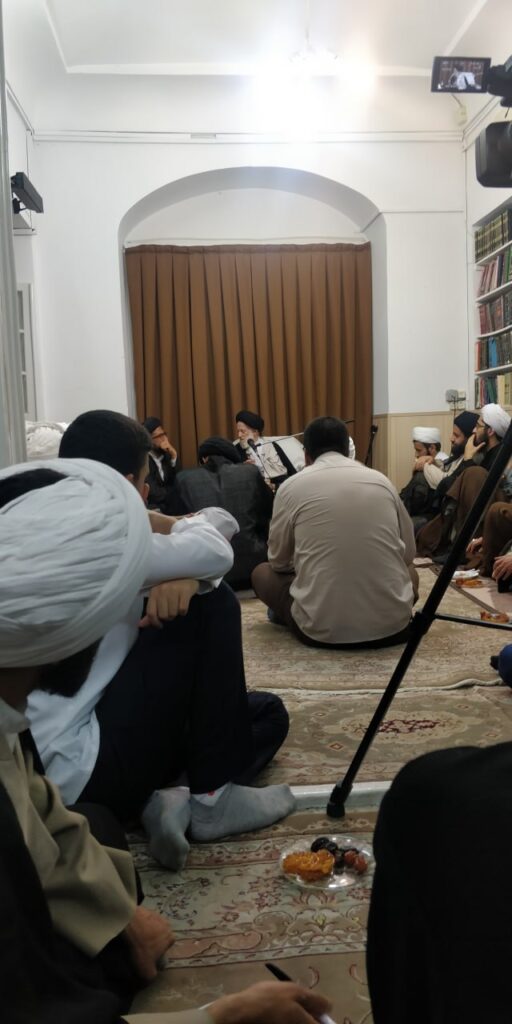
Even when I think back two to three decades ago, I remember how much more we cared about spending time with the scholars who would visit us, or the ones who were already local in our cities. What mattered to us was accompanying these scholars and teachers, growing alongside them, observing them and simply being around them, for years at a stretch. That’s what is referred to as suhba – companionship – in the narrations, not attendance. It was clear to anyone that the relationship with the scholar itself did our forming, not the mere attendance of a lecture. Shaykh Kulayni even has an entire chapter in Usul al-Kafi that shows the significance of this: Majalasat al-‘Ulama’ wa Suhbatihim, “Sitting With Scholars and Accompanying Them.”
There’s a story Ayatullah Shubayri Zanjani tells that shows what that kind of accompaniment with local scholars builds. Sayyid Muhammad Kazim al-Yazdi – the author of al-‘Urwah al-Wuthqa – had a representative in Basra who’d served the local merchants for years, collecting and distributing the religious dues on his behalf. He’d earned their trust the slow way, just by being there. When Sayyid Yazdi eventually sent a telegram dismissing the representative and instructing the merchants to deal with someone else directly, they wouldn’t even accept the letter. Their reply was blunt: “We knew you through him — we never knew him through you.” They had never actually known the marja’ at all. Every bit of their trust in him ran through the one local scholar they’d actually lived alongside.
That story is basically a principle the narrations state outright. Imam Ali (a) is reported to have said:
“I am amazed at one who desires to multiply his companions – how does he not accompany the wise, pious scholars, whose virtues he would gain, whose knowledge would refine him, and whose companionship would adorn him?”
And elsewhere:
“Know that companionship with the scholar and following him is a religion by which one draws near to Allah. It is the most valuable treasure for the believers, an elevation for them in their lifetime, and something spoken of with honour after their death.”
Whatever companionship meant to the people who first heard these words, it clearly wasn’t a selfie taken in passing and posted as proof that some artificial connection existed. It was the religious practice itself, not some accessory hanging off the side of it.
None of this is me arguing that you should sit at the feet of only one scholar and no other – I’d be the last person to say that, given how many different teachers I’ve had the chance to sit and learn from myself. However, traditionally, students often studied under a whole string of teachers across a lifetime, sometimes travelling a long way to do it. But that variety was sequential, not simultaneous – one relationship built up properly before moving to the next – and it was still built on accompaniment.
That kind of sustained presence takes patience, and the tradition is honest about how much. Imam Ali (a) has narrated elsewhere in al-Kafi warning against growing impatient with how long it takes companionship to bear fruit: “the scholar is like a date palm – you must wait patiently until something falls from it for you.” Whoever manages that earns a greater reward than someone who fasts, prays, and fights in Allah’s way for a year.
Once scholarship turns into something you consume instead of a relationship you build, religiosity collapses into its own kind of quantity — how much content we’ve taken in, how many lecturers we’ve heard, how many sittings we can say we attended. For much of the year, and especially through Muharram, Safar, and Ramadan, religious life starts to look like a marathon: lecture to lecture, speaker to speaker, nothing given the time to actually settle in us. Quantity becomes the whole measure of religiosity. It has essentially turned into a kind of drug – you feel like you can’t survive without it. You need that calendar filled with repeatitve and mundane lectures and programmes, and if a few weeks goes by without one, you start to feel like your religiosity itself is slipping, when in reality nothing was ever being built in the first place.
It’s also why popularity gets mistaken for depth so easily. Anyone who’s spent real time in the Hawzah knows the most popular speaker in a room is not necessarily the most learned one in it – popularity, in an age of algorithms and virality, is just another symptom of the same quantity problem. Real learning tends to come from the least visible teachers, the ones with a very small audience usually. Imam al-Kadhim (a) put it plainly: “to remain in the company of a scholar on a garbage heap is better than the company of the ignorant on a fine carpet.”
If you have scholars in your own city, consider that a blessing. Go build something with them – a friendship, a mentorship, whatever it becomes. Don’t just consume ulema, making yourself feel good as if you have achieved something significant – accompany them; otherwise, it is just an ego massage, not transformation. You can see the difference in people. Someone who’s sat with a scholar consistently for years carries himself differently than someone who’s collected a dozen speakers off reels and clips and can quote you the exact timestamp of a good line. The first person tends to actually change. The second, more often than not, doesn’t.
And people need to see a scholar’s life up close before they’ll really trust him – his prayer, his honesty, how he treats his own family – sustained over some period. That’s not something you can build from a distance, and it’s certainly not something a screen can give you. All in all, remember that the ghayah of this companionship and closeness is not just to walk away with a story to tell. It is for you to change – to let that proximity slowly do its work on our character until we’re a little closer to Allah than we were before.