
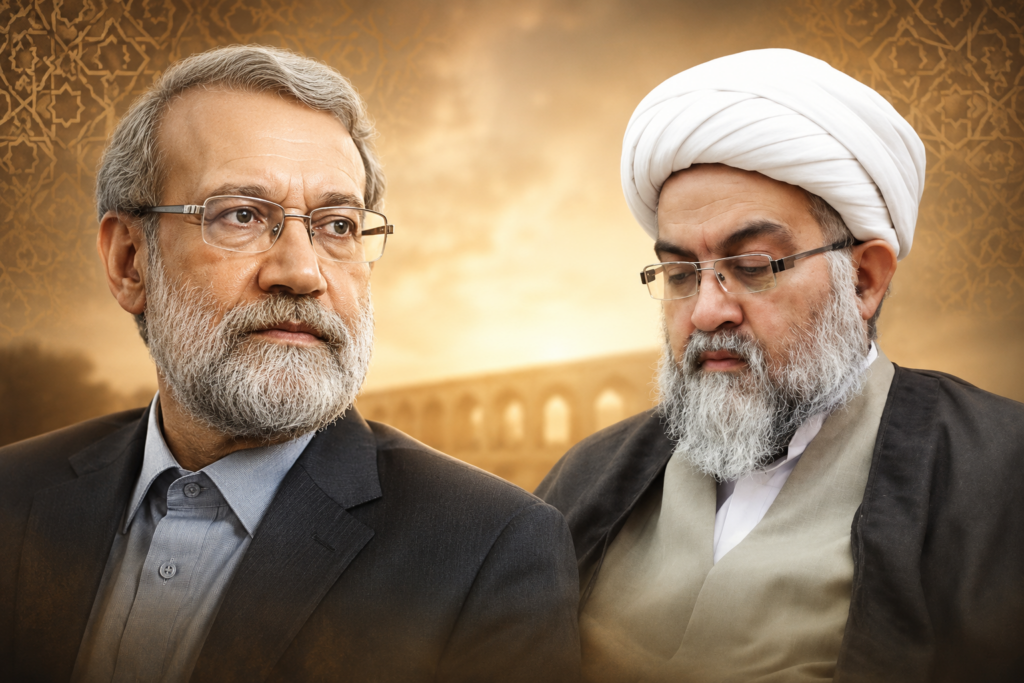
In this article, Ustad Taqi Sobhani examines the thought and governing experience of Shaheed Dr. Ali Larijani through the lens of applied Islamic rationality. He argues that the central concern of Larijani’s approach was the integration of religious teachings, political rationality, social justice, and the comprehensive development of Iran. Within this analysis, Larijani is presented as an example of a “reflective practitioner” – a figure who possessed both extensive experience in governance and a deep commitment to developing theoretical foundations for religious governance.
This article will be of particular interest to those concerned with rational governance, political theology, social justice, Islamic rationality, and the political thought of Shaheed Dr. Ali Larijani.
Published in the Commemorative Volume Marking the Fortieth Day of the Martyrdom of Dr. Ali Larijani. Compiled by Hujjat al-Islam Rasul Ja’farian and Hujjat al-Islam Muhammad Mahdi Miʿraji.
Translated by Sayyid Ali Imran
By Ustad Mohammad Taqi Sobhani
Reason (ʿaql) and rational reflection (taʿaqqul) are among the key concepts in the Qur’anic worldview, constituting a fundamental foundation for both the intellectual and practical dimensions of human life. The Noble Qur’an repeatedly, and in various forms, calls people to exercise reason, defining the path to truth and felicity as the cultivation and following of intellect. The Qur’an regards the human system of knowledge and cognition as centered upon reason, considers the fuʾād (inner heart-consciousness) to be the most important source of knowledge, and identifies the possessors of understanding (ahl al-albāb) as the only group among humanity who attain salvation. The narrations of the Ahl al-Bayt, continuing this same approach, describe reason as the most beloved of God’s creations. They portray religion and proper religious practice as operating within the framework of rational reflection, regard religious commitment as dependent upon reason, and consider alignment with the armies of reason and avoidance of the armies of ignorance as the sole path leading to human growth and perfection.
All of this has made rationality one of the foundational concerns within the Islamic sciences. Contemporary Muslim scholars have each, in their own way, devoted special attention to this issue. Not only theologians and philosophers, but also traditionists, exegetes, and jurists have addressed it according to their respective methodologies and understandings. The division of reason into theoretical reason (ʿaql naẓarī) and practical reason (ʿaql ʿamalī), and from there the classification of Islamic sciences into theoretical wisdom (ḥikmah naẓariyyah) and practical wisdom (ḥikmah ʿamaliyyah), encompassing all branches of human knowledge, represents one of the efforts clearly visible within the Islamic intellectual tradition. Yet what has attracted greater attention in the contemporary era is the question of how these sciences and ideas can be translated into the sphere of everyday human life and how an applied Islamic rationality, appropriate to concrete and contemporary circumstances, can be produced.
One of the questions repeatedly raised by contemporary Muslim thinkers concerns the absence of practical approaches within religious thought. Many believe that the decline of Muslims over recent centuries is rooted in precisely this deficiency. As a result, Islamic civilization has suffered numerous weaknesses and shortcomings in its competition with modern Western civilization, and this deficiency has become one of the major challenges facing the Muslim world in its effort to engage actively with the practical problems of the modern age.
The question of how the theoretical and practical teachings of Islam can be transformed into applicable ideas and effective theories capable of explaining real-world situations, and subsequently offering solutions to the social problems and challenges faced by Muslims, has today become one of the pressing needs of contemporary Islamic discourse.
It is precisely this deficiency and fundamental gap that has led some Muslim intellectuals toward Western philosophies and ideologies. Seeking solutions to unresolved problems, they turn to the paradigms and methodologies of the modern human sciences. At times, this has involved distancing themselves from the traditional Islamic sciences and separating rationality from religion altogether; at other times, it has involved blending religious concepts with modern Western ideas in an attempt to resolve these challenges. Although many Islamic scholars have emphasized the renewal of Islamic sciences and the harmonization of religious knowledge with contemporary conditions, and have taken steps toward addressing these issues, the absence of a clear framework for reconstructing scientific rationality remains one of the fundamental problems confronting both seminaries and universities.
The emergence of the Islamic Revolution and the establishment of the Islamic Republic – founded upon the vision of creating an Islamic civilization based on a wholesome Islamic way of life (ḥayāt ṭayyibah) – brought this theoretical question into the realm of practical reality. The issue of religious governance became central to this intellectual debate. Islamic rationality was now required to demonstrate itself not merely at the theoretical level, but also in responding to the concrete challenges of governing society and addressing national and international problems.
The question arose: within the realities of the world, how can political, economic, cultural, and environmental issues be conceptualized through the lens of Islamic rationality, and how can solutions be proposed in the form of practical and applicable plans? This was a question that, until then, had perhaps occupied the minds of Islamic thinkers less seriously. Theoretical discussions were now being translated into the sphere of social administration, and the duality of theory and practice began to manifest itself as a civilizational reality within the consciousness of intellectual elites. This issue was felt especially acutely by those directly involved in administering the system, from whom society expected solutions to its daily needs and challenges.
The historical experience of human civilizations demonstrates that such issues can only be adequately addressed through a combined perspective; one that simultaneously attends to concrete reality and theoretical reflection. When everyday needs and problems enter the realm of scholarly inquiry, practical solutions are proposed, and these proposals are then tested through action and implementation, the resulting feedback prompts scholars to seek new solutions. It is at this point that the process of producing applied knowledge begins to take shape. The human sciences, in their broad and universal sense, gradually give way to a localized and context-sensitive conception of the human sciences.
It must be remembered, however, that this spiral process of theory and practical testing itself requires a model of applied rationality capable of making these relationships possible and of opening the path of reform and perfection within both the realms of knowledge and action.
A brief look at the experience of Iran’s governing elite in the Islamic Republic compels us to admit that one of our serious weaknesses over the past decades has been the absence of this reciprocal exchange between the arena of governance and the realm of intellectual reflection. Our administrators have often lacked a deep engagement with theoretical thought, or have failed to recognize the significance of this foundational gap. On the other hand, many of our researchers have lacked practical experience in the field of governance and have paid insufficient attention to concrete problems at the micro and applied levels.
The result of this separation and disconnect between the field of action and the world of knowledge has been that policymakers have frequently sought solutions detached from religious values and knowledge, often relying on borrowed and imperfect models and experiences. In many cases, the sphere of governance has become a testing ground for foreign or hybridized paradigms. Meanwhile, researchers, assuming that scientific solutions alone could overcome these challenges, have often confined their work to specialized academic domains. In other words, one of the fundamental shortcomings of contemporary Iranian governance has been the absence of a class of reflective practitioners and a class of field-oriented scholars capable of generating this level of applied knowledge.
Among the few individuals who at least carried a genuine concern for such a domain, and who not only called upon the seminary and the university to enter this broad arena, but also utilized their own capacities to respond to this need, one may mention Dr. Ali Larijani. While actively participating in various levels of governance and executive management, and while accumulating diverse and successful experiences in advancing the objectives of the Islamic Republic, he also possessed the intellectual and scholarly capacities necessary to formulate these questions.
Through his deep familiarity with the history of modern thought and civilization, and because of his intellectual upbringing and association with leading figures in both the seminary and the university, he became profoundly aware of this social need. Over time, he cultivated and refined this concern within himself. Alongside his serious engagement in governance, Larijani never ceased reading, learning, and conversing with thinkers and scholars. Through his close acquaintance with the intellectual achievements of contemporary scholars, and particularly through his deep affinity with the intellectual system of figures such as the Shaheed Morteza Motahhari, for whom he held great admiration, he successfully focused his efforts on this intermediate space between theory and practice. He regarded the production of social rationality as the key to overcoming this historical backwardness.
Although he himself was unable to establish a broad intellectual movement capable of producing a complete and coherent framework, through his scholarly diagnosis of the problem and his articulation of its practical necessities, he opened a path before us. By revisiting this field-based experience of intellectual engagement, it is possible to breathe new life into this endeavor and transform his ideas into a new arena for research and practical experimentation in knowledge.
Now, on the eve of the fortieth day following his blessed martyrdom – which occurred during one of the most difficult periods of his managerial career – I wish to revisit aspects of his intellectual and practical experience. Drawing upon a longstanding acquaintance and shared experience, I will attempt to analyze some of these dimensions.
The central concern in Ali Larijani’s thought, and undoubtedly one of his most important concerns in the field of governance, was the comprehensive growth and development of Iran and the advancement of the country in its cultural, economic, and social dimensions. Evidence for this can be seen in his efforts throughout all of his responsibilities to remove obstacles to national progress, improve living conditions, overcome managerial deadlocks, and address the problems that constrained social development and narrowed the possibilities of life for the Iranian people.
A brief review of Larijani’s administrative record reveals that he consistently sought to activate latent capacities, expand the scope of public service, and establish new pathways for progress. Seeking counsel from scholars and experienced individuals, creating opportunities for younger generations and dynamic talents, avoiding excessive bureaucracy and cumbersome procedures, and maintaining an active, field-oriented, and mission-driven presence in the arenas of action and development were among his managerial characteristics.
Larijani was among the limited number of public officials who ascended the entire managerial hierarchy, from the lowest levels of administration to the highest positions of governance. His experience was not confined to a single field or specialization. From demanding executive responsibilities to advisory roles in high-ranking institutions, and ultimately through three terms as Speaker of Parliament – the institution responsible for resolving major governmental challenges – he developed into a comprehensive, mature, and effective statesman.
To these qualities, one must add his humility, practical piety, courage, and willingness to critically examine intellectual and political experiences and movements. These characteristics undoubtedly played a major role in the development of his thought. Through interaction with diverse individuals, dialogue with thinkers from different intellectual and political currents, continuous study of a wide range of works, and learning from the failures and lessons of the past, he constantly reexamined both his own views and those of others. He was never reluctant to step beyond intellectual confines or to reconstruct and revise his own perspectives.
For this reason, it can truly be said that Dr. Ali Larijani was one of the most sincere and committed advocates of Iran’s development in the contemporary era, dedicating years of his life and effort to this cause. It was for this reason that he repeatedly stated: “The primary duty of government is to secure the welfare and well-being of the people alongside their spiritual growth.”
In one of his speeches – perhaps his final scholarly address in an official setting – entitled “Development and the Necessity of Political Rationality,” he clearly revealed this deeply held conviction. He openly stated that:
“The ultimate goal of all our diplomacy must be the facilitation of national development, including economic and technological growth.”
Based on this premise, he argued that in a polarized and multipolar world, establishing balance among major powers – provided they possess the willingness and capacity for balanced interaction – is one of the primary responsibilities of governance in the sphere of international relations.
It is from this perspective and intellectual starting point that Dr. Larijani places reason and rationality at the center of governance, considering them a “general principle” governing all processes of administration and statecraft. In his view, the call to wisdom and rationality is both a stable foundation of religious commitment and one of the essential duties of governance in the modern age.
He was keenly aware of the unstable and contested definitions of rationality among various intellectual currents. Accordingly, he criticized three common political approaches to reason before presenting his own understanding of rationality and depicting governance within the framework of religious wisdom.
According to him, one group of politicians pursues only “calculative reason” (ʿaql-i ḥisābgar). In his view, the United States and domestic Westernizers belong to this category. The destruction and crises of the contemporary world are, he argues, products of this pragmatic and self-interested conception of reason.
In contrast, there are those who adopt a negative attitude toward reason and expel rationality from the sphere of religious life altogether, pursuing politics devoid of any rational foundation. Contemporary terrorist movements and takfiri ideologies represent this tendency.
A third group consists of those whose interests are served by disregarding reason altogether. Populist approaches bring them immediate gains, whereas rational governance requires attention to long-term horizons and distant consequences. Such individuals imagine that revolutionary zeal is a self-sufficient virtue requiring no political rational justification. Yet, Larijani argues, the Islamic Revolution itself was an uprising against a regime whose despotism had rebelled against rationality.
For this reason, Dr. Larijani spoke forcefully against every form of religious obscurantism that seeks to remove rationality from religion and society. In this context, he frequently cited a famous statement of Shaheed Motahhari:
“Obscurantism is worse than disbelief and hypocrisy, because obscurantism empties religion from within.”