
Ustad Soroush Mahallati is covering several unique topics during the hawzah summer breaks on a weekly basis. One of them is this treatise written by ‘Allamah Tabataba’i. I will try to translate these lessons over the summer if Allah (swt) gives me the tawfiq. Below is the translation of the 1st class delivered on June 3rd, 2026.
In the Name of God, the Most Compassionate, the Most Merciful
All praise belongs to God, Lord of the worlds. May God’s blessings be upon our Master and Prophet, Muhammad, and his Pure Family.
I extend my greetings to our respected friends and companions.
In these summer school discussions, we now turn to another topic, one that may be unfamiliar to many of our participants and perhaps not something they have encountered before. In these sessions, we intend to revisit and explain one of the treatises of the late ‘Allamah Muhammad Husayn Tabataba’i.
This treatise does not have a specific title, but from its subject matter it has come to be known as Risālat al-Muḥākamāt (The Treatise of Arbitrations). This is because the distinguished student of Allamah Tabataba’i, our esteemed teacher the late Ayatullah Hasan-zadeh Amuli, who edited and published the work, referred to it by this title.
In reality, this treatise consists of a scholarly discussion that took place between two scholars in the seminary of Najaf approximately 120 years ago. These two distinguished figures held differing views regarding the subject of Tawḥīd (Divine Unity), and Allamah Tabataba’i undertook the task of arbitrating between their positions and evaluating their arguments. For this reason, his work became known as al-Muḥākamāt (“The Arbitrations”).
What exactly was the subject of their disagreement? Who were these two scholars who engaged in this debate? And how did Allamah Tabataba’i rule in his arbitration between them? Since these matters may not be clear to some of our friends, I prefer in this first session to provide some preliminary explanations so that we become familiar with the overall context of the discussion and so that the subject matter of the coming sessions becomes clearer.
Broadly speaking, you are aware that there are different views among Muslim scholars concerning Tawḥīd. In particular, among our scholars there have been three major intellectual approaches:
- The first is the approach of the theologians (mutakallimūn), who discuss Tawḥīd from a theological perspective.
- The second is the approach of the philosophers and sages (ḥukamāʾ), who analyze the subject from a philosophical standpoint. Of course, there are also disagreements among the philosophers themselves. For example, there are differences between what Ibn Sina taught and what Mulla Sadra established.
- The third approach is that of the gnostics (ʿurafāʾ). There is a significant difference between the perspective of the philosophers – particularly the school of Transcendent Philosophy (al-Ḥikmah al-Mutaʿāliyah) – and the perspective of the gnostics.
The philosophical view, especially as developed by the followers of Mulla Sadra, is based upon the principality of existence (aṣālat al-wujūd) and the gradation of existence (tashkīk al-wujūd). This view accepts multiplicity and diversity within existence.
The other view is based upon the doctrine of waḥdat al-shakhṣiyyah (the personal or singular unity of existence), which does not accept such multiplicity and diversity in existence.
There are important differences between these two perspectives.
Naturally, the proponents of the first theory possess their own arguments and have produced numerous works over the past four centuries. Likewise, the followers of the mystical approach have their own views and have also authored many works on this subject.
In the seminary of Najaf more than a century ago, one scholar emerged as a spokesman for Transcendent Philosophy and defended the philosophical understanding of Tawḥīd. He was Ayatullah Shaykh Muhammad Husayn Isfahani, commonly known as Kompani.
Another great scholar defended the doctrine of the personal unity of existence. He was Ayatullah Sayyid Ahmad Karbala’i.
One of the talented scholars of that era, Shaykh Isma’il Nā’ib, obtained a written statement from Shaykh Muhammad Husayn Isfahani and brought it to Sayyid Ahmad Karbala’i. Karbala’i critiqued Isfahani’s position. Shaykh Isma’il then carried Karbala’i’s response back to Isfahani, who in turn critiqued Karbala’i’s remarks.
This scholarly exchange continued through seven rounds of correspondence. There were seven letters from Shaykh Muhammad Husayn Isfahani and seven letters from Sayyid Ahmad Karbala’i. These fourteen letters together constitute a profound and serious discussion of this issue from two distinct perspectives.
Despite these exchanges, Shaykh Muhammad Husayn Isfahani was ultimately not prepared to abandon the philosophical position rooted in Transcendent Philosophy, nor was he persuaded by the critiques of Sayyid Ahmad Karbala’i. Consequently, after the seventh response, Sayyid Ahmad Karbala’i brought the discussion to an end.
These correspondences later came into the possession of Allamah Tabataba’i. He carefully followed these scholarly discussions and undertook the task of judging the two claims and evaluating the arguments advanced by each side. Unfortunately, the Muḥākamāt of Allamah Tabataba’i, written in his own hand and in Persian, remained incomplete and unfinished.
What is available to us today contains only his arbitration concerning the first three exchanges. In other words, he evaluated three of Shaykh Muhammad Husayn Isfahani’s letters and three of Sayyid Ahmad Karbala’i’s letters. At that point, the project ceased.
We do not possess much information regarding the reason for this interruption. However, one of Allamah’s students, the late Sayyid Muhammad Husayn Husayni Tehrani, relates the following account:
He says that when they were studying under Allamah Tabataba’i during the early years after the latter had settled in Qom, Allamah would gather a small circle of approximately ten students every Thursday and Friday. In these private sessions he would present these correspondences, discuss them, explain the positions of each of the two scholars, and then offer his own assessment of their views. The written work that we possess today is the product of those lessons.
Ayatullah Husayni Tehrani adds that after some time the summer season arrived and the seminary classes, including these sessions, were suspended. He himself subsequently migrated from Qom to Najaf. Apparently, after that, the sessions were never resumed.
This account suggests that Allamah Tabataba’i’s work of arbitration and the composition of Risālat al-Muḥākamāt dates back to approximately 1331–1332 Shamsi (1952–1954 CE), since that was the period in which Husayni Tehrani left Qom.
But who exactly were these two great figures?
Both were extraordinary personalities, and before entering into their debates and the details of the Muḥākamāt, it is appropriate that we become somewhat acquainted with them.
In reality, throughout these discussions we will be dealing with the views of three major figures from the traditions of philosophy and mysticism:
- Sayyid Ahmad Karbala’i, who serves as the representative of the mystical school and defends the doctrine of the personal unity of existence.
- Shaykh Muhammad Husayn Isfahani, who serves as the representative of Transcendent Philosophy.
- Allamah Muhammad Husayn Tabataba’i, who evaluates and arbitrates between their analyses and arguments.
Ultimately, Allamah Tabataba’i considers the position of Sayyid Ahmad Karbala’i to be the more defensible one, a point to which we shall return during the course of these discussions.
As for these three great figures, I will first briefly introduce Sayyid Ahmad Karbala’i by quoting what the late Shaykh Aqa Bozorg Tehrani said about him, and then I will continue the discussion.
Shaykh Aqa Bozorg, in his biographical work on Shi‘i scholars, Nuqabāʾ al-Bashar, which concerns the scholars of the fourteenth century, introduces Sayyid Ahmad as follows:
“He is Sayyid Ahmad ibn Sayyid Ibrahim al-Musawi: Tehrani by origin, Ha’iri by birth, and Najafi by burial.”
In other words, Sayyid Ahmad was originally from Tehran, was born in Karbala, and was buried in Najaf. He then describes him as:
“A noble scholar, a great jurist, a well-known man of ethics, deeply scrupulous, God-wary, ascetic, and devoted in worship.”
This is the praise and honour that Shaykh Aqa Bozorg gives him. From the juristic perspective, he describes Sayyid Ahmad as a great jurist. From the ethical and spiritual perspective, he describes him as a renowned moral personality, possessing a high degree of scrupulousness, piety, asceticism, and worship.
He then adds that Sayyid Ahmad was one of the students of Mirza Shirazi. In ethics and spiritual wayfaring, he was also one of the students of the late Mulla Husayn Quli Hamadani.
But Shaykh Aqa Bozorg does not stop there. He uses very lofty expressions for Sayyid Ahmad Karbala’i. He says that he was unique in his era, rare in his time, both in knowledge and in action, in spiritual wayfaring, asceticism, scrupulousness, piety, knowledge of God, and fear and awe of Him.
He then adds that Sayyid Ahmad wept frequently, to such an extent that he could not control himself in his prayers, especially in the night prayers. Shaykh Aqa Bozorg says:
We lived near his house and were his neighbours, and we would observe his states. He wept very much, and especially during the night prayer he could not restrain his tears.
In these biographies and accounts, there are two important points. I especially emphasize them for my dear friends, for my children, and for respected seminary students. I ask you to pay attention to these points.
The first point is that this great man was a major jurist. The second point is that he was also an outstanding ethical and mystical personality. Our great scholars in those periods combined these different merits. I will first mention his juristic stature, and then I will also point to his spiritual states.
The account I am about to mention was narrated by my esteemed teacher, His Eminence Ayatullah Sayyid Musa Shubayri Zanjani, in the second volume of Jurʿī az Daryā. He said that Sayyid Ahmad Karbala’i was at a very high scholarly rank, and in ethics, spiritual wayfaring, and mysticism he also possessed an elevated station.
He then narrates the story from one of the great figures named Sayyid Ali Lawasani. Sayyid Ali was the son of Sayyid Abu al-Qasim Lawasani, who was among the close and intimate companions of Sayyid Ahmad Karbala’i. Sayyid Ali Lawasani would narrate from his father, that he said:
“I went to Sayyid Ahmad Karbala’i. Sayyid Ahmad said, ‘Tell Mirza Muhammad Taqi that on the Day of Resurrection, before my grandfather the Messenger of God, I will seize him by the collar.’”
Sayyid Ahmad Karbala’i complained to this close student and friend of his, saying: Go and tell Mirza Muhammad Taqi that on the Day of Resurrection, before my grandfather, I will seize him by the collar.
This is the expression that has been transmitted from him.
Now, first of all, who is this Mirza Muhammad Taqi, the one about whom Sayyid Ahmad is complaining? Secondly, what did Mirza Muhammad Taqi do that caused Sayyid Ahmad Karbala’i to complain about him and say that on the Day of Resurrection, he would seize him by the collar before his grandfather?
The Mirza Muhammad Taqi intended here is Mirza Muhammad Taqi Shirazi, the great marja‘ of his time, known as the Second Mirza Shirazi.
Sayyid Ahmad said: Go and tell Mirza Muhammad Taqi Shirazi that I will seize him by the collar before my grandfather.
But what had Mirza Muhammad Taqi done? They say that something resembling infallibility existed in him. Could it even be imagined that he would wrong someone and have a complainant? He was first-rate both in jurisprudence and precision of thought, and also first-rate in piety and scrupulousness. He was an exceptional personality in both respects.
Sayyid Ahmad Karbala’i said to Sayyid Abu al-Qasim: I will seize him by the collar.
Why? Because whenever anyone asks Mirza Muhammad Taqi, “To whom should we refer in matters where you exercise precaution?” he says, “Refer to Ahmad Karbala’i.”
This was the cause of the complaint. Sayyid Ahmad Karbala’i’s grievance was that Mirza Muhammad Taqi Shirazi, the great marja‘, had directed others by saying: In cases where I exercise precaution, you should act according to the fatwa of Sayyid Ahmad Karbala’i.
There are two points here.
First, the scholarly rank of Sayyid Ahmad Karbala’i was such that a very great and very cautious jurist recognized him as the foremost jurist of his time, to whom people should refer in matters of precaution. Since in cases of precaution one must refer to the most learned, this statement implies that Mirza Shirazi regarded him as the most learned of the jurists.
The second point is that this testimony, which had no worldly or outward motive at all, was so heavy and unacceptable for Sayyid Ahmad Karbala’i, and he fled from leadership and authority to such a degree, that he said with distress: Tomorrow, on the Day of Resurrection, I will complain about Mirza Muhammad Taqi before my grandfather.
The matter was so troubling to him. Instead of saying, “Go and thank Mirza Muhammad Taqi; he has shown kindness and good opinion toward this poor servant,” he reacted so severely. True scholars in the seminaries were like this, and they still are like this.
Ayatullah Shubayri narrated this story in four lines, but he himself adds that when Sayyid Ali Lawasani narrated this story from his father, he and Sayyid Muhammad Husayn Husayni Tehrani were both present. Husayni Tehrani wrote down the details of the matter at length.
If you wish to see the details of this story, it is truly hair-raising. Read it in the book Tawḥīd ʿIlmī wa ʿAynī, page 24, where Ayatullah Shubayri’s testimony is also given regarding the detailed account. He himself refers the details to that source.
It would be a shame not to read the actual text of this narration. Husayni Tehrani narrates from Sayyid Ali with these details:
He said that the late Sayyid Abu al-Qasim would say:
“One day, when the lesson ended and the students began to leave, I also stood up to go. The late teacher, Sayyid Ahmad, said: ‘Sayyid Abu al-Qasim, if you have nothing to do, sit for a while.’ I understood that he had a private matter. I said, ‘No, I have nothing to do,’ and I sat down. Everyone left.
He said: ‘Write to Mirza Muhammad Taqi…’
Then his state became disturbed, meaning he could not continue because of how deeply affected he was. He said, ‘Write to Mirza Muhammad Taqi…’ Then his condition changed, and he said: ‘Ah, ah! He himself said it. He himself said it. It is certain. It is certain.’
He became so overwhelmed that he lost strength.
We thought that perhaps Mirza Muhammad Taqi had said something painful about him or attributed something to him that had upset him to such a degree. But we knew that Mirza Muhammad Taqi was a just, righteous, and pious person, and that he would not utter anything that involved backbiting or anything contrary to reality.
We also knew that Sayyid Ahmad was not the kind of person who would become upset and distressed by false accusations made against him. If someone spoke badly of Sayyid Ahmad, he would not become upset.
We were confused and fell into silence and astonishment.
In any case, Sayyid Ahmad used snuff. We prepared something like the tobacco or smoking material used today and gave it to him, saying, ‘Do not be upset.’
The late teacher took it, and when he recovered somewhat, he said:
‘This man, meaning Mirza Muhammad Taqi Shirazi, has referred his precautions to me. People went to him and asked: “If, God forbid, something happens to you, whom should we follow after you? And in your precautionary rulings, to whom should we refer?”
Mirza Muhammad Taqi answered: “To Sayyid Ahmad. I do not know anyone other than him.”
Sayyid Abu al-Qasim, write to him: “O Mirza Muhammad Taqi, you have authority in worldly affairs. If you do such things again and refer people to someone, tomorrow on the Day of Resurrection, in the presence of my grandfather, the Messenger of God, where authority is in our hands, I will complain about you and will not be pleased with you.”’”
This, then, was the scholarly station of this personality. He was this great jurist, as Shaykh Aqa Bozorg Tehrani also described him: “a great jurist.”
I have read and seen in some places that it is transmitted from the late Muhaqqiq Isfahani, Shaykh Muhammad Husayn, that he said: “I have not seen anyone in jurisprudence like Sayyid Ahmad Karbala’i.”
But this same jurist was also a great personality in theoretical mysticism and practical spiritual wayfaring. You noticed that Shaykh Aqa Bozorg described him as someone who wept frequently.
There are, of course, many testimonies regarding this matter, and we should not pause too long here. But I will mention some of them, since it may be appropriate.
I remember that at one time the late martyred leader, Ayatullah Khamenei, in one of his talks, narrated from his grandfather, Sayyid Hashim Najafabadi. He said that his grandfather had said:
“In Najaf, when we would wake up at night, for example, to go to Masjid al-Sahla and then return, the sound of Sayyid Ahmad Karbala’i’s weeping could be heard in the alley.”
This is the same “frequent weeping” that Shaykh Aqa Bozorg also mentioned, especially in the supererogatory prayers and the night prayer.
Of course, the issue is not simply the sound of weeping. His inner states and spiritual qualities were more important than these outward matters.
One account is narrated by the late Aqa Jamal Khwansari, who was influenced by Sayyid Ahmad Karbala’i. Aqa Jamal himself was one of the great spiritual personalities, but he was among the students of Sayyid Ahmad Karbala’i. He narrates how he came to attach himself devotionally to Sayyid Ahmad Karbala’i.
He says:
“One night I had gone to Masjid al-Sahla. Part of the night had passed, and I was preparing myself for keeping vigil. I saw that in Masjid al-Sahla there was no one there, and it was dark. Then a sound reached my ears: the sound of weeping, the sound of intimate supplication. At times it would become silent; at times it would continue. At times he would speak from the heart; at times he would move. At times he would come forward.
I became so bewildered and captivated that, that night in Masjid al-Sahla, I was unable to do anything at all. Those supplications, that burning and melting, those poems he was reciting, those prayers he was murmuring, and that state of intimate conversation with God captivated me so deeply that until the call to dawn prayer, I was entirely stunned by him.
Finally, when it was close to the dawn call to prayer, he reached the station of the Imam of the Time and began reciting these verses addressed to the Imam:
‘We have come to this door not for rank or splendour;
Driven by the misfortunes of fate, we have come here for refuge.
Travellers on the path of love’s stations, from the frontier of non-existence
To the realm of existence, we have come all this way.
Where is Nuh, the captain of the storm’s ship,
That in this ocean of generosity, we have come as drowned ones?
O cloud of forgiveness, wash away my honour lost through error,
For in the register of deeds, we have come with blackened names.
Hafiz, cast away this woollen cloak,
For we have come from behind the caravan with fire.’”
Then he became silent. For a while he prayed. The light of dawn appeared. He performed the prayer and its follow-up devotional acts, while I remained astonished and bewildered, asking myself: Who is this, and what state is this?
I asked the servant of the mosque. He said: ‘This is Sayyid Ahmad Karbala’i.’”
This became the cause of Aqa Jamal Khwansari’s acquaintance with Sayyid Ahmad. From then on, Aqa Jamal Khwansari became one of those who came under the spiritual training of the late Sayyid.
My dear ones, what we will pursue in these sessions, by God’s power and permission, are not words from a few Sufis or dervishes who had no knowledge of Islamic foundations, jurisprudence, or ijtihad.
We are speaking about people who, even in the conventional seminary sciences of jurisprudence and legal theory, were first-rate scholars, and who were also first-rate in spiritual state, piety, and worship.
Why should we today deprive ourselves of the spiritual and intellectual achievements of these great personalities? Why should we deprive ourselves?
And why should certain currents exist and remain active in the seminary that prevent students from becoming acquainted with these spiritual and educational teachings?
We must think about ourselves.
These figures are not from outside the seminary. They are from the very heart of the seminary. These correspondences are from the heart of the seminary, and not just any seminary, but the seminary of Najaf, more than a century ago. Around 115 years have passed since the passing of the late Sayyid Ahmad Karbala’i. I believe his passing was in 1292 Shamsi. These figures lived within the very body of our traditional seminary.
This was Sayyid Ahmad Karbala’i.
As for Muhaqqiq Isfahani, Shaykh Muhammad Husayn Gharawi, there is no need to say much. Who can deny his scholarly rank in jurisprudence and legal theory? Even now, after around eighty years, his views and opinions remain current in the seminaries. His gloss on Kifayat al-Usul, his gloss on al-Makasib, and his other scholarly works are all marked by the utmost precision.
These great figures had something to say, and this word must be heard. As for Allamah Tabataba’i, there is no need to say anything about him here.
We must come to know this spiritual and intellectual inheritance. We must free ourselves from the shell and casing we have woven and constructed around ourselves, through which we have imprisoned ourselves within the outward aspects of legal rulings.
We must pursue knowledge of the different dimensions that exist within Islam. This table has been spread for everyone, and before anyone else, it has been spread for us seminary students, who are honoured to be students in the school of Imam al-Sadiq, peace be upon him.
We are free to accept or not accept. We may accept or reject. But we are not free to deny before we have attained a researched understanding and become acquainted with the matter. Let us see what they say.
If I have chosen this treatise, al-Muḥākamāt, for these discussions alongside the weekly jurisprudential discussions, it is so that this combination may take place, and so that we may move beyond a one-dimensional understanding.
I entrust the arbitration between these two scholars to someone like Allamah Tabataba’i, from whom I benefit, because he was fundamentally a personality committed to demonstration and reasoning. Some of his students had asked him to teach certain mystical texts. They had gone to him and requested this. He replied that something can be discussed when it possesses an argumentative dimension.
In this arbitration, he entered with the criterion of rational proof. He judged the views of these two great figures through the standard of demonstration. The distinction of his treatise is precisely that it is reasoned and argued.
If you wish to appreciate the importance of the texts before us, both the text of those two great figures and the text of the late Allamah Tabataba’i, may God be pleased with him, it is useful to look at the discussion that the late Martyr Mutahhari has in his extensive commentary on Manzumah. When he compares the personal unity of existence and the gradational unity of existence and provides an explanation, he says there:
“The correspondences and exchanges of questions and answers that took place between Shaykh Muhammad Husayn Isfahani Gharawi, known as Kompani, and the late Sayyid Ahmad Tehrani Karbala’i are very valuable and concern this very subject. Sayyid Ahmad was a gnostic man and thought gnostically. Shaykh Muhammad Husayn thought philosophically and was a supporter of the gradational unity of existence.”
He uses the expression “very valuable” here. He has a similar expression in his own notes as well. In volume eleven of his notes, he says:
“The correspondences between Sayyid Ahmad Karbala’i and Shaykh Muhammad Husayn Isfahani are extremely precious.”
That is, when he lists the sources concerning unity, the manner of unity, gradational unity, and personal unity, he refers to these correspondences as extremely precious.
I think that at that time, Martyr Mutahhari may not have known about Allamah Tabataba’i’s Muḥākamāt, or perhaps because it had not yet been published, he did not mention it here.
Of course, he also makes one point that I have not seen elsewhere, and it is noteworthy. He says that according to the documents available concerning Sayyid Jamal al-Din Asadabadi, during the period when he was in Najaf, he had a close friendship with Sayyid Ahmad Karbala’i. This is a separate discussion and is not presently related to our topic.
Well, time has passed, and we were unable to begin the actual subject of discussion. We will leave the beginning of the discussion for the next session. But as guidance for our friends, I will mention that this collection of correspondences has several editions. Whichever of them you have access to, we can use.
The first time these correspondences were published, they appeared without the judgments and marginal notes of Allamah Tabataba’i. This was in the years 1354 and 1355 Shamsi, through the efforts of the late Sayyid Jalal al-Din Ashtiyani, under the title Mukatabat-i ʿIrfani.
He published these mystical correspondences in two parts, as two articles, in the journal Javidan Khirad. This journal belonged to what was then the Imperial Iranian Academy of Philosophy, which later became known simply as the Academy of Philosophy. The journal was under the supervision of Dr. Seyyed Hossein Nasr, and Sayyid Jalal Ashtiyani published the correspondences there.
Later, he published those same two articles as an independent work in 1361 Shamsi through the Scientific and Cultural Publishing Centre. This edition contains only the correspondences of Sayyid Ahmad Ha’iri with Shaykh Muhammad Husayn Gharawi.
As for Allamah Tabataba’i’s Muḥākamāt, the first person to publish it was our great teacher, the late Ayatullah Hasan-zadeh Amuli. That is, he published the collection of all three sections in the memorial volume for the martyred Ayatullah Quddusi, I believe around the years 1362–1363 Shamsi.
In the introduction, Ayatullah Hasan-zadeh explained that he had received the manuscript of this treatise from his teacher, Allamah Tabataba’i, and had copied it from that manuscript.
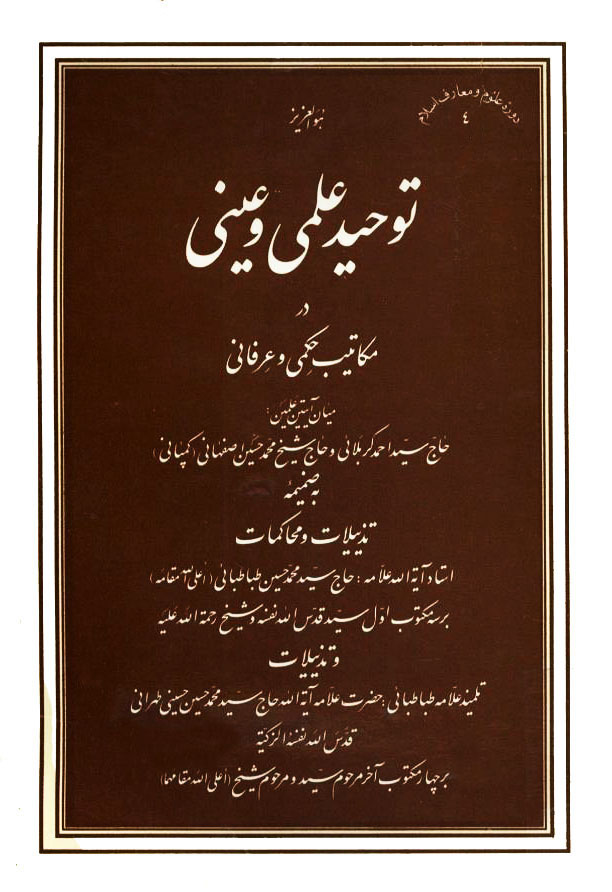
The third stage was when this book, in all three of its parts—the correspondences of Sayyid Ahmad Ha’iri, the correspondences of Shaykh Muhammad Husayn Gharawi, and the Muḥākamāt of Allamah Tabataba’i, was published by Allamah Sayyid Muhammad Husayn Husayni Tehrani. He named the collection Tawḥīd ʿIlmī wa ʿAynī. The book Tawḥīd ʿIlmī wa ʿAynī contains all of these sections. The late author, who published these sections, also wrote a useful introduction and added marginal notes and explanations in his own sections.
In any case, the work that is easily available to you today for reference is this book, Tawḥīd ʿIlmī wa ʿAynī. It contains the letters of the two great figures, the additions and Muḥākamāt of Allamah Tabataba’i, along with explanations by the editor himself.
God willing, we will use these sources, and we hope to be granted success through them, and that by means of them we may receive a portion, even a drop from the ocean, of Islamic knowledge.
May you be successful and supported.
Peace be upon you, and the mercy and blessings of God.