
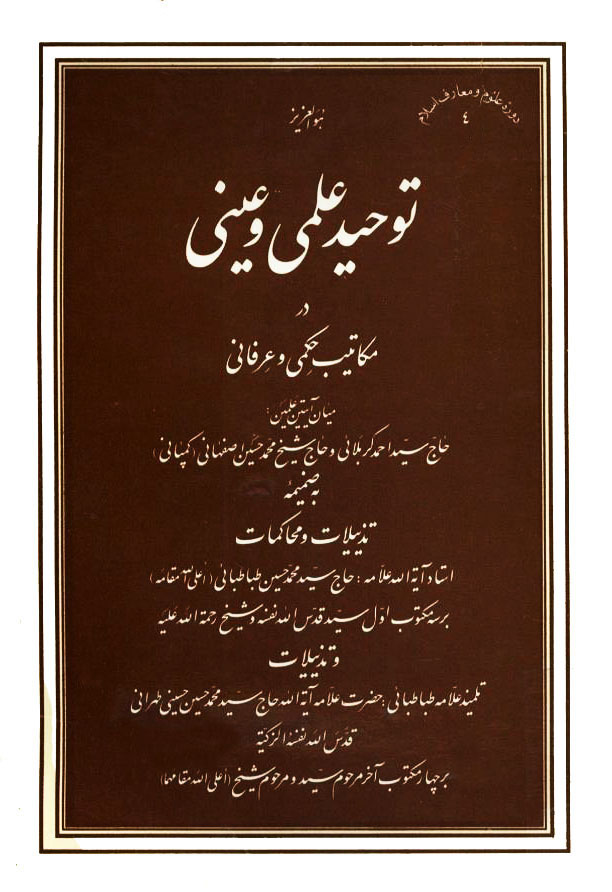
Second lecture by Ustad Soroush Mahallati on this treatise written by ‘Allamah Tabataba’i. Below is the translation of the 2nd class delivered on June 10th, 2026.
In the Name of God, the Most Compassionate, the Most Merciful.
All praise belongs to God, Lord of the worlds. May God’s blessings be upon our master and prophet, Muhammad, and his pure family.
In the first session of our discussions on the book al-Muḥākamāt, a work of ʿAllamah Tabataba’i, an introduction was presented concerning this work and the individuals who played a role in its formation. We now enter into the book al-Muḥākamāt itself.
ʿAllamah Tabataba’i begins this treatise with an introduction:
“In the Name of God, the Most Compassionate, the Most Merciful. To Him belongs praise in the beginning and the end, and to Him belongs judgment. Peace be upon His servants whom He has chosen.”
In this introduction, he first explains that there were correspondences between two great scholars, Sayyid Ahmad Karbala’i and Shaykh Muhammad Husayn Isfahani. Given the importance of these correspondences, he examined and analyzed them.
Then, in this introduction, ʿAllamah Tabataba’i briefly introduces these two scholars: Sayyid Ahmad Karbala’i and Shaykh Muhammad Husayn Isfahani. The first section contains valuable points, and the second section also contains useful material. Therefore, before entering into the main discussion, I will read some of ʿAllamah’s statements from this introduction.
The introduction begins as follows:
“A series of correspondences took place between our two noble teachers: the most eminent Sayyid, possessor of the two noble lineages and the two honours, the glorious standard of the two ranks, the gnostic jurist, the banner of gnosis, the support of jurisprudence, the lighthouse of knowledge and the refuge of knowledge, the late rightly-guided Sayyid Ahmad Karbala’i, may God pour upon us from his blessings; and the most eminent Shaykh, the divine sage and the brilliant jurist, around whose celestial sphere investigation revolves, and across whose broad plain precision moves and extends, Shaykh Muhammad Husayn al-Isfahani al-Gharawi, may God raise his lofty station, concerning the meaning of one verse from the verses of Shaykh ʿAttār.”
These are two short introductions to these two great figures. Of course, it is very clear that in this introduction, ʿAllamah Tabataba’i gives much greater weight to Sayyid Ahmad Karbala’i and introduces him with stronger and loftier expressions.
ʿAllamah gives further explanations about these two personalities later on. For now, we do not intend to pause over the personalities of these great figures, since we briefly referred to them in the previous session.
A series of correspondences took place between our two noble teachers. One point here is that Shaykh Muhammad Husayn Isfahani Gharawi, known as Kompani, was certainly a teacher of ʿAllamah Tabataba’i, and ʿAllamah studied under him. But was Sayyid Ahmad Karbala’i also one of ʿAllamah Tabataba’i’s teachers? The phrase says: “A series of correspondences between our two noble teachers.” It is clear that the late ʿAllamah Tabataba’i was not a direct student of Sayyid Ahmad Karbala’i. In terms of age, he could not have attended his classes, nor did he do so. Rather, ʿAllamah Tabataba’i was the student of his student.
Therefore, the expression “teacher” that ʿAllamah uses here does not mean direct study under him. I have seen that our noble teacher, the late Ayatullah Hasan-zadeh Amuli, explained in some of his works that, considering Sayyid Ahmad Karbala’i passed away in 1332 AH, ʿAllamah Tabataba’i at that time was not at an age where he could have participated in such lessons. Rather, this expression can refer to an indirect teacher and an indirect student relationship. The intermediary here is the late Ayatullah Sayyid ʿAli Qadi Tabataba’i.
ʿAllamah Tabataba’i himself actually points to this matter. He says that Sayyid Ahmad Karbala’i spent many years in the presence of the late Akhund Mulla Husayn Quli Hamadani, surpassed his peers, and eventually became established in the first rank and foremost class of his students and those trained by him. In both outward and inward sciences, he occupied a firm place and a secure station.
After the passing of Mulla Husayn Quli, he resided in Najaf and occupied himself with teaching jurisprudence. In divine knowledge and in the training and perfection of people, he displayed a shining hand.
This section concerns the late Sayyid Ahmad Karbala’i. ʿAllamah then points out that a large number of great figures, through the blessing of his training, became dwellers of Paradise and intimates of the sanctuary of nearness. Among them was “the most eminent Sayyid, the sign of truth, the rare one of the age, the worshipping scholar, the jurist, the traditionist, the eloquent poet, the master of the divinely-grounded scholars, the late Haj Mirza ʿAli Qadi Tabataba’i.”
He then adds that “he was the teacher of this insignificant one in divine knowledge, jurisprudence, hadith, and ethics.”
Thus, ʿAllamah was the student of the student of Sayyid Ahmad Karbala’i. If he uses the expression “teacher” regarding him, it is because through Mirza ʿAli Qadi Tabataba’i he was also able to benefit from Sayyid Ahmad Karbala’i.
The point worthy of attention here is the importance that ʿAllamah Tabataba’i gives to these correspondences. In this introduction, he says that in these letters between the two teachers, “as one discussion leads to another,” two well-known foundations of the philosophers and the gnostics are discussed. Each of these two great figures sought to strengthen one of them. Sayyid Ahmad Karbala’i is the voice of the gnostics, while Shaykh Muhammad Husayn Isfahani is, in this context, the voice of the philosophers.
He says that in clarifying the intended matter, they exerted their full effort:
“Considering the preciousness of the subject and the subtlety of the discussion, it was not free from difficulty and obscurity. Therefore, for the sake of preserving the works of the great scholars and fulfilling the right of learning and training, this insignificant servant, Muhammad Husayn Tabataba’i, wrote several pages under the title of Tadhyīlāt wa Muḥākamāt, and did not fall short in clarifying the truth of the matter.”
This statement of ʿAllamah in the introduction is important because he says that these correspondences possess precious subject matter and subtle discussion. He says that the two sides exerted their full effort in presenting their points. But because ʿAllamah saw that these precious matters contained difficulty, obscurity, and complexity, he entered into the discussion and, in this treatise of Tadhyīlāt wa Muḥākamāt, tried to clarify those discussions.
Therefore, from the perspective of the late ʿAllamah Tabataba’i, this treatise, which is based on examining those correspondences, seeks to clarify precious truths that were exchanged between these two great figures in their letters.
This two-page introduction itself contains subtleties and valuable points. I leave reflection on the introduction and the discovery of those points to our dear friends. Now we enter into the first letter, which is the letter of Shaykh Muhammad Husayn Isfahani.
The central issue of the first letter, as well as the next letter, is the human being’s ability to comprehend the reality of the Necessary Being, exalted is He. Is God comprehensible for us or not?
The discussion begins with a question raised on the basis of some verses that ʿAttār Nishaburi mentions in Manṭiq al-Ṭayr, where he says:
“How can the intellect reach the place where He is?” Shaykh Isfahani answers this question, and Sayyid Ahmad also answers it. Can we comprehend or can we not? If we cannot, why not?
The central argument of Shaykh Muhammad Husayn Isfahani for denying such an ability in the human being is that God is pure being and existence. A being that is pure is unlimited, while we are limited. A limited knower cannot comprehend an unlimited reality. This is the main framework of Shaykh Muhammad Husayn Isfahani’s argument and position.
First, then, we must reflect on this expression: what does “pure being” mean? More generally, what does “pure” mean?
We will make use of the expressions and discussions that the philosophers themselves have presented in this regard. As an example, we will use Badāyiʿ al-Ḥikam by Aqa ʿAli Mudarris. The discussion I have selected and will explain from Aqa ʿAli Mudarris is not unrelated to the late Isfahani. On one hand, it explains Isfahani’s brief and condensed discussion, and on the other hand, it reveals the intellectual source from which Isfahani drew.
This is because Isfahani, in philosophy, was a student of Muhammad Baqir Istahbanati in the Najaf seminary. Before migrating to Najaf and Samarra, Muhammad Baqir Istahbanati had studied philosophy in Iran under Aqa ʿAli Mudarris. For this reason, it has been said that Muhaqqiq Isfahani, in his philosophical thought, was more influenced by Aqa ʿAli Mudarris. Of course, the later philosophers as a whole, whether Isfahani, Aqa ʿAli Mudarris, or other philosophers such as Haj Mulla Hadi Sabzawari, are all classified under the Transcendent Philosophy of Mulla Sadra.
At the beginning of Badāyiʿ al-Ḥikam, Aqa ʿAli Mudarris has a clear and helpful discussion about “purity” or “pure reality.” He explains what “the pure reality of a thing” means, so that we may then arrive at the claim that the Necessary Being, exalted is He, is the pure reality of existence.
The “pure” of any reality means that reality in such a way that it is empty of whatever stands opposite to that reality. This is what “pure” means. For example, pure whiteness, or the pure reality of whiteness, means a whiteness in which no kind of non-whiteness exists. It is empty of its opposite. In reality, pure whiteness or sheer whiteness is that which has completely expelled its opposite, namely blackness. This means that no degree of blackness exists in it, and all degrees of whiteness, up to the final degree, are realized in it.
When this is the case, pure whiteness necessarily does not possess one limited boundary among the boundaries of whiteness. One cannot ask: what limit of whiteness is it? If you consider a limit within whiteness, or observe a degree of whiteness in it, then necessarily there is a higher degree above it. Such whiteness would no longer be pure whiteness, but only one degree of that whiteness.
Pure whiteness, or the pure reality of whiteness, must possess all degrees of whiteness. There must be no deficiency or absence of whiteness in it. In other words, beyond it, no whiteness can even be imagined. This is pure whiteness.
Now I will read the statement of Aqa ʿAli Mudarris from Badāyiʿ al-Ḥikam:
“Know that the pure reality of every truth consists of that truth in such a manner that it is empty of whatever stands opposite to that truth. For example, pure whiteness is a whiteness that is empty and free from the absence and lack of whiteness, and is not described by non-whiteness in any way. Thus, the pure reality of whiteness is a whiteness that lacks all degrees of blackness and possesses all degrees of whiteness insofar as it is whiteness. Since this is so, no limit among the limits of whiteness can be considered in it. For if it were limited by one of the limits of whiteness, then above that limit another station would be conceivable, and that truth, in the degree and limit that it has, would not possess that station. It would therefore possess the absence of that station. And since that station is also one of the stations of the reality of whiteness, it would follow that it possesses a degree of the degrees of its opposite, and lacks one of the degrees of itself insofar as it is that reality. Thus, what had been assumed to be the pure reality of whiteness would not be the pure reality of whiteness.”
Reflection on these expressions shows the intended meaning and the claim in this regard. If we consider the pure reality of a truth, it follows that we cannot consider anything of that truth outside of that pure reality. If something were outside it, then that reality would necessarily have a degree and limit while lacking the higher degree. We would have to say that this reality both possesses a certain level and lacks what is beyond that level.
If it has some degrees and lacks others, this means that it has taken on something from its opposite. It would be whiteness at one degree while also having some blackness. In that case, this would not be compatible with the assumption that it is pure whiteness.
If we assume that something is the pure reality of a truth, then that pure reality must possess all degrees, and nothing can exist outside it.
This is the meaning of “pure” here: the reality is free and transcendent from whatever stands opposite to it.
Now, in relation to God, when it is said that God, exalted is He, is the pure reality of existence, the concept of “pure” applies here. The meaning is that the reality of existence is a reality that possesses all levels of being, and its opposite, which consists of non-being aspects, has no access to it in any way or form. Since He is pure being, He is empty and free of every non-being aspect, and possesses all modes of existence, of course, in such a way that no composition arises in Him, because composition itself is also incompatible with purity.
The continuation of the statement of the late Aqa ʿAli Mudarris is as follows. First, he explained the concept of purity through an example like whiteness. Then he moves from this example to the subject under discussion: the reality of existence as it applies to God in a pure manner. He says:
“Thus, the pure reality of existence is an existence that, in its essence, is empty and free from all non-being aspects, all quiddative respects, and all concepts.”
The expressions he uses here, such as “all non-being aspects,” “all quiddative respects,” and “all concepts,” and being free from all of them, refer back to the point mentioned at the beginning: every reality is pure only when it is empty of its opposite.
When we speak of whiteness, its opposite is blackness. When we speak of knowledge, its opposite is ignorance. Pure knowledge means a knowledge in which there is no aspect of ignorance whatsoever. This is pure knowledge, or the pure reality of knowledge.
Now if we apply this same idea of purity to existence, we must say that pure existence is an existence in which there is nothing of its opposite. What is the opposite of existence?
First, non-being aspects, since existence stands opposite to non-existence. Sometimes existence is also considered in contrast to quiddity. Therefore, sheer existence and pure existence must not possess quiddative respects either. On the other hand, what is meant here by existence is “beingness,” externality, and having reality. What stands opposite to this beingness, reality, and externality is concepts. Pure existence stands opposite to non-being respects, quiddative respects, and concepts.
Let us return to the text of Aqa ʿAli Mudarris:
“Thus, the pure reality of existence is an existence that, in the level of its own essence, is empty and free from all non-being aspects, all quiddative respects, and all concepts.”
The reality of existence, in its own essence, cannot be described by such things. It cannot be described by non-being, because it is pure existence. It also cannot be described by quiddity, nor can concepts be predicated of it.
“And since this is so, it necessarily possesses all modes of existence insofar as it is existence.”
Because it is pure existence, it necessarily has all levels of existence. Of course, it has all things and all levels in a simple manner, because if it possessed them in a composite manner, it would be limited, and limitation is opposed to purity.
This was an explanation concerning “purity,” since the first letter of Muhaqqiq Isfahani begins in this way.
These two sentences, that God has manifested Himself through His beauty and that His majesty is a veil over Him, are briefly explained by the late Muhaqqiq Isfahani in this first letter. Therefore, we will not pause over this expression, which functions like an opening sermon. Its meaning and concept will become clear later. What Isfahani says here begins from this point:
“The Essence of the Necessary Being, in itself, is the pure reality of existence.”
First, he uses here the expression “in itself,” just as we read a similar expression earlier from Badāyiʿ al-Ḥikam.
When we say that God, exalted is He, is the pure reality of existence, we are saying this with respect to the Essence of the Necessary Being Himself. As for the divine manifestations, the divine acts, and the appearance and disclosure that occur in created things, the issue there is no longer the purity of the reality of existence. The Essence is the pure reality of existence.
Now, the necessary implication of being pure is that it is transcendent above whatever stands opposite to it. Therefore, Muhaqqiq Isfahani continues by saying that He is “the pure reality of existence, transcendent above existential, non-existential, and quiddative limits, as has been established in its proper place and among those qualified for it.”
These issues have, of course, been discussed in their own place, and we are not presently trying to prove them here. We are treating them as accepted principles in order to arrive at the issue that had been asked about. The question put to him was about ʿAttar’s statement:
“How can the intellect of existence ever reach
the place where He is?
He is always the absolute sovereign,
in His perfection independent of Himself.
He is there by the secret of His own needlessness.
How can the intellect of existence reach
the place where He is?”
In order to explain why the human being cannot gain access to the reality of the Creator, exalted is He, we now make use of these premises: the Necessary Being, in Himself, is the pure reality of existence. In general, no limit, whether existential, non-existential, or quiddative, can enter into Him.
At this point, a question arises. If He is the pure reality of existence, then what are these attributes that are ascribed to God and affirmed for Him, such as knowledge, life, and power? You said that He is pure existence, meaning that anything other than existence cannot enter there.
The answer is that these attributes of perfection all return to the reality of existence. They are not something additional to the reality of existence. Those attributes of perfection whose reference point is this reality of existence are called affirmative attributes, and they are known to be identical with the Essence of the Necessary Being, such as knowledge, life, power, and so on.
But what about negative attributes? Can any perfection be negated from the reality of existence, which is the pure reality of existence?
The answer is yes. Whatever is negated is not the negation of a perfection, such that it would introduce limitation into the reality of existence. Rather, it is the negation of a limit, which therefore affirms absoluteness and establishes non-limitation. Whatever returns to the negation of existential, quiddative, or non-existential limits is called a negative attribute, and is considered one of the necessary implications of the purity of existence and the sheerness of the reality of being.
When you say that He is pure, its necessary implication is that He has no limit. This becomes a negative attribute. Since this reality of existence possesses all perfections, unlimited existence, unlimited knowledge, and unlimited power, the negative attribute ultimately returns to affirming unlimited perfections for God, exalted is He.
We say that He is the pure reality of existence. Therefore, the attribute of non-existence cannot enter there. He is not a body, He is not ignorant, and so on.
We take this as an accepted principle and as an entry point, because we want to derive something from it here that relates to the main discussion. We now move past that premise and come to the second point: the pure reality of existence is not capable of being fully grasped by knowledge, and the human being cannot reach the very reality of the pure reality of existence.
Why can’t the human being reach it? The reason is that we are limited. Both the knower himself and his faculties of cognition are limited. When the knower and his faculties of knowing are limited, he is incapable of grasping an unlimited reality.
The explanation is as follows. Reaching the very depth of a reality can be imagined in two ways. One way is that the human being gains a conceptual and acquired understanding of that reality. The second way is that the human being gains a presential understanding of that known reality. As for acquired knowledge, it is conceptual, mental knowledge. Is it possible here to grasp the very depth of a reality through acquired knowledge? The answer is no.
Why? Because the assumption is that we want to understand the reality of existence. The reality of existence stands opposite to the mental concept of existence. Therefore, whatever we understand as a concept in the mind is never the reality of existence itself. It is not possible to grasp the very reality of existence itself through acquired knowledge.
But what about presential knowledge? In presential knowledge, the known must be present with the knower. The very reality of the known must become present to the knowing subject. This is presential knowledge. It is like the soul’s presential knowledge of itself, and the human being’s presential knowledge of his own faculties and states. This is presential knowledge.
Here, an existential relation comes into being between the known and the knower. The very reality of the known is realized with the knower. Is it possible for the human being to have presential knowledge of the reality of existence, which is pure, precisely as the pure reality of existence? Such a thing is never possible.
This is because presential knowledge requires a relation between the knower and the known. The knower is a contingent and limited being. The known is the Necessary and unlimited Being. How could a limited being have such an existential relation with the unlimited? How could the contingent have such a relation with the Necessary?
Now observe the continuation of the statement of the late Muhaqqiq Isfahani:
“The source of the inability to grasp the depth of the most sacred Essence, exalted and sanctified is He…”
That is, why can we not reach the depth of the most sacred Essence of God, exalted is He? What is the source of this? Why is the human being incapable and unable?
“The source of the inability to grasp the depth of the most sacred Essence, exalted and sanctified is He, is the absence of limitation by existential, quiddative, and non-existential limits.”
Since God has no limitation, a limited human being cannot truly grasp Him.
He continues:
“For grasping the depth of something by means of acquired, representational knowledge does not occur except through the occurrence of one quiddity among quiddities within the faculties of cognition.”
He explains that knowledge is of two types: acquired or presential. Acquired knowledge is representational knowledge, meaning that a form of things is imprinted in the human mind. This applies to beings that possess a quiddity, and that quiddity obtains mental existence, just as it also has an external form.
For example, a tree has a quiddity. That quiddity enters the human mind, and that same quiddity also exists externally. Therefore, grasping the depth of something through acquired knowledge does not occur except through the occurrence of one quiddity among quiddities within the faculties of cognition.
Now, can such acquired knowledge exist here? No.
Why? Because there is no question of quiddity there. We have already said that He is pure existence and stands opposite to quiddity. The purity of existence negates quiddity. No quiddity could enter the human mind.
The pure reality of existence is the reality of actuality and externality, which stands opposite to the mind. The mind, in contrast to actuality and externality, cannot be described by that externality.
Because the reality of existence, which is pure actuality and externality, stands opposite to the mind, and because it is assumed that the existence of the Creator, exalted is He, is transcendent above existential and quiddative limits, whether the quiddity be substance or accident, none of the categories of substance or accident can be predicated of God, exalted is He. Nor can existential limits be predicated of Him.
This is the proof that one cannot have acquired knowledge of the Essence of the Creator, exalted is He.
But is it possible to reach the Essence by way of presential knowledge?
The answer is:
“Grasping the depth of something by way of presential knowledge is not possible unless the known, by the reality of its own essence, is itself present to the knower through illuminative presence.”
Yes, where the known, by the reality of its essence, is present to the knower, this is presential knowledge.
“And this meaning of presence is not possible unless this essence of the known, by which what is meant here is the Creator, exalted is He, is connected in its own essence to the essence of the knower.”
The known must be connected to the knower. The knower is the human being. The Necessary Being, exalted is He, would have to possess such a relation. In other words, the existential capacity of the human being would have to become a container for the existence of the Necessary Being, exalted is He. We seek refuge in God from such a conception. Such a thing is impossible.
It would follow that what is assumed to be the Necessary Being would become a contingent being and connected to another. This would be the necessary implication of such a claim: the Necessary would become contingent and connected to another. In that case, He would no longer be Necessary.
This meaning would also involve limitation by an existential limit. In other words, if you accepted this, the Necessary Being that is known through presential knowledge would necessarily acquire an existential limit, because His knower is limited, and the known would also have to be limited. Yet our assumption is that the Necessary Being, exalted is He, is transcendent above all existential and quiddative limits. It is assumed that the Essence of the Necessary Being is transcendent above all existential and quiddative limits.
What, then, is the conclusion?
The conclusion, in response to the question of why the human intellect is unable to reach that exalted level of the reality of existence, is this: that reality does not fit into any form of limitation and does not accept any limit, whereas our existence and our mind are mixed with limitations. We pour everything into particular moulds in order to understand it. That reality, which is pure existence, is not intellectually graspable for us.
Thus, the source of the intellect’s inability to reach the essential station of the Necessary Being, exalted is He, is the absence of limitation by limits.
This is the main discussion of Muhaqqiq Isfahani. In the continuation, he then briefly refers to negative attributes and attributes of majesty, and he provides some explanation in this regard. We will leave that for the future and for the next session.
May God send blessings upon our master and prophet, Muhammad, and his pure family.