
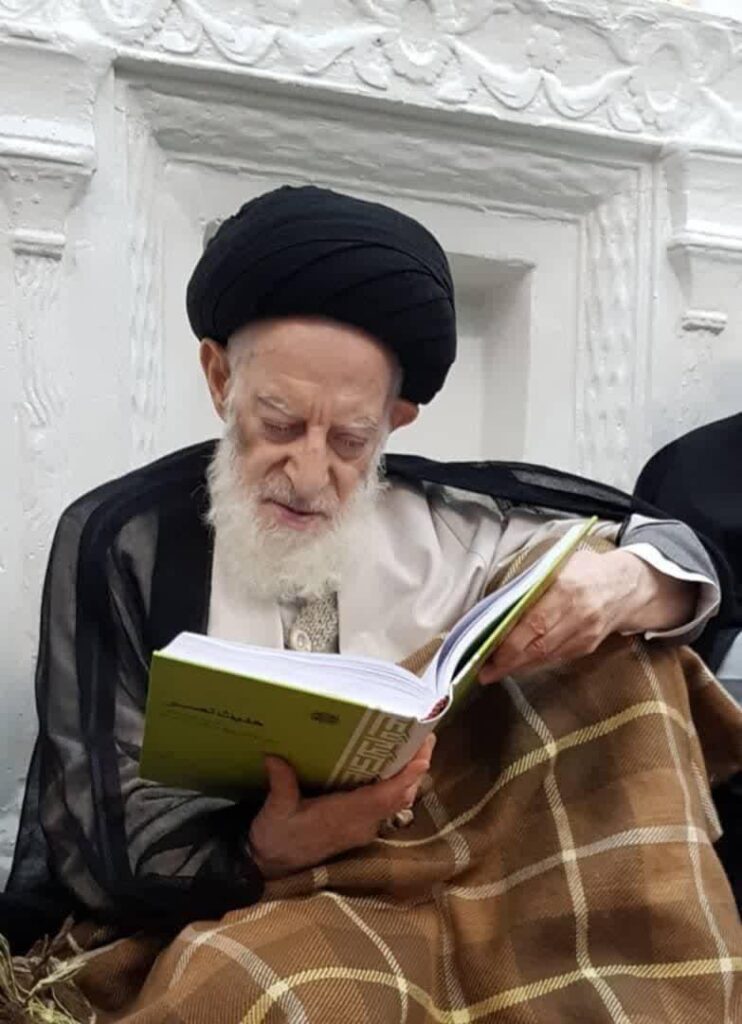
By Ustad Sayyid Muhammad Mahdi Rafiʿpur
This is a speech delivered at the memorial ceremony for the eminent Shiʿi marjaʿ, His Eminence Grand Ayatullah Hajj Sayyid Musa Shubayri Zanjani (may God have mercy on him), in Qom on 10 Mehr 1405 SH [2 October 2026]. The text of the speech is presented to readers with editing and additions.
In the Name of God, the All-Beneficent, the All-Merciful
There is much to be said, from many different angles, about the eminent marjaʿ, our master and teacher, His Eminence Grand Ayatullah Sayyid Musa Shubayri Zanjani — may God the Exalted be pleased with him. In this note I shall touch on only some of them.
1. Personal Life
This great marjaʿ and scholar was born in Qom in 1306 SH [1927–28 CE], and married there. After several decades of serious engagement in study, and then in teaching, research, and the formation of accomplished and scholarly children and students, he passed away in Shahrivar 1405 SH [August–September 2026] at the age of ninety-nine, in the neighbourhood of the heavenly shrine of the Noble Lady of the Ahl al-Bayt, Hazrat Fatima Maʿsuma (s). Following a magnificent funeral procession, and the funeral prayer led by Ayatullah Subhani (may his blessings endure), his pure body was laid to rest on the first of Mehr [23 September 2026] in the shrine of the Noble Lady of the Ahl al-Bayt (a), beside the saintly marjaʿ, the late Ayatullah Sayyid Ahmad Khwansari (may God have mercy on him).
1.1 His Father
His noble father, the late venerable Ayatullah Hajj Sayyid Ahmad Shubayri Zanjani (1269–1352 SH [1890–1973 CE]), was his principal teacher in matters of ethics and character formation. Sayyid Ahmad Zanjani was one of the distinguished students of the late Grand Ayatullah Hajj Shaykh ʿAbd al-Karim Haʾiri Yazdi, the founder of the Qom seminary.
The Ustad was deeply influenced by his father’s dignified nobility, ethics, and detachment from worldly things. One might even say that although he benefited academically from great teachers such as the late Grand Ayatullah Burujirdi and the late Ayatullah Muhaqqiq Damad, it was from his noble father that he drew most in terms of conduct and disposition. I recall him once remarking that his father was superior to him (in jurisprudence).1
He grew up in such a family, under the shadow of his father’s care and upbringing, and from childhood entered the ranks of seminary students and the Shiʿi clergy.
1.2 Education and Teachers
After studying the introductory (muqaddamāt) and intermediate (suṭūḥ) levels under eminent figures such as Ayatullahs Shaykh ʿAbd al-Jawad Sidihi, Sayyid Rida Bahaʾ al-Dini, and Hajj Aqa Murtada Haʾiri, Ayatullah Shubayri Zanjani benefited from great teachers, among them the “Three Ayatullahs” (Āyāt-e Thalāth): Sayyid Sadr al-Din Sadr, Sayyid Muhammad Hujjat Kuhkamari, and Sayyid Muhammad Taqi Khwansari — he was one of the last surviving students of the Three Ayatullahs in our time — and then the supreme marjaʿ of the Shiʿa, Grand Ayatullah Burujirdi, who came to Qom in 1324 SH [1945 CE]. Mr. Shubayri was among those who attended his classes until the end of his blessed life.
He was also one of the students of the late Ayatullah Sayyid Muhammad Kazim Shariʿatmadari. The greater part of his years of study, however, was spent under the distinguished master of the Qom seminary, the late Ayatullah Hajj Sayyid Muhammad Muhaqqiq Damad (1286–1347 SH [1907–1968 CE]),2 and it was from him that he benefited most, particularly in the discussions of uṣūl al-fiqh. The late Ustad was one of Mr. Damad’s inner circle of companions and was known as such.
1.3 Study Partners and Friends
Alongside his studies and teaching, Ayatullah Shubayri Zanjani held extensive and sustained group discussions (mubāḥatha) with learned and well-regarded figures such as Ayatullahs Musavi Ardabili, Makarim Shirazi, Imam Musa Sadr, the martyr Beheshti, Sayyid Mahdi Ruhani, Ahmadi Miyanji, and Azari Qummi.
Most scholars hold study discussions during their student years and youth, but one of the Ustad’s scholarly distinctions was that his discussion sessions continued. His group discussion carried on until recent years, and in it the istiftāʾāt (requests for legal rulings) that had reached his office were deliberated. The participants changed over different periods; in later years eminent figures such as Ayatullahs Sayyid Muhsin Kharrazi, Shaykh Rida Ustadi, and Sayyid ʿAli Muhaqqiq Damad took part.
The late Ustad also maintained wide connections with leading scholars and learned friends, such as the late Ayatullah Hajj Aqa Rida Sadr, and held many scholarly conversations with them.
2. Juristic School, Teaching Method, and Intellectual Characteristics
Ayatullah Shubayri’s juristic school was a blend of the schools of the late Grand Ayatullah Burujirdi and Ayatullah Muhaqqiq Damad, together with the Ustad’s own particular characteristics, innovation among them.
In precision and attention to fine points, he followed the style of the late Muhaqqiq Damad (the analytical method); in his thorough investigation of scholarly opinions and his attention to the early scholars (qudamāʾ) and to Sunni jurisprudence (the historical method), he belonged to the style of his teacher Ayatullah Burujirdi — accompanied, of course, by very detailed discussions of rijāl. As his published works attest, the Ustad’s rijāl discussions are more detailed and more precise than those of his teacher, the late Ayatullah Burujirdi.
Unlike our own time, when most people are inclined to learn knowledge in summarized and rapid form and welcome fluent and simple lessons, the Ustad’s teaching method was the complete opposite: he took great care to set out the details, the remote and proximate premises, the sources, and the manuscript tradition.
The size of the class and the number of students did not matter to him. He presented the lesson with its full premises, laid out every source he had consulted one by one, and if a position faced, say, five objections — unlike those who, for brevity, content themselves with mentioning one or two — he would state them all, so that nothing remained and the investigation was complete. One might say that he was a fine researcher even more than he was a fine teacher.
2.1 Chapters of Jurisprudence Taught
Over some fifty years of teaching dars-e khārij in jurisprudence, he taught the following books in detail:
- Hajj (Pilgrimage)
- Ijāra (Hire and Lease)
- Khums
- Ṣawm (Fasting)
- Nikāḥ (Marriage)
- Part of Bayʿ (Sale)
2.2 Precision and Subtlety
From his youth, he was known for the precision of his views. Ayatullah Makarim Shirazi’s message of condolence likewise refers to the discussions he held with the Ustad in their youth, and to the Ustad’s precision and subtlety.
Some scholars possess a breadth of knowledge but little precision. Their statements are full of inconsistencies; at times even the beginning and end of the anecdotes they relate do not agree. The late Ustad, however, combined a breadth of knowledge and anecdote with precision.
This precision and subtlety ran through how he received, expressed, and investigated every matter — whether juristic, uṣūlī, or historical. For example, I witnessed how, when presented with an account of a dream about one of the marājiʿ after his death, he questioned each individual carefully about every detail of the dream, then weighed, assessed, and compared their accounts in order to arrive at the original dream.
A person who is this exacting even when hearing a dream — how much precision and scrupulousness must he have exercised in transmitting hadiths, in the verses of the Qur’an (such as the discussions he held in the Book of Marriage on the noble verse «وَابْتَلُوا الْيَتَامَىٰ حَتَّىٰ إِذَا بَلَغُوا النِّكَاحَ» “And test the orphans until they reach the age of marriage…” (4:6)), and in attributing anything to the religion.
2.3 Return to the Sunna/Hadith
His most prominent intellectual and scholarly characteristic, which set him apart from most of his contemporaries, was his return to, and the importance he gave to, the Sunna and the hadith sciences. If, in the deductive framework of some jurists, the Qur’an or consensus/widespread opinion (ijmāʿ/shuhra) carries greater weight, in his deductive framework the Sunna carried the principal weight. Rather than naively accepting things that had come into being over the course of various centuries, he was — owing to his precision and attention to the primary sources — highly sensitive to the principle that anything attributed to the Sunna must have a basis in the earliest sources. Mr. Shubayri was one of the great hadith experts of the Shiʿi world.
His dedication to collating different manuscripts of the hadith collections, and the great amount of time he devoted to studying and researching the science of rijāl, can be understood in this light.
As a result of this very dedication to the hadith sciences, Ayatullah Shubayri was honored with licences of transmission (ijāzat al-riwāya) from eminent figures, and was himself one of the transmission authorities (mashāyikh al-riwāya) of the contemporary period, granting licences of transmission to a relatively large number of people.
His transmission authorities, as far as is well known, were Ayatullahs Sayyid Sadr al-Din Sadr (the father of Imam Musa Sadr), Sayyid Sharaf al-Din ʿAmili, Shaykh Aqa Buzurg Tihrani, and Sayyid ʿAbd Allah Thiqat al-Islam Isfahani,
and I believe he may also have held licences from certain other eminent figures.
2.4 A Great Critic
Another of his prominent intellectual characteristics was his critical engagement with widely held views (mashhūr) and with the eminent scholars of his time. In particular, he was attentive and persistent with regard to the views of Muhaqqiq Khuʾi. In the contemporary period, the juristic and uṣūlī views and foundations of the late Grand Ayatullah Sayyid Abu al-Qasim Khuʾi are among the principal bodies of thought discussed in the seminaries, and they have many followers. Many of the works of Muhaqqiq Khuʾi’s students are little more than rewritings and summaries of that great man’s scholarly discussions. For this reason, and because of his lofty scholarly standing, the late Mr. Shubayri took great care to present and critique his views — though in many cases his own rulings were also influenced by him. Scholarly and intellectual discussion is, by its nature, a field of mutual influence. Even a cursory review of his published works of ijtihād bears out this claim. Mr. Shubayri was perhaps not a great founder of new systems, but he was a very fine critic, and he critiqued every deductive approach — sometimes at the level of foundations (naqd-e mabnāʾī) and sometimes at the level of their application (naqd-e bināʾī) — the details and instances of which are extensive.
2.5 The Science of Uṣūl
The late Ayatullah Shubayri held a minimalist view of the science of uṣūl. He neither opposed nor denied, as the Akhbaris did, the lofty place of uṣūl in deriving legal rulings and in ijtihād; nor, like many contemporary jurists, did he believe in spending time on learning the uṣūlī foundations of contemporary scholars. He considered it sufficient for a capable student to master Shaykh Ansari’s al-Rasāʾil, Akhund Khurasani’s Kifāyat al-Uṣūl, and Hajj Shaykh ʿAbd al-Karim Haʾiri’s Durar al-Uṣūl.
He himself apparently taught only one cycle of khārij in uṣūl and left it at that. In his juristic discussions, of course, wherever it was necessary and the discussion turned on settling an uṣūlī foundation, he engaged with it seriously — as in the discussion of inqilāb al-nisba (the reversal of relation) in the conflict of evidence. Yet even in such cases he felt no obligation or inclination to study and present the discussions of great uṣūlīs such as Muhaqqiq Isfahani and Muhaqqiq ʿIraqi, let alone contemporary uṣūlīs such as Muhaqqiq Ruhani and the martyr Sadr. In this respect his style resembled that of the late Ayatullah Muntaziri. He would present and examine the views of the Shaykh [Ansari] and the Akhund [Khurasani], defend his own position, and move on. At times the views of Muhaqqiq Naʾini and Muhaqqiq Khuʾi were also considered, but he did not bind himself to them.
At times, of course, some of those present who had studied or had in mind the views of other great uṣūlīs would raise them in his class or scholarly gathering, and he would listen carefully, raise objections, and discuss them.
2.6 Belief in the Closure of the Door of Knowledge (Insidād)
In the science of uṣūl, there is an important and decisive question: to what extent can we reach the actual rulings of the Sharia/religion? If we can attain knowledge, or at least particular reliable evidence whose authority has been established by a knowledge-yielding proof — such as the solitary report (khabar al-wāḥid) — then there is no need to act upon conjectures (ẓunūn). This is the widely held view of contemporary uṣūlīs. In the Ustad’s view, however, there is no reliable evidence for that claim, and he therefore arrived at the closure of the door of knowledge and of knowledge-equivalent evidence (insidād bāb al-ʿilm wa-l-ʿilmī). An account of this decisive foundation and its consequences lies beyond the scope of this note, and is therefore deferred to another occasion. Briefly, however, it should be noted that this was one of the most important reasons for the divergence between Ayatullah Shubayri Zanjani’s rulings and those of his contemporaries.
2.7 Changing His Opinion
Unlike some distinguished scholars for whom changing their view and revising their opinion is difficult, the Ustad held no partisan attachment to his own opinions. If he found strong evidence contrary to his view, he would retract it, whether in teaching or in issuing rulings. An example is his ruling on the ritual bath (ghusl) of iḥrām.
There is much more to be said about the Ustad’s scholarly side, but for now these points will suffice.
3. Marjaʿiyya
The late Mr. Shubayri’s marjaʿiyya began formally after the death of the late Grand Ayatullah Araki (in 1373 SH [1994 CE]), with his nomination by the Society of Seminary Teachers (Jāmiʿa-ye Mudarrisīn). It is likely that people had begun turning to him for emulation (taqlīd) from after the death of the late Grand Ayatullah Khuʾi.3
From beginning to end he took no interest whatsoever in spreading his marjaʿiyya, and the reason it did not expand was, first and foremost, his own personal character. The number of followers and requests for rulings meant nothing to him; he gave greater importance to the educational dimension — to teaching and research — and regarded the marjaʿiyya as something that had come about and been placed upon his shoulders as a duty.
His practical treatise (risāla ʿamaliyya) was a single, incomplete volume, and it took years before the contents of its second volume were discussed and examined in the council for rulings and in special sessions, then published and subsequently merged with the first.
His marjaʿiyya and issuing of rulings began in 1373 SH and continued until 1405 SH (about thirty-two years). He left behind a fine legacy of rulings (istiftāʾāt), part of which has been published; it is hoped that the rest will be completed and made available. By virtue of this marjaʿiyya and the religious dues that reached him, he administered the Imam Muhammad Baqir (a) School and Juristic Center.
4. Works
Although Ayatullah Shubayri wrote few independent books and articles, he annotated and commented on many works. Fortunately, during the last two decades of his blessed life, through the efforts of his juristic center and the Shiʿi Bibliographical Institute (Muʾassasa-ye Kitābshināsī-ye Shīʿa), a number of fine works based on his views were compiled and published, some of which are listed below:
- Tawḍīḥ al-Masāʾil
- Al-Masāʾil al-Sharʿiyya (his Arabic treatise)
- Istiftāʾāt (2 vols.)
- Manāsik-e Ḥajj (Arabic/Persian)
- Aḥkām-e Kārbordī (Applied Rulings)
- Kitāb al-Nikāḥ (12 volumes so far: transcribed lectures)
- Kitāb al-Ijāra (lecture notes)
- Kitāb al-Ṣawm (lecture notes)
- Kitāb al-Khums (lecture notes)
- Kitāb al-Bayʿ (lecture notes)
Critical editions:
- Critical edition of the noble al-Kāfī
- Critical edition of Tahdhīb al-Aḥkām
- Critical edition of al-Barqi’s Kitāb al-Maḥāsin
Annotations:
The Ustad annotated many books, some of which have been published while others remain in manuscript. Each volume of the four-volume collection Jurʿa-ī az Daryā (A Sip from the Ocean) opens with his annotations on Arabic and Persian books. Most of these works concern history and biography. Some of them are:
- Annotations on the treatise al-Witr Thalāth by the late Ayatullah Sayyid Mahdi Ruhani
- Annotations on al-Ijāza al-Kabīra by ʿAllama Sayyid Hasan Sadr
- Annotations on Ṭabaqāt al-Ijāzāt bi-l-Riwāyāt by ʿAllama Sayyid Hasan Sadr
- Glosses on Nuqabāʾ al-Bashar by Shaykh Aqa Buzurg Tihrani
- Glosses on the Khātima of Mustadrak al-Wasāʾil by Hajji Nuri
- Gloss on al-Majdī fī Ansāb al-Ṭālibiyyīn by Sayyid Sharif ʿAlawi ʿUmari
- Annotations on Āshnā-ye Ḥaqq (the life and thought of Aqa Muhammad Bidabadi) by Shaykh ʿAli Sadraʾi Khuʾi
- Glosses on al-ʿUrwa al-Wuthqā (manuscript)
5. His Ethical and Spiritual Conduct
Much could be said about the ethical qualities of the late Ayatullah Shubayri Zanjani. Although he was not formally a teacher of ethics in the seminary, and avoided occupying the seat of spiritual guidance and moral instruction, he had gathered within himself many ethical perfections, and spending time with him was, quite naturally, a lesson in ethics. In this limited space I shall mention a few of these qualities:
5.1 Humility
Humility is among the teachings of the ethical and educational school of the Ahl al-Bayt (a). One of the late Ustad’s most conspicuous qualities was humility. His humility was genuine, not affected. It was not that he considered himself superior and yet tried to behave modestly towards others; rather, he truly did not regard himself as anyone of note. He genuinely respected others, and this was natural and ordinary for him.
In earlier years, when he still had the strength and used to sit on the floor, he would rise for anyone who entered the room — it made no difference whether they were old or young, or whether or not they wore the dress of a religious scholar.
5.2 Accessibility
Another of his qualities, which stemmed from the humility just described, was his accessibility. Anyone who had business with him could easily find him and speak with him. He had set up no gatekeepers or entourage around himself. He listened carefully to the questions of ordinary people and of beginner students, whatever their level, and tried to guide them.
5.3 Avoidance of Pretension and Cultivating Devotees
Among his conspicuous qualities was his avoidance of self-praise, pretension, and the cultivation of devotees (murīd-bāzī). When a person does not see himself, he naturally makes no claims. Sadly, we see that some, after a few dreams and spiritual experiences, become deluded and make false claims.
5.4 Congregational Prayer
He was one of the few contemporary scholars who, for more than forty years, led the congregational prayer three times a day: the dawn and sunset prayers in the holy shrine of Hazrat Maʿsuma (s), and the noon prayer at the Fayziyya School.
5.5 Commitment to the Supererogatory Prayers
He was committed to performing all the daily supererogatory prayers (nawāfil). He was one of the few who performed the sixteen rakʿas of supererogatory prayer for noon and afternoon — which prayer leaders usually do not manage to perform — swiftly and carefully. If a Sunna is not upheld by great scholars, what can be expected of others?! The narrations of the Ahl al-Bayt (a) place great emphasis on performing the daily supererogatory prayers, and even recommend making them up if missed.
5.6 Visiting Graves
When visiting the graves of believers and scholars, he made a point of following the instruction given in a reliable narration: placing his hand on the grave of the deceased seven times and reciting the blessed Surat al-Qadr seven times, so that — in the words of the narration — both the visitor and the deceased would be forgiven.
6. His Social and Political Conduct
The late Ayatullah Shubayri’s main and principal audience was the seminary elite, and at times the university elite. Even so, he never separated himself from society at large, and did whatever was within his power for the people. Leading the three daily congregational prayers for all, performing marriage contracts, istikhāra, answering religious and ethical questions, and at times offering family and educational counsel were among the things to which he was regularly committed.
He held a regular public gathering every day at sunset, which in recent years had moved to the evenings, and anyone who wished to see him could attend. I must speak separately, on another occasion, about this public and scholarly gathering and its role in transmitting the culture of authentic Shiʿi clergy to other generations.
His noble gathering was closed to no one. He had connections with various spectrums of contemporary scholars and politicians, and people of different outlooks and intellectual tastes came and went at his home.
If we look at a list of his study partners and friends, we find all kinds of spectrums with diverse intellectual differences, and he exchanged views and debated with all of them.
Some individuals who had at times been harmed in the political currents and events of the day would turn to him, and he would try, as far as possible, to resolve their difficulties. Ayatullah Shubayri believed that the standing and honor God had granted him must be spent in meeting the needs of believers and of human beings, and for this reason he would sometimes mediate on humanitarian grounds.
Refraining from expressing opinions on, or intervening in, matters in which he had no expertise or experience was one of the late Ustad’s characteristics, of which numerous instances could be cited. Accordingly, in his meetings with politicians and officials of the country, he would usually advise them to be mindful of the people’s condition, to ease the economic pressure on them, and to uphold the established essentials of the religion and the school [of the Ahl al-Bayt], and would say nothing more.
In closing, we ask God the Exalted to immerse the soul of this noble scholar and God-fearing marjaʿ in His all-encompassing mercy, and to grant all of us the success to grasp, understand, and act upon the Book and the Sunna.
And all praise belongs to God, Lord of the Worlds.
Footnotes
- In fairness, a study of the works of the late Ayatullah Sayyid Ahmad Shubayri Zanjani compared with those of the Ustad shows that the late Ustad was more precise in his views than his father, but that his father had a more comprehensive command of jurisprudence as a whole. Moreover, the Ustad was more given to writing glosses, whereas his late father was more given to authorship.
- For further reading on the late Ayatullah Muhaqqiq Damad, see Āmūzgār-e Fiqāhat (Teacher of Jurisprudence), published by the Shiʿi Bibliographical Institute, first edition, 1398 SH [2019 CE].
- Some marājiʿ hold an informal marjaʿiyya for a period before their marjaʿiyya is formally announced. This period is sometimes short and sometimes long.