By Sayyid Husayn Kashfi
In the Name of God, the Most Compassionate, the Most Merciful
Introduction
These notes are the fruit of certain meetings and contacts I had in recent years with the jurist of the Ahl al-Bayt of infallibility and purity, the eminent marjaʿ, the late Grand Ayatullah Shubayri Zanjani. At times it was at the Thursday-night gatherings in the home of the late Ayatullah Hajj Sayyid Mahdi Rawhani; at times in his lessons and scholarly discussions; and at times, by virtue of a family tie through marriage, I was granted the opportunity to meet and converse with him.
What I record here reaches only as far as my own vessel and capacity, and as far as the opportunity I was given over these years to observe and understand some dimensions of the personality of this great marjaʿ.
If one cannot draw up all the water of the sea,
One should still taste as much as one’s thirst allows.
This piece does not set out to relate everything I heard from him or every memory I have of him. What has been gathered here relates mostly to recollections and observations concerning his character, disposition, manner and conduct; and for this reason I believe that recording and passing them on, however slight, is not without value.
Sayyid Husayn Kashfi
2 Mehr 1405 SH [24 September 2026]
Precise Retention: The Mark of a Trustworthy Narrator
Ayatullah Shubayri Zanjani was fond of relating stories about the conduct of the ʿulama and the events of contemporary history, and in these accounts he was, in the truest sense of the word, thiqa (trustworthy). Being thiqa here does not only mean probity and truthfulness; he was also ḍābiṭ in his narration, meaning that he retained what he had heard exactly as he had heard it, with care, nuance and detail, and then related it. For this reason, his accounts of the conduct of the scholars and of historical events hold a special place.
I recall one example of this precise retention, which I will relate.
Ayatullah Shubayri Zanjani made a point of attending the Thursday-night rawḍa gathering in the home of the late Ayatullah Hajj Sayyid Mahdi Rawhani. On the occasion of his presence, I in turn would try to present to him documents, photographs and recollections that were in some way connected to him.
Ayatullah Shubayri relates the account of the final moments of Mirza Shirazi and the episode of the “ruling on burnt bread” in his book Jurʿa-i az Darya (vol. 1, p. 113), from the late Hajj Sayyid Mahdi Rawhani, who in turn related it from his uncle, the late Hajj Aqa Ahmad Rawhani.
Recently, the diary of the late Ayatullah Hajj Aqa Ahmad Rawhani, some forty pages in a small format, came to light, and this same account concerning Mirza Shirazi was recorded in it.
On 25 Dey 1398 SH [15 January 2020], on the occasion of Ayatullah Shubayri’s visit to the home of the late Aqa Rawhani, I took a copy of the late Hajj Aqa Ahmad’s handwritten text with me to the gathering and raised the matter with him. He said:
“First I will relate the account to the gentlemen, and then you read from Hajj Aqa Ahmad’s handwriting.”
The late Hajj Aqa Ahmad wrote in a cursive shikasta hand, and in places I could not read it easily; nevertheless, I read out the greater part of it to him.
What was remarkable was that the text of the late Hajj Aqa Ahmad’s manuscript matched exactly the account Ayatullah Shubayri had related years earlier from the late Aqa Rawhani. This correspondence shows clearly both his precision and retention in narration and the precision of the late Aqa Rawhani.
The audio of this session was also recorded, and I have published it online.
Differences Between Accounts: Not Even the Details Escaped His Memory
I recall another example of his precise retention. The late Ayatullah Hajj Aqa Nasrullah Shahabadi used to relate an account from his maternal uncle, the late Ayatullah Hajj Aqa Ahmad Rawhani. The gist of it was that Hajj Aqa Ahmad had said to Shariat Sangalaji, who denied the rajʿa (the Return): “You have left aside the deviations of the Safi-ʿAli-Shahis, the Gunabadis and the like, and fastened onto the question of the Return?!”
Shariat replied: “I am afraid of them.”
Shariat then related a lengthy account: one day he was teaching Sharḥ al-Lumʿa, and in the middle of the lesson he said something insulting about al-Shahid al-Thani. An old man with a bundle on his shoulder, who was present in the class, apparently exerted some influence over him, such that Shariʿat said: “It was as though I had no learning at all and could not work out how to hold the book.” (See Hadith-e Nasr, p. 143.)
Ayatullah Shubayri would relate this story and then say: “In the late Hajj Aqa Nasrullah Shahabadi’s account, the book is Sharḥ al-Lumʿa; but in the account I heard from Aqa Sayyid Muhammad ʿAli Rawhani, it is al-Maʿālim.”
This struck me greatly, because it showed that he had retained not only the substance of the story but also the difference between the two accounts, and even the details of how they diverged.
Many such examples can be found in Jurʿa-i az Darya, and anyone familiar with that work can readily see his precision and his command of historical recollections and accounts.
The Humility of a Great Marjaʿ
 We have all heard of the humility of Ayatullah Shubayri Zanjani; but when we witness this humility in a personality of such scholarly and social standing, it takes on a different meaning. When someone whose teachers acknowledged his learning and excellence from his youth, and whose friends and study partners always gave him precedence, preserves that same spirit of humility in later years and upon reaching the station of marjaʿiyya, that humility carries all the more worth.
Here I relate a few examples of his humility, in conduct and in scholarship, that I witnessed myself.
Among the People, Even at Funerals and Prayers
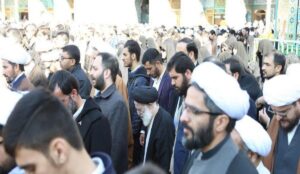
In 1397 SH [2018–19] I attended the funeral procession of the late Ayatullah Muʾmin Qummi. The funeral prayer over his body was led by Ayatullah Subhani. At the time of the prayer, in the middle of the courtyard of the shrine of Lady Maʿsuma (s), I noticed Ayatullah Shubayri standing among the crowd, preparing to pray.
For all his standing, he claimed no special status for himself; like everyone else, he stood among the crowd and took part in the procession and the prayer over the body of a scholar.
A Humility That Was Not Mere Courtesy
Ayatullah Shubayri’s humility was not merely ceremonial behaviour or ordinary politeness; one genuinely felt this lowliness in dealing with him.
In Ordibehesht 1401 SH [April–May 2022], I attended the scholarly sessions held at his office.
As I arrived at the office, Ayatullah Shubayri’s car also pulled up, and Aqa Mustafawi, his nephew (his sister’s son), was also standing at the door.
His office has a door onto the lane; once inside, one reaches another space with a second door, and from there a corridor leads to the courtyard of the office, where the scholarly sessions were usually held.
As we were about to enter, Ayatullah Shubayri insisted several times that I go ahead of him. I was truly embarrassed by this, and at the same time astonished at the humility of this great marjaʿ.
After me, he also invited Aqa Mustafawi to go ahead. Once we had passed through the first door, as we came to the second door and the corridor, he again insisted that I go first.
Humility in the Field of Scholarship and Honouring His Contemporaries
His humility was not confined to social conduct; the same spirit was clearly visible in scholarly and intellectual matters.
People usually mention their contemporaries less in scholarly matters; but Ayatullah Shubayri had no reservation in this regard. If he found a principle held by a contemporary scholar convincing, or made use of it, he would say so openly.
For example, when in 1387 SH [2008–09] he began the discussion of the Qāʿidat lā ḍarar (the no-harm principle) on Thursdays and Fridays, the discussion centred on Ayatullah Sistani’s book Qāʿidat lā ḍarar. He also had a thorough grasp of Ayatullah Sistani’s principles and views. Once in class I even heard him say: “By his principles, Aqa Sistani would say this.”
A Man Has Two Words
One of the important expressions of his scholarly humility was his acceptance of criticism and his readiness to admit error; at times this even led to a change of view and of fatwa.
In those same sessions on the no-harm principle, he had quoted and explained a passage from the late Fayd [Kashani] in al-Wāfī. Later it seemed to him that he had not correctly understood what the passage in al-Wāfī meant. In the next session he began the lesson with these words:
“My late father used to relate a saying from his teacher, the late Ayatullah Haʾiri, who would say: ‘It is well known that a man has only one word; but I say a man has two words. A real man is one who, when he realises what he said was wrong, does not stand by it but goes back on it.’”
Then, regarding the narration on “withholding surplus water” (manʿ faḍl al-māʾ), he said: “Various meanings have been given for this hadith. As for the first meaning given for it, the one reported in al-Wāfī, we misunderstood the wording of al-Wāfī and took it wrongly…”
An Unbreakable Bond with Students and People
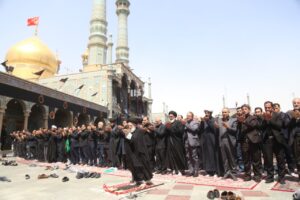
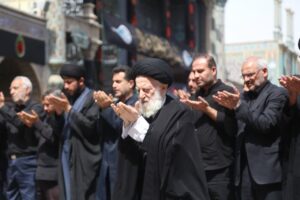
Some time ago I wrote a note entitled “The Tradition of Mosque Stewardship and the Unbreakable Bond Between the Hawza and the People”, in which I referred to the leading of congregational prayer by the great scholars of Qum and Najaf. One of the clearest examples of this tradition was the late Ayatullah Shubayri Zanjani.
He led all three prayer times in congregation: the dawn prayer and the sunset and night prayers in the holy shrine of Lady Maʿsuma (s), and the noon and afternoon prayers in the Fayziyya seminary.
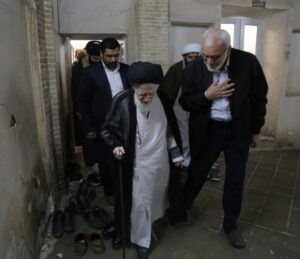
His home, in the Qum-e Now neighbourhood, was neither a stone’s throw from the shrine nor so far away that coming and going was difficult; even so, he chose to walk to the congregational prayers and to his lessons, and continued this practice until the late 1380s SH [c. 2010].
This meant that a marjaʿ al-taqlid, with all his scholarly standing, was present among ordinary people three times a day. People could see him, raise a question or a need with him directly, walk alongside him, and benefit from his words and counsel.
This direct connection with the people has been part of the tradition of the Shiʿi seminaries.
This practice of his was not limited to Qum. In Mashhad too he led congregational prayer at the Mulla Hashim Mosque, and even when he went for short stays in the summer to the village of Dastgerd near Qum, he kept up his connection with the people and continued to lead the congregation. His grandson told me that for the noon and sunset prayers one of the villagers would come to fetch him. Interestingly, Hajj Aqa made a point of returning by a different route from the one he had come by, saying that this was recommended (mustaḥabb).
Not Even for One Day in the Village Did He Neglect Prayer in the Mosque
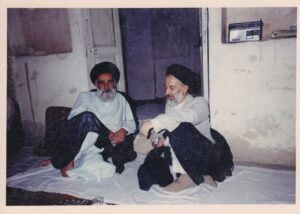
A resident of the village of Tireh, Aqa Mash-Ismaʿil Zareʿ, who was in contact with the late Aqa Rawhani for many years and had repeatedly invited his friends, including Ayatullah Shubayri, to his orchard in Tireh, told me that his acquaintance with Aqa Rawhani began when he saw him in the village mosque.
Hajj Ahmad, the caretaker of Aqa Rawhani’s mosque, was from Tireh and had invited him there. On the one day he was in Tireh, Aqa Rawhani went to the village mosque.
Aqa Zareʿ related: “Aqa Rawhani came into the mosque courtyard, took the loudspeaker pole, and drew a line on the ground. Then he said to me:
‘Next week, at one minute past one in the afternoon, see whether the shadow of this marker falls on this line or not, and let me know.’
The following week I did as Aqa Rawhani had asked, and when I came to Qum I reported back to him. That episode was the beginning of our connection and acquaintance with him.”
A Marjaʿ Who Answered the Students
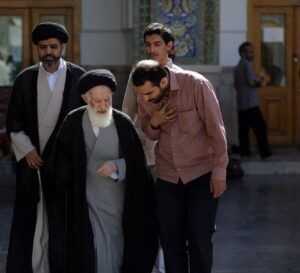 Ayatullah Shubayri’s connection with the seminary students was not limited to their attending his lessons or accompanying him on his way to and from them. Scholarly sessions were also held before sunset, and any student could attend and put his questions to him directly.
I have a friend among the learned of the hawza, Shaykh Muhammad Dehqani, who asked Ayatullah Shubayri a great many questions. At times his questions concerned rare hypothetical cases and matters not addressed at all in the manuals of practical law or the collections of istiftāʾāt. He put most of these questions to him by telephone.
Even so, Ayatullah Shubayri answered patiently and never held back from responding to the students’ scholarly questions. Aqa Dehqani would say: “I do not recall him ever once saying, ‘Aqa, please don’t phone any more!’” This attitude reflected his breadth of heart and his concern for the students’ scholarly questions.
Aqa Dehqani has compiled these questions, some two hundred questions and answers, under the title Suʾalat-e Dehqani az Ayatullah Zanjani [Dehqani’s Questions to Ayatullah Zanjani].
No One Escaped His Notice
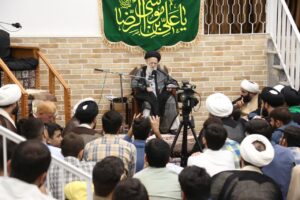 The way Ayatullah Shubayri conducted himself in these scholarly sessions, held in the late afternoons and, in recent years, in the evenings, always struck and delighted me. When he entered the courtyard of the office, he would greet everyone he saw along the way from the entrance to his chair.
Then, once seated, he would start from one side and look at each person sitting in the front row in turn, greeting and saluting them, continuing until the very last person.
Sometimes there were people in the second row or further back, and he would acknowledge them with a gesture of his hand and greet them. This simple act was a sign of his attention and respect for each individual present; it was as though it mattered to him that no one should feel unseen in that gathering.
Loyalty to an Old Friendship: Thursday Nights at Aqa Rawhani’s Home
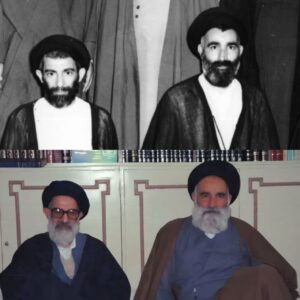
The friendship between Ayatullah Shubayri Zanjani and the late Ayatullah Hajj Sayyid Mahdi Rawhani was a long one, lasting more than fifty-six years. From the beginning of their seminary days the two were study partners, companions, and close and loyal friends.
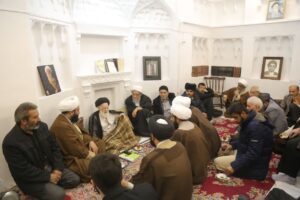
One expression of this loyalty was Ayatullah Shubayri’s regular attendance at the Thursday-night tawassul gathering at the late Aqa Rawhani’s home.
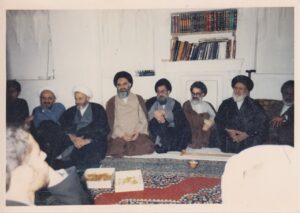
This gathering apparently had older roots: gatherings were also held in the time of the late Aqa Rawhani’s father and grandfather, the late Ayatullah Hajj Sayyid Sadiq Qummi. The late Ayatullah Hajj Sayyid Sadiq held his gathering on Friday mornings, whereas the late Aqa Rawhani held a tawassul gathering on Thursday nights. He himself would sit behind the samovar and pour tea for those present.
Aqa Rawhani’s friends, mostly among the learned and senior figures of the hawza, also attended. Indeed, in a meeting that the household of the late Ayatullah Shahabadi had with the martyred Leader of the Revolution, he remarked that he used to attend this Thursday-night gathering at Aqa Rawhani’s home almost every week.
From what I have heard from friends and those who attended, the gathering usually went like this: after a short talk by the speaker, Ayatullah Shubayri Zanjani would raise a point of fiqh, and a scholarly discussion would take shape from there.
After the passing of the late Ayatullah Rawhani, the gathering, praise be to God, continued. His son, Hajj Sayyid Muhammad Rawhani, would come from Tehran to Qum every few weeks, and the late Ayatullah Shahabadi also made a point of attending.
Ayatullah Shubayri Zanjani attended this gathering almost every week and spoke many times of his fondness for it and for being there. After he developed pain in his legs in the 1390s SH [2010s], his attendance became less frequent, roughly once every one or two months. This continued until the outbreak of COVID-19.
Part of my own connection with Ayatullah Shubayri, and of my personal recollections of him, goes back to these Thursday-night gatherings.

“All My Attachment Was to That Home and to the Late Aqa Rawhani”
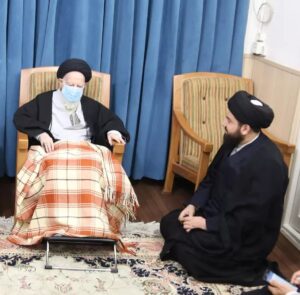
After the COVID period, on 28 Ordibehesht 1401 SH [18 May 2022], following Ayatullah Shubayri’s lesson, I went to see him in the upstairs room of his office. He was waiting to meet the children of the late Ayatullah Misbah.
I said to him: “Aqa! The Thursday-night gatherings at the late Aqa Rawhani’s home have resumed. Because we love you, we are letting you know; otherwise we would not wish to trouble you.”
He replied: “All my attachment was to that home and to the late Aqa Rawhani; but if circumstances permit, I will come.”
Then he made a remark that I found very striking and worth hearing. He said:
“Among our friends, Aqa Rawhani was the most complete (ajmaʿ): he was a learned scholar (mullā), and in that respect we benefited from him, and I also liked his taste and temperament. Some of our friends were not scholars, and some were scholars, but I did not care for their taste.”
Caring Correction: Criticism Paired with Encouragement
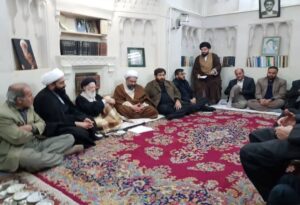 At the Thursday-night gatherings I would sometimes give the talk myself, and several times I had the privilege of speaking from the minbar in the presence of Ayatullah Shubayri.
His manner and his way of nurturing the speaker were very striking and instructive for me. He listened carefully to the talk, praised it, and if he had any criticism or observation, he would mention it afterwards.
Encouragement from a marjaʿ al-taqlid and a great scholarly figure like him has a profound effect on a young seminarian; it is something that many senior figures, despite its great importance, may pay little attention to.
Once I gave a short talk about Lady Fatima al-Siddiqa al-Tahira (s). After the talk, Ayatullah Shubayri said: “If we wanted to summarise a whole book about Lady Zahra, it would come out as your talk.”
That remark was greatly encouraging for me.
What was noteworthy, however, was that alongside this encouragement, if something needed correcting, he would point it out carefully, even in the details.
Once, during the rawḍa, I recited this verse:
lā khayra baʿdaki fī l-ḥayāti wa-innamā
abkī makhāfata an taṭūla ḥayātī
“There is no good in life after you; I weep only
for fear that my life will be long.”
But I recited baʿdaka, with the final kāf in the masculine form. After the gathering, as we were leaving (not in front of others), he first praised the talk and then said: “I know it was a slip of the tongue, but baʿdaki is correct.”
On another occasion I spoke about the necessity of dissociation (barāʾa) from the enemies of the Ahl al-Bayt (a) and about the Batriyya sect. There I pronounced “Batriyya” with a fatḥa on both the bāʾ and the tāʾ. After the talk Ayatullah Shubayri said to me: “The correct vocalisation is Butriyya, with a ḍamma on the bāʾ.”
A Friendship That Began in Mashhad
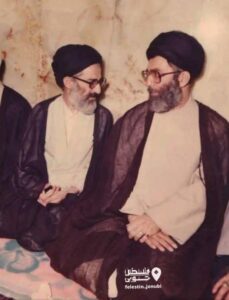 I have also heard accounts of Ayatullah Shubayri Zanjani’s relationship with the martyred Leader of the Revolution which show that this relationship went back a very long way.
The martyred Leader of the Revolution was a friend of Hujjat al-Islam wa al-Muslimin Hajj Aqa Jaʿfar Shubayri, and through him he also came to be close to Ayatullah Hajj Aqa Musa Shubayri Zanjani.
In a meeting that the household of the late Ayatullah Shahabadi had with him, the martyred Leader himself, referring to his companionship and friendship with Ayatullah Shubayri, said:
“My friendship with the late Hajj Sayyid Mahdi Rawhani goes back to the old days. I was friends with the Zanjani gentlemen, Hajj Aqa Musa and Sayyid Jaʿfar, back when I was in Mashhad. Aqa Zanjani’s friends, such as Hajj Sayyid Mahdi Rawhani, Aqa Azari, Aqa Mirmuhammadi, Aqa Mustafawi (the son-in-law of Aqa [Sayyid Ahmad] Zanjani) and perhaps Aqa Mirza ʿAli Ahmadi, used to come to Mashhad and had a room in the Nawwab seminary. That is where I got to know Hajj Sayyid Mahdi. I had not yet come to Qum. When I came to Qum in [13]36–37 [1957–58], since I already knew Hajj Aqa Musa, I became connected with this circle as well.”
The martyred Leader’s relationship with Ayatullah Shubayri was not limited to friendship and companionship; he also drew on his guidance in the course of his studies and in choosing his teachers.
Our esteemed teacher, Hajj Aqa Jawad Shubayri Zanjani, related that the martyred Leader of the Revolution had said:
“In how we studied and in choosing our teachers, we were under the guidance of your father [Ayatullah Shubayri]. He chose Aqa [Shaykh Murtada] Haʾiri for us. There were three of us: myself, Aqa Jaʿfar and one other person.”
The Martyred Leader of the Revolution’s Special Regard for Ayatullah Shubayri Zanjani
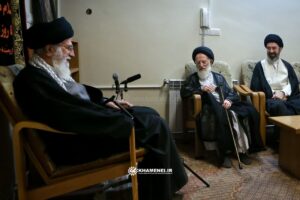 A few months before the martyrdom of the Leader of the Revolution, I was at Ayatullah Shubayri’s office. Ayatullah Musawi Jazaʾiri was also there, and on that occasion he related a memory of Ayatullah Khamenei’s regard for Ayatullah Shubayri.
He said that years earlier, perhaps in the early period of Ayatullah Khamenei’s leadership, a meeting had been held in Mashhad, in the holy shrine of Imam al-Rida (a). A room behind the Hall of Mirrors had been set aside for the meeting, and at the head of the gathering sat senior figures and scholars such as Ayatullah Murwarid. Ayatullah Shubayri was seated at the lower end of the room.
He said: “When I came in, I sat down beside Aqa Shubayri.”
He then related that when Aqa Khamenei entered, he first looked around at those present, and as soon as his eyes fell on Ayatullah Shubayri, he came over and sat down beside him. Hajj Aqa Musa then began speaking with him, and the Leader of the Revolution kept affirming what Aqa Shubayri said.
An Embodiment of Shiʿi Unity
Another of Ayatullah Shubayri Zanjani’s qualities was his cordial and warm relationship with a wide range of intellectual and social groups: from philosophers and mystics to followers of the Maktab-e Tafkik, from the most traditional currents in the hawza to intellectuals, as well as individuals and currents from across the political spectrum. He could relate to all of these groups with ease, without conflict or dispute. In my view, this quality can be seen as one of the important expressions of unity and rapprochement within the school, and for this reason I regard him as an embodiment of Shiʿi unity; a quality that seems to have been rooted in his intellectual principles and his manner of conduct.
For example, he did not hold that someone who denies an indispensable tenet of the religion (ḍarūrī al-dīn) is necessarily an unbeliever. In one of his advanced (khārij) lectures on zakat, in the course of discussing whether one who denies zakat is an unbeliever, he said: if someone inwardly acknowledges that whatever the Prophet (p) said is from God, and believes in this universal major premise, but says of zakat that Islam did not bring such a ruling and that there is no zakat in Islam, while inwardly believing that this ruling is part of Islam, we have no evidence that such a denial makes him an unbeliever. This act is not in fact a denial of the Prophet’s truthfulness (takdhīb al-nabī) but rather a lie attributed to the Prophet (kadhib ʿalā al-nabī), which counts as a sin and is among the acts that invalidate the fast, but does not entail unbelief or departure from the religion.
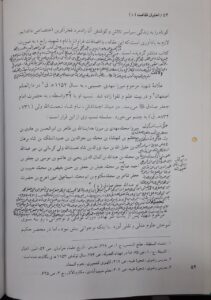
In the same vein, in his marginal notes on the book Akhtaran-e Fiqahat, which had attributed the declaring of members of the National Front to be unbelievers to the late Imam [Khomeini] and Ayatullah Gulpayigani, he wrote:
“The station of these two great marjaʿs is far too exalted for them to issue a blanket ruling of unbelief. A general declaration of unbelief does not accord with what is written in their manuals of practical law.” (Jurʿa-i az Darya, vol. 2, p. 281)
It is worth noting that Imam Khomeini’s declaration of the National Front’s apostasy was in fact a rejection of the group’s continued political activity, not a declaration that all of its members were apostates, since on most of a party’s positions there are those within it who agree and those who disagree, and they cannot all be brought under a single ruling.
We also heard him say repeatedly that the differences he had with some of his friends came down to a difference in taste; he did not turn them into disagreements over fundamental principles and beliefs. The range of his relationships was also very broad: from Aqa Azari Qummi, editor of the newspaper Resalat in the 1360s SH [1980s], to the late Hajj Aqa Reza Sadr, who was one of his close friends. He himself, however, considered his own intellectual and social temperament to be closest to that of the late Ayatullah Hajj Sayyid Mahdi Rawhani.
“I Am Acting on the Principle of What Remains Possible”
One of the qualities of Ayatullah Shubayri Zanjani was his particular attention to social courtesies, one expression of which was attending gatherings: whether rawḍa and mourning gatherings, or memorial (fātiḥa) gatherings held in honour of scholars and notable figures.
He used to attend the rawḍa of the first ten days of Muharram held at the Aqa Mosque and at the home of the late Aqa Burqaʿi in Guzar-e Khan. He also attended the memorial gatherings of scholars and notable figures whenever he could, right up to the final years of his life; the last of these was the commemoration of the martyred Leader on 19 Tir 1405 SH [10 July 2026].
During the COVID period, when attending such gatherings had become restricted, if he could not take part in person, he would make up for it in another way.
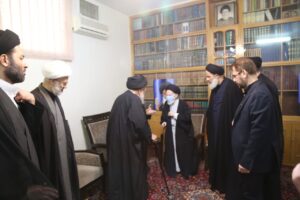
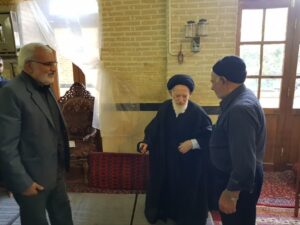
After the passing of the late Ayatullah ʿAlawi Gurgani on 24 Esfand 1400 SH [15 March 2022], he had been unable, because of the circumstances at the time, to attend the memorial gathering for him. A few days later he went in person to his home, and after apologizing, said:
“I am acting on the principle of what remains possible (qāʿidat al-maysūr); since I was unable to attend the memorial, I wanted to make up for it by coming to the house.”


Ayatullah Shubayri Zanjani’s Marginal Annotations
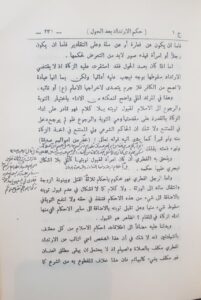
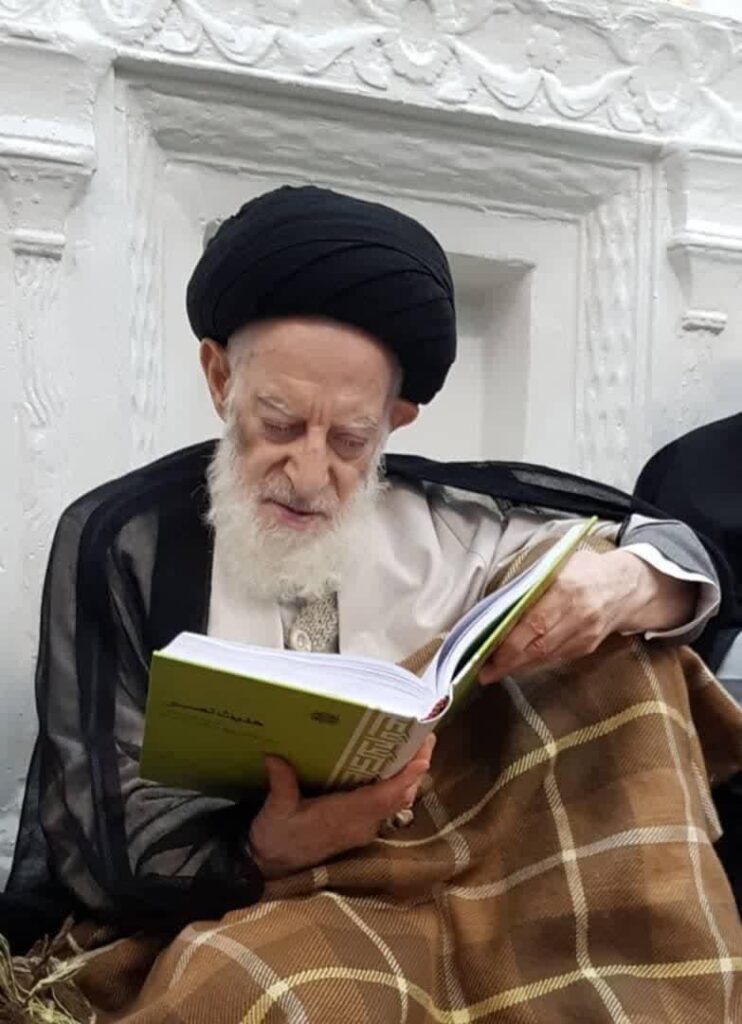
Ayatullah Shubayri Zanjani read books with great care and attention, and in the margins of many of them he recorded scholarly observations, critiques and even corrections of printing errors. His handwriting, too, was very fine, in the nastaʿlīq script. Nor were these books confined to works of rijāl and biography; he had read and annotated numerous works across a range of subjects and scholarly disciplines.
One evening, at one of his scholarly sessions, in connection with a discussion that had come up, some of the friends went to look for al-Mustanad fī Sharḥ al-ʿUrwa al-Wuthqā, the record of the late Ayatollah Khuʾi’s lectures. The book was in the upstairs room, within the friends’ reach. I too leafed through it, and as I turned the pages I noticed that Ayatullah Shubayri had written marginal notes and annotations on parts of it. I was delighted to see these notes and photographed that page as a keepsake. I then handed the book to our esteemed teacher, Hajj Aqa Jawad Shubayri, so that it would be preserved.
It is hoped that, through the efforts of the Imam Muhammad al-Baqir Institute, the collected annotations and other writings of Ayatullah Shubayri Zanjani will be gathered and brought to print, so that this valuable scholarly legacy may be made available to the people of learning.