
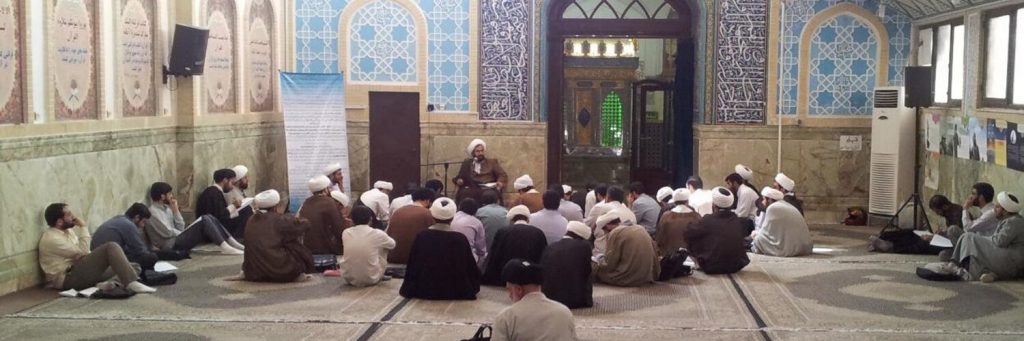
Principles of Jurisprudence (Uṣūl al-Fiqh)
Uṣūl al-Fiqh as well as Fiqh are known as the bread and butter of the seminary. A huge portion of what is studied in the seminary is studied because of its application in Uṣūl and Fiqh. Many scholars have tried to apply discussions in Arabic grammar, logic, philosophy etc. in discussions on the principles of jurisprudence. Following the division made popular by al-Shaykh Muḥammad Riḍā al-Muẓaffar in his Uṣūl al-Fiqh, the science can be divided into four main parts, followed by a concluding discussion on contradictory proofs.
The first part deals with understanding general concepts about language, particularly the Arabic language (mabāḥith al-alfāẓ). For example, this part will discuss the implications understood from a verb in the command tense. Some scholars will argue that a verb in the command tense implies wujūb (obligation) whilst others may argue that wujūb cannot be strictly understood from the command tense because the command tense has been used many times simply to establish istiḥbāb (recommendation). This part will also discuss more linguistic discussions such as how language came to originate, how we learn language and the relationship between words and meanings. Another discussion in this part is determining the implication of conditional statements. For example, take the proposition, “If a poor man comes to you, be respectful of him”. Does this proposition imply that if someone other than a poor man comes to you, that you do not have to be respectful of him? Similarly, this part discusses general and specific terms (al-‘āmm wa al-khāṣṣ), unrestricted and restricted terms (al-muṭlaq wa al-muqayyad), and how each is to be understood. These are the sorts of discussions that are dealt with in this part.
The second part deals with the rational relationships between rulings (al-mulāzamāt al-‘aqlīyyah). Here the question is not what a word means, but what reason concludes once a ruling has been established. For example, if an act is obligatory, are its preliminaries (muqaddimat al-wājib) also obligatory? If one is commanded to do something, does that imply a prohibition of its opposite? Can a single act be both commanded and prohibited at the same time, such as praying in a usurped place (ijtimā‘ al-amr wa al-nahy)? Does a prohibition on an act of worship or a transaction render it invalid (iqtiḍā’ al-nahy li al-fasād)? These discussions have very direct consequences in Fiqh.
The third part deals with establishing what can be used as evidence in jurisprudential discussions (mabāḥith al-ḥujjah). Most scholars agree that anything that results in certainty for a person can be used as proof when deriving jurisprudential rulings. Thus, they attempt to identify what tools can result in certainty. For example, does our apparent understanding of the jurisprudential verses of the Quran convey certainty to us so that we can use it when deriving rulings in Fiqh? Most scholars of the Uṣūlī school of thought would say yes, while scholars of the Akhbārī school may say no, each based on their own proofs.
Another important question in this part is concerning tools that may not give us certainty but are still recognized as being reliable by God. For example, most scholars would argue that solitary narrations (as opposed to mutawātir narrations) can be used as evidence in Fiqh because God has recognized their reliability. One of the proofs that such scholars will resort to prove this is the following verse, “O you who have faith! If a profligate [person] should bring you some news, verify it…” They will argue that if there is a solitary narration, narrated by someone who is trustworthy as opposed to profligate, then that narration can be relied upon because this is what is implied by the verse. Similar discussions take place regarding consensus (ijmā‘), the fame of a fatwā (shuhrah), and the conduct of rational people (sīrat al-‘uqalā’).
The fourth part deals with determining the principles to be applied when there is no proof in certain discussions (al-uṣūl al-‘amalīyyah, the practical principles). Using these principles, scholars will be able to determine what should be done in a situation when no proof can be found in the Islamic textual corpus for the permissibility or impermissibility of a certain action. There are four such principles: barā’ah (exemption from responsibility), iḥtiyāṭ (precaution), takhyīr (choice between two options) and istiṣḥāb (presumption of continuity of a previous state). Much of the discussion revolves around which principle applies in which kind of doubt, and these principles are used constantly in Fiqh. In the terminology of al-Shahīd al-Ṣadr, the proofs of the third part are al-adillah al-muḥrizah (proofs that reveal the ruling), while the principles of the fourth part are al-uṣūl al-‘amalīyyah (principles that determine one’s practical duty in the absence of such proofs).
The last discussion of Uṣūl is on determining what to do when there are two seemingly contradictory proofs for a certain matter (al-ta‘ādul wa al-tarājīḥ). There are many times that scholars will find seemingly contradictory proofs for different matters. Sometimes, one proof may be a verse of the Quran whilst another may be a narration. In other cases, both may be a narration. In any case, this part of Uṣūl discusses the methods of dealing with such cases. The first step usually discussed is to determine if it is possible to reconcile the two proofs. For example, the two proofs may seem contradictory, but it may in fact be possible to reconcile them if considered properly. In cases where reconciliation is not possible, different scholars will adopt different approaches. Some may argue that you can choose to adopt either proof whilst others may argue that you cannot use either proof. In any case, general principles on determining what to do in such instances are typically discussed in this part of Uṣūl.
Main Works in this Science
One should realize that Uṣūl al-Fiqh is a very vast subject in terms of literature. Most Shī‘ī scholars since the 4th & 5th century hijrī have focused their efforts on Uṣūl and Fiqh so as to be able to determine Islamic law. In what follows, the study guide will attempt to offer a brief summary of different Uṣūlī works and their authors so as to offer readers an idea of what this field entails. All death dates are in hijrī years.
Arguably, the first Uṣūlī book that was written and is still accessible today is al-Risālah by al-Shāfi‘ī (d. 204). Uṣūl was a science primarily developed by the Ahl al-Sunnah. In terms of Shī‘ī scholarship, the earliest extant work is a short treatise by al-Shaykh al-Mufīd (d. 413) entitled al-Tadhkirah bi Uṣūl al-Fiqh, which survives in an abridged form through his student al-Karajakī. Although brief, it is important because it shows the Uṣūlī positions of the Baghdad school before they were developed at length by his students. The oldest comprehensive extant books were written by al-Sharīf al-Murtaḍā (d. 436), entitled al-Dharī‘ah ilā Uṣūl al-Sharī‘ah, and al-Shaykh al-Ṭūsī (d. 460), entitled al-‘Uddah fī Uṣūl al-Fiqh. In terms of the history of the development of the science itself, al-Shaykh al-Ṭūsī was a heavy supporter of the reliability of solitary narrations as proofs, as opposed to his teachers al-Sharīf al-Murtaḍā and al-Shaykh al-Mufīd.
Later on, Muḥaqqiq al-Ḥillī (d. 676) and ‘Allāmah al-Ḥillī (d. 726) also wrote Uṣūl works such as Ma‘ārij al-Uṣūl and Nihāyat al-Wuṣūl ilā ‘Ilm al-Uṣūl respectively, amongst other works. ‘Allāmah also wrote a short introductory work, Mabādi’ al-Wuṣūl ilā ‘Ilm al-Uṣūl. Another very important work that was written was Ma‘ālim al-Dīn wa Malādh al-Mujtahidīn by the son of al-Shahīd al-Thānī, Ḥasan b. Zayn al-Dīn (d. 1011). This book was the subject of many famous glosses and was taught in the Islamic seminary up until recently. Shortly after, al-Shaykh al-Bahā’ī (d. 1030) wrote Zubdat al-Uṣūl, a concise work that also attracted commentaries.
Around this point, the Akhbārī school of thought began to rise. This was a school of thought that opposed the Uṣūlī school of thought. They argued against many general principles that were developed by the Uṣūlīs; for example, many Akhbārī scholars would argue that the apparent meaning understood from the Quran cannot be used to derive Islamic laws, and in fact verses of the Quran can only be used once determined and explained through the Imams within the ḥadīth corpus. Many famous scholars over the history of Islam were either Akhbārīs or at least expressed Akhbārī tendencies or views. One of the most famous Akhbārī scholars was Muḥammad Amīn al-Astarābādī, who wrote al-Fawā’id al-Madanīyyah as a refutation against many popular Uṣūlī views. There were many other famous scholars associated with Akhbārī views, such as ‘Allāmah Majlisī, al-Shaykh Ḥurr al-‘Āmilī and al-Shaykh Yūsuf al-Baḥrānī, just to name a few. In the same period, al-Fāḍil al-Tūnī (d. 1071) wrote al-Wāfiyah, a work of Uṣūl which takes a moderate position between the two schools and is a good example of how the Akhbārī critique influenced Uṣūlī writing. As of now, there may not be many scholars who claim to be Akhbārī, but there are many Uṣūlī scholars today who still possess Akhbārī tendencies and views. Although this school of thought played an important role in the future development of Uṣūl, and they developed many important ideas, their views and understandings are typically not very well covered in most classes. As such, one may refer to Professor Robert Gleave’s extensive research into the topic, as presented in his books such as Scripturalist Islam, to at least serve as an introduction.
In any case, the Akhbārī school developed and almost came to wipe out the Uṣūlī school until Waḥīd Bihbahānī (d. 1205) came and wrote a series of treatises refuting them, which are compiled in his al-Fawā’id al-Ḥā’irīyyah. He managed to strengthen the foundations of the Uṣūlī school through numerous works, and his students continued to do as such and wrote key works that were still studied until recently, such as al-Qawānīn al-Muḥkamah fī al-Uṣūl by Muḥaqqiq al-Qummī (d. 1231). Two other important works of this generation are Hidāyat al-Mustarshidīn, a lengthy commentary on Ma‘ālim al-Dīn by al-Shaykh Muḥammad Taqī al-Iṣfahānī (d. 1248), and al-Fuṣūl al-Gharīyyah by his brother al-Shaykh Muḥammad Ḥusayn al-Iṣfahānī, known after his book as Ṣāḥib al-Fuṣūl.
The present form of Uṣūl was entrenched by al-Shaykh al-Anṣārī (d. 1281), whose work Farā’id al-Uṣūl (also known as al-Rasā’il) is still the major work studied by senior students within the seminary. His school of Uṣūl ushered in a new era of efforts made within Uṣūl, as his students wrote further works, many of them being commentaries and glosses on the works of al-Shaykh al-Anṣārī. One of his students, Ākhund Khurāsānī (d. 1329), wrote a work entitled Kifāyat al-Uṣūl. This work also became an essential text within the Islamic seminary, primarily because of its inclusion of many philosophical discussions within Uṣūlī discussions.
The generation after Ākhund Khurāsānī produced three figures whose views dominate advanced Uṣūl to this day. Mīrzā Muḥammad Ḥusayn Nā’īnī (d. 1355) did not author his Uṣūl himself, but his lessons survive through two transcriptions: Fawā’id al-Uṣūl by al-Shaykh Muḥammad ‘Alī al-Kāẓimī and Ajwad al-Taqrīrāt by Sayyid al-Khū’ī. Āqā Ḍiā’ al-‘Irāqī (d. 1361) is known through Nihāyat al-Afkār, transcribed by al-Shaykh Muḥammad Taqī al-Burūjirdī, and Muḥaqqiq al-Iṣfahānī (d. 1361), known as Kumpānī, wrote Nihāyat al-Dirāyah, a highly philosophical gloss on the Kifāyah. In Iran, al-Shaykh ‘Abd al-Karīm al-Ḥā’irī al-Yazdī (d. 1355), the founder of the modern seminary of Qom, wrote Durar al-Fawā’id, which shaped the Uṣūlī tradition of Qom.
Later, al-Shaykh Muḥammad Riḍā al-Muẓaffar (d. 1383) wrote his work Uṣūl al-Fiqh, which became one of the primary introductory Uṣūlī texts studied in the Islamic seminary. More recently, al-Shahīd Muḥammad Bāqir al-Ṣadr (d. 1400) wrote a series of Uṣūl works designed to progressively introduce students to the science of Uṣūl. His series is named Ḥalaqāt al-Uṣūl (also published as Durūs fī ‘Ilm al-Uṣūl) and consists of three works. The first is supposed to serve as a very short introduction, while the second is what is primarily studied instead of al-Muẓaffar’s Uṣūl al-Fiqh in many seminaries. The third work may be studied instead of other works such as Farā’id al-Uṣūl or Kifāyat al-Uṣūl. After this level, a student should be more than ready to enter advanced classes (baḥth al-khārij). Al-Shahīd al-Ṣadr’s own advanced lessons were transcribed in Buḥūth fī ‘Ilm al-Uṣūl by Sayyid Maḥmūd al-Hāshimī al-Shāhrūdī and Mabāḥith al-Uṣūl by Sayyid Kāẓim al-Ḥā’irī, and are among the most original works of Uṣūl in the twentieth century.
It should be noted that the works of many contemporary scholars are not in the form of works authored by the scholars themselves. Rather, there is a tradition within the Islamic seminary for students to publish their transcriptions of their teachers’ lessons after their teacher completes a course that can take many years. For example, Shaykh Muntazārī is famous for his transcription of Sayyid Burūjirdī’s Uṣūl lessons, entitled Nihāyat al-Uṣūl. There have been at least two published transcriptions of Sayyid al-Khū’ī’s Uṣūl lessons; one of them, entitled Muḥāḍarāt fī Uṣūl al-Fiqh, was done by Shaykh Muḥammad Isḥāq al-Fayyāḍ, and another, Miṣbāḥ al-Uṣūl, by Sayyid Muḥammad Sarwar al-Bihsūdī.
In terms of the current Uṣūlī environment in the seminary, there is a lot of talk of shortening Uṣūl. Many scholars have argued that many Uṣūlī discussions do not have much application in Fiqh. Many works present Uṣūl so as to only include discussions that are applicable within Fiqh, such as Tahdhīb al-Uṣūl (lit. The Refinement of Uṣūl), Shaykh Ja‘far Subḥānī’s transcription of Sayyid Khumaynī’s Uṣūl lessons, or Sayyid ‘Abd al-A‘lā al-Sabzawārī’s work with the same title.
As evident, barely any mention of Sunnī Uṣūl al-Fiqh was made throughout this discussion, even though their Uṣūl played an important role in the development of Shī‘ī Uṣūl. One work within Sunnī Uṣūl that students may refer to is Sharḥ al-‘Aḍud ‘alā Mukhtaṣar Muntahā al-Uṣūl by ‘Aḍud al-Dīn al-Ījī, which is a commentary on Ibn al-Ḥājib’s Uṣūl work. This is a work that was studied by many Shī‘ī scholars as well, such as al-Shahīd al-Thānī. There are many other Sunnī Uṣūl works by famous scholars such as al-Ghazālī. Contemporarily, there have been works written comparing Sunnī and Shī‘ī Uṣūl al-Fiqh, such as al-Uṣūl al-‘Āmmah li al-Fiqh al-Muqāran by al-Sayyid Muḥammad Taqī al-Ḥakīm.
A Suggested Path of Study
Curricula differ between Najaf, Qom and other seminaries, and they have changed over the years. However, the general progression of Uṣūl textbooks usually looks like this:
-
Introductory level. Al-Muẓaffar’s Uṣūl al-Fiqh, or the first two Ḥalaqāt of al-Shahīd al-Ṣadr. Some seminaries also use shorter introductions such as Shaykh Ja‘far Subḥānī’s al-Mūjaz fī Uṣūl al-Fiqh. The goal at this stage is to know the map of the science, its terminology and the main positions on each question.
-
Intermediate level. Al-Shaykh al-Anṣārī’s Farā’id al-Uṣūl (al-Rasā’il), usually the sections on certainty, conjecture and the practical principles, followed by Ākhund Khurāsānī’s Kifāyat al-Uṣūl. Alternatively, the third Ḥalaqah of al-Shahīd al-Ṣadr may be studied in their place. Since the Kifāyah relies heavily on philosophical concepts, a good grasp of logic, and ideally some philosophy, is needed before studying it.
-
Advanced level. Baḥth al-khārij, where there is no fixed textbook. Here, the transcriptions of Nā’īnī, ‘Irāqī, Iṣfahānī, Sayyid al-Khū’ī and al-Shahīd al-Ṣadr mentioned above become the main reference points.
At each stage, commentaries are an important aid. On the Rasā’il, well-known glosses include Baḥr al-Fawā’id by Mīrzā Muḥammad Ḥasan al-Āshtiānī and Awthaq al-Wasā’il by Mīrzā Mūsā al-Tabrīzī. On the Kifāyah, apart from Muḥaqqiq al-Iṣfahānī’s Nihāyat al-Dirāyah, students often refer to Ḥaqā’iq al-Uṣūl by Sayyid Muḥsin al-Ḥakīm and Muntahā al-Dirāyah by Sayyid Muḥammad Ja‘far al-Jazā’irī al-Marawwij. For the third Ḥalaqah, Shaykh Bāqir al-Īrāwnī’s al-Ḥalqah al-Thālithah fī Uslūbihā al-Thānī restates the text in a more accessible style.
Finally, students will benefit greatly from a good dictionary of Uṣūlī terminology. One of the best is Farhang-e Tashrīḥī-ye Iṣṭilāḥāt-e Uṣūl by Āqā ‘Īsā Wilā’ī, a Persian dictionary that explains the terms with their usage and the differing views of the Uṣūlīs. It is especially useful when reading legal texts such as Sharḥ al-Lum‘ah, where Uṣūlī terms are used without explanation.
Methods and Benefit of Studying
As with all sciences, but more so in Uṣūl, students should first focus on developing a precise understanding of Uṣūlī concepts. There are many concepts that students may argue over, but they may not be able to explain and define them properly. At this stage, students should be able to draw out the premises used by Uṣūlī scholars and put them in the form of syllogisms for further criticism. Upon doing so, students may criticize such reasoning or may refer to other books of Uṣūl for further discussions. One will quickly realize that the amount of works and views within Uṣūl al-Fiqh is very vast. Students will need to be able to sort out different lines of reasoning based on different premises. They will need to understand that certain lines of reasoning can only be carried out based on certain premises.
One of the most important points for students new to Uṣūl is to establish the depth at which they want to study Uṣūl. As mentioned, there is a vast amount of works on Uṣūl al-Fiqh and a vast amount of views. Students wishing to try and discuss every view, or even multiple views, as they progress through Uṣūl textbooks may find this task to be impossible or difficult. As such, students should identify specific goals in terms of what other views they wish to study, rather than trying to comprehensively study many works at once. For example, someone studying the Ḥalaqāt of al-Shahīd al-Ṣadr will quickly realize that al-Shahīd often mentions and criticizes the views of his teacher, Sayyid al-Khū’ī. As such, it might behoove such a student to study Sayyid al-Khū’ī’s Uṣūlī discussions in order to develop a better understanding. This would also allow the student to try and defend Sayyid al-Khū’ī’s views in class against their teacher, for the sake of argument, in order to develop an understanding of Uṣūlī arguments.
In terms of the benefits of studying Uṣūl, perhaps the most immediately practical benefit for students will be developing an understanding of Uṣūlī jargon. This is important because students will see such jargon heavily used in other sciences and other texts. As mentioned before, many scholars, particularly Shī‘ī scholars, were scholars of Uṣūl as well. Thus, on many occasions, they will try to apply Uṣūlī-style lines of reasoning within their discussions, or they may use jargon that is typically used in Uṣūlī contexts. A famous example of this is Sayyid al-Khū’ī’s discussion on abrogation within the Quran in his work al-Bayān fī Tafsīr al-Qur’ān.
Other than that, the most important purpose of Uṣūl is first to be able to understand its application within jurisprudential discussions, and then for one to develop their own Uṣūlī views so as to be able to apply them in deriving and determining Islamic laws.
Related Reading
-
Muḥammad Bāqir al-Ṣadr, Lessons in Islamic Jurisprudence, translated by Roy Parviz Mottahedeh (Oneworld, 2003): an English translation of the first Ḥalaqah, with a helpful introduction.
-
Hossein Modarressi, An Introduction to Shī‘ī Law: A Bibliographical Study (1984): a survey of the history and literature of Shī‘ī law and legal theory.
-
Robert Gleave, Scripturalist Islam: The History and Doctrines of the Akhbārī Shī‘ī School (Brill, 2007).
-
Robert Gleave, Inevitable Doubt: Two Theories of Shī‘ī Jurisprudence (Brill, 2000): on the practical principles in the works of al-Baḥrānī and al-Qummī.
In the next part, we will look at Jurisprudence (Fiqh) itself, where the principles discussed here are applied to the sources of law in order to derive rulings.