
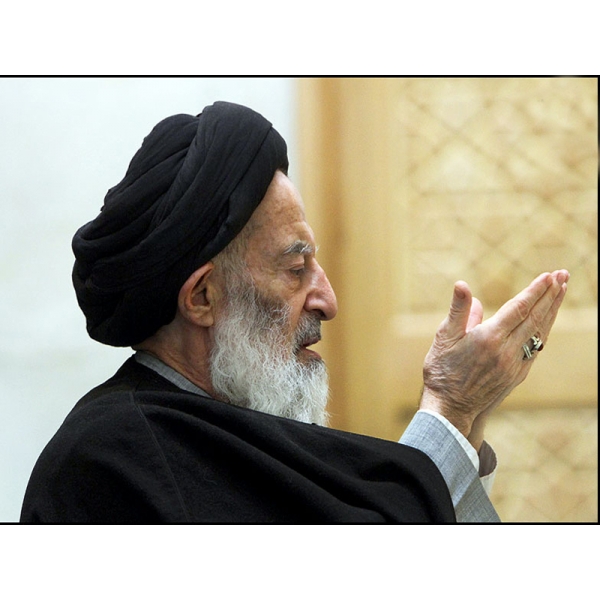
Memories of Sayyid Baqir al-Durchei about the Gatherings of the Great Marja’ Sayyid al-Zanjani
His Eminence Ayatullah Sayyid Baqir al-Mousawi al-Durchei al-Isfahani wrote in his book Cheshme-ye Shirin:1
Allah has blessed me — the least of His servants — with many favours, among them attending the gatherings of the great scholars and maraji’. One of the blessed figures I was privileged to attend for 27 years2 was Ayatullah Sayyid Shubayri al-Zanjani. At a time when it was difficult to gain access even to second- and third-rank scholars, his gathering was open every day to all students and to the general public.
I will record some particulars of this scholarly gathering for the historical record:
1. This scholarly gathering is held in his office throughout the year, including Thursdays, Fridays, and official holidays, except during the summer, when he travels to holy Mashhad or to one of the villages near holy Qom for a month or two. What is beautiful is that the gathering is also held at his home in Mashhad.
His office in Qom was the house of [the religious authority] Sayyid Sadr al-Din al-Sadr, father of Imam Musa al-Sadr. After his death, the gatherings of his son Ayatullah Sayyid Rida al-Sadr were held there daily before sunset, and Ayatullah Sayyid Shubayri was committed to attending that gathering daily before going to lead congregational prayer in the shrine of Lady Ma’suma, since it is close [to the office].
2. Since the Sayyid is committed to leading congregational prayer in the holy shrine, he would come to the sitting every afternoon and remain until the call to prayer. The sitting would last from half an hour to a full hour, depending on the season and, in recent times, on his health.
3. The sitting was extremely varied and beneficial in its content, useful to students of knowledge at every level. Sometimes students studying the fundamentals of Arabic would come, and he would give them fine, precise points from the book Jami’ al-Muqaddamat,3 which they study. At other times, senior scholars and maraji’ would come, and he would discuss with them the finest points of jurisprudence and legal theory (fiqh and usul). At other times he would raise topics in the science of narrators (rijal), and at still other times he would relate stories and anecdotes — many of the stories later published in the book Jur’ayee az Darya were ones we had heard from him repeatedly in the sitting. Nonetheless, we will relate some of them in this book 4 because of additions the Sayyid mentioned previously that were not [otherwise] recorded.
4. The Sayyid was extremely humble and would discuss matters with us just as with any ordinary student. We never felt any formality with him, and he never acted superior to us; we discussed matters with great, great ease. I say truthfully: the ease I felt discussing with him I did not feel with some teachers who were, in rank, his own students. [From this] one recalls the noble hadith mentioned in Bihar al-Anwar: a man came to the Prophet (p) to speak with him and trembled [with awe], so the Prophet said, “Be at ease, I am not a king; I am only the son of a woman who used to eat dried meat” (i.e., an ordinary woman).
5. Whoever attends the sitting for even a few minutes benefits to that extent, as one of the sayyids used to say: no one leaves the gathering empty-handed.
6. I always regretted that many people of learning did not seize the opportunity of attending such gatherings, for the number of regular attendees did not exceed the fingers of one hand for many years,5 and sometimes those present did not even fill one side of the room — yet he paid no attention to this matter. He did not care whether those present were scholars or ordinary students, and he would sometimes raise very fine discussions that exceeded the level of most of those present.
7. The Sayyid’s sitting was never a silent gathering.6 As soon as he arrived, questions would be posed to him, or he himself would open with an issue from al-Jawahir, al-Rasa’il, al-Kifaya, or al-‘Urwa al-Wuthqa, saying: “This idea occurred to me — what do you think?” In many cases he would ask our opinion on the matter first, then present his own view, and in this way the matter would become more firmly fixed in our minds.
8. He never tired of repeating stories and points of learning, and this was one reason such information remained fixed in his memory — although his memory was in any case extremely strong. I heard that when he heard a beautiful story, he would relate it to his family at home, then relate it again at the morning fatwa-session9, sometimes saying: “I related this account this morning.”
9. On many days, during the sitting, the Sayyid would conduct a marriage contract once or twice, without relying on the [written] conditions usually stated in a marriage certificate — he himself acting as proxy for the bride and one of those present as proxy for the groom. He would insist on stating the dower amount precisely, even if a copy of the Qur’an formed part of the dower, specifying its exact value so that no ambiguity would occur.
10. Many of his official meetings took place within the sitting, as scholars from various countries, officials, and members of parliament would come to him. He would usually exchange greetings with them and then continue his ordinary discussion, unless they had a fatwa question or a particular query, in which case he would answer it.10
11. For a long time, the Sayyid would not sit on a chair; he would sit on the floor, and would stand up out of respect for every newcomer, as was customary, until the pain of old age forced him to sit on a chair — though he still showed at least partial respect by standing for every newcomer.
12. The Sayyid never refrained from mentioning the views of contemporary maraji’; he would relate a marja’s opinion, naming him, and then discuss it. Some years ago the Sayyid managed to read the book Qa’idat La Darar by Sayyid al-Sistani, and told us one day: “I have some comments on the views in this book that I would like to raise in the sitting.” And indeed he raised the points in several sittings, while also praising the book.
13. Some might imagine that the book al-‘Urwa al-Wuthqa has been thoroughly exhausted by the many commentaries and glosses written on it, leaving no room for new opinion — but the Sayyid had many new and precise comments on the difficult issues in this book, which he would raise in the sitting. I hope they will be published. He used to say repeatedly: “Al-‘Urwa is a difficult book, more difficult than al-Kifaya.” He would sometimes mention instances where great scholars erred in their commentary due to a misunderstanding of the author’s wording.
14. I myself taught the book al-Rasa’il at the school founded by the Sayyid, and during this I raised most of the difficult and precise passages in the sitting, benefiting greatly. I wish these benefits could be transcribed from the audio recordings and published for everyone’s benefit. The Sayyid attended more to al-Rasa’il than to al-Kifaya, saying: “This book requires a competent teacher.” One day someone present mentioned that there was a scholarly seminar criticizing al-Rasa’il. The Sayyid became unusually angry and told that person: “You erred in attending that seminar!” — meaning those sittings held by non-specialists, since the Sayyid doubted their correct understanding of the book’s content. As for scholarly criticism by those with expertise, that is welcome, for Shaykh al-Ansari is not infallible.
15. In my humble opinion, the Sayyid revived the views of his teacher Ayatullah Sayyid al-Muhaqqiq al-Damad. He studied under him for 21 years and absorbed his views completely, always relating them in the sitting — and sometimes raising objections to some of them. The same applies to the views of his own honoured father [Ayatullah Sayyid Ahmad al-Husayni al-Zanjani].11
16. The Sayyid was not aligned with any particular political current; attendees came from various political tendencies, but political matters were not raised in the sitting, because the Sayyid held that politics requires specialized expertise.
The Sayyid once told one of the sayyids: “In this matter, we are simply ignorant!” — implying criticism of those who read a few newspapers and then consider themselves qualified to give opinions on the most difficult political questions!
17. The Sayyid was influenced by the method [and approach] of the Qom school, following Ayatullah Sayyid al-Burujerdi and Ayatullah Sayyid al-Damad, even though he had studied for a short period — about nine months — in Najaf under its scholars such as Sayyid al-Khoei, Sayyid al-Hakim, and Sayyid Abd al-Hadi al-Shirazi. Since a number of teachers of advanced studies in Qom were influenced by the Najaf method, becoming familiar with the Qom method was necessary in order for a student to be conversant with both approaches.
[The author adds:] I myself am influenced by the Najafi method, since all my teachers were Najafis — such as the maraji’ Shaykh al-Wahid al-Khurasani, Shaykh Jawad al-Tabrizi, Sayyid Muhammad al-Rouhani, and Sayyid Taqi al-Qummi — and for this reason I often discussed various issues with the Sayyid.18. When the Sayyid praised someone, his praise was genuine, for he was not given to exaggeration in describing scholarly or spiritual standing. There is a tendency that sometimes spreads among us — that when a person rises in social standing, we try to conceal his shortcomings and exaggerate his knowledge and piety. This trait was never present in the Sayyid at all. When Sayyid Mahdi al-Rouhani12 passed away, Sayyid al-Zanjani was asked about him and described his qualities without any exaggeration — even correcting the questioner directly when he attributed to the deceased a quality meant to elevate his standing that was not accurate. In contrast, he mentioned an excellent quality of his — specialization in the various schools of jurisprudence. Unfortunately, it has become common in memorial gatherings and the like to exaggerate and to conceal certain matters, and even where there is no outright lying, concealing certain facts produces the same effect as lying. We unfortunately imagine that denying some good qualities [when absent] conflicts with honouring the deceased.
19. The Sayyid never hesitated to ask about matters he did not know; he would ask ordinary questions about the details of any issue unfamiliar to him.
20. The Sayyid was, and remains, tender-hearted; we often saw his eyes well up and saw him struggle to hold back tears while relating a moving story.
21. The Sayyid’s manner of explanation is difficult for those unaccustomed to it, and he acknowledges this himself — but what eases the matter is the possibility of asking questions and requesting clarification during the sitting, unlike in a formal lecture.
22. The Sayyid never withheld from anyone a scholarly discussion or a useful story; whoever asked him for such a thing received a complete answer without hesitation.
23. The Sayyid has a particular sensitivity to raised voices; if someone raises their voice during a discussion, he is pained by it and sometimes asks them to lower their voice. It seems he suffered from this issue early in his scholarly career with some of his peers.
24. Throughout his life, the Sayyid met many scholars and righteous people. Of some — such as Sayyid Muhammad Taqi al-Khunsari and Sayyid Ahmad al-Khunsari — he would say they were “free of worldly desire,” and of Sayyid al-Burujerdi he used to say: “When a person sees his conduct, he comes to know of the existence of the Hereafter.”
25. On the first night of every lunar month, and every Thursday before noon, a Husayni mourning gathering is held at the office. The Sayyid listens to the gathering as usual, and if he has a comment or criticism, he mentions it to the speaker afterward, either privately or before everyone. Some speakers took his silence and lack of comment as approval and satisfaction with what they had said.
26. He did not formally engage in preaching or teaching ethics — he avoided this — but his conduct was itself more effective as moral instruction.
27. He often complained about the phenomenon of relying on secondary rulings and altering primary rulings, and he would praise certain people by saying: “He was not quick to resort to secondary rulings.” He put his finger on the wound in this matter, considering it one of the subtle satanic tactics used against people of learning, a matter requiring extreme precision.
28. The Sayyid had a servant who served him for long periods named Jalil Pour, who acted as his personal attendant and was responsible for serving tea to those present. He would come to the office first to prepare the tea, then go to the Sayyid’s house and return with him to the office, serving tea to all those present without exception, and then accompany him home. He was extremely organized and disciplined.
29. During the holy month of Ramadan, the time of the sitting changes to after the breaking of the fast, sometimes extending to two hours, and many scholars make a point of visiting him during the blessed month. Those sittings were extremely beneficial, featuring important and original stories and accounts, along with scholarly discussions. Some years ago the Sayyid brought the book on fasting by Ayatullah Sayyid Muhammad al-Rouhani and discussed some of its material on the rulings concerning intention over several nights.
30. In the summer, the Sayyid would move to the village of Dastjerd and lead the Maghrib prayer in congregation at one of the mosques while remaining occupied with reading and scholarly research. He would invite the regular members of the sitting to hold the gathering there once a week. Afterward, he would travel to holy Mashhad, where the sitting would also be held daily, and he would be honoured to visit Imam al-Rida (a) daily around noon.
31. After the sitting ends, a group of students would walk with him on his way to the shrine, continuing the discussion, and likewise on his way home after prayer. Most of the stories in the book Jur’ayee az Darya were recorded in this manner, which is why they were called “the wayside accounts” (tariqiyyat).
32. The Sayyid, in word and deed, filled one of the gaps in the development of the seminaries — namely, scholarly discussion and debate. When people speak of the past, they mention this quality as characteristic of that era. The dominant topic among students’ conversations used to be scholarly matters and new discoveries in jurisprudence, legal theory, and exegesis, such that when someone asked “What’s the news?” they meant scholarly news. Now, unfortunately, the dominant topics are political and economic issues, which negatively affects students’ scholarly level.
33. The Sayyid generally maintained his composure in discussions with students of knowledge, yet at the end of each year he would apologize to everyone, saying: “Forgive me if I was sometimes harsh with you in speech”.13
34. Discussions did not end with the sitting — the Sayyid would continue thinking about the topic, and sometimes he would say in the next sitting: “I thought about the matter and concluded such-and-such,” sometimes changing his initial opinion.
35. His regard for courtesy toward those present was exceptional. Sometimes, when it was hot, he was forced to remove his turban for a while, and he would apologize to those present for doing so. When he wished to place a turban on a new student [marking his entry into clerical studies], he would invite those present to do so out of courtesy, and likewise when conducting a marriage contract.
36. There was no gatekeeper or doorman for the Sayyid’s sitting; students of every scholarly level attended without restriction, and sometimes ordinary people would come during the sitting to ask their questions or to request financial assistance.
37. Many authors would come to the sitting and present their works to the Sayyid, prompting a discussion of the book’s content on that occasion. Sometimes the author would ask, out of caution: “Is this book a gift, or is it [merely] entrusted to you?”
38. In recent years, the time of the sitting shifted to the evening and the number of attendees increased, but unfortunately the sitting was suspended for a year and a half due to the COVID-19 pandemic, then resumed with improved conditions, now held two nights a week only.
39. In conclusion, I say: this information is a summary of what occurred to me hastily about this sitting. With the Sayyid’s advancing age and the diminishing of these gatherings, people of learning have lost one of the finest scholarly sittings of all.14
Footnotes
- Some minor edits and necessary corrections have been made. — Muhammad Ja’far al-Zaki
- This was at the time the book was printed, three years ago. The book is a collection of memories, anecdotes, and points of benefit heard from him and from those close to him; footnotes accompanying these memories are understood to be from the author, may his blessings endure.
- The Sayyid studied some Arabic literature and the book al-Amthila with his blessed father at an early age, and would sometimes raise objections to the text. It is related that his father used to say of his objections that they were valid and cogent.
- Meaning his book Cheshme-ye Shirin.
- Many individuals and personalities attended merely to pay a visit or to ask a particular question, without this sitting being part of their regular scholarly program!
- Unfortunately, some scholars’ sittings are limited to silence and simply looking at the scholar! A heavy atmosphere dominates the gathering and everyone is silent!! And we find some praising such gatherings, proudly saying: “What a great gathering!” But were the gatherings of the Prophet and the Imams (peace be upon them) like that? Out of familiarity with the Sayyid’s sitting, I reflected often on those [other] gatherings, and I was never — and am still not — comfortable attending them. I attend [them] only because everyone is silent, and if a question is raised, the scholar answers it briefly with no desire for discussion.
- The morning fatwa-session was originally attended by his old friends such as Sayyid Mahdi al-Rouhani, Shaykh Ali al-Ahmadi al-Miyanji, Sayyid Abu al-Fadl Mir Muhammadi, Shaykh Ahmad al-Adhari al-Qummi, and Shaykh Ibrahim al-Ramadani al-Firdawsi; later they were joined by Sayyid Ali al-Muhaqqiq al-Damad, Shaykh Rida Ustadi, and Sayyid Muhsin al-Kharazi.7 with his old friends, then relate it a third time at the afternoon sitting8Some friends related that they noticed he would hear a story from someone and then begin recounting it back to them, to make sure he had memorized its details correctly.
- In one of the previous years, the Consultative Assembly passed a resolution requiring anyone who sells at an inflated price to return the price difference to the buyer and also pay a fine to the state. In those days, one of the members of parliament came to the sitting and I objected that in Islamic law there is no ruling requiring the payment of a price difference except in the case of a defect, whereas overcharging (ghabn) only entitles the buyer to rescind the contract, nothing more. That member was not a scholar, but he said: “We had scholars in the Assembly and they did not object to this law, so we assumed it was lawful.” I said to His Eminence the Sayyid: “It is necessary for members of parliament to consult competent scholars before passing laws,” and the Sayyid agreed with me and supported what I said. He said to me: “If it were left to me, I would require anyone applying for a position — whether the presidency, membership of parliament, or even the chairmanship of a car company, for example — to be tested on his knowledge of the practical manual [of rulings] and general legal rulings. To whom shall we complain of this calamity? A student spends a lifetime in the seminary studying and verifying the conditions of transactions, only to find that those responsible for major transactions such as housing and cars do not know the basic rulings on transactions mentioned in the practical manuals. If the government sells housing in advance, the price and delivery time must be specified, and the price must be paid in full in a forward sale (bay’ al-salaf). I fear some may imagine that the legal rulings on government matters have been abolished and that they have complete freedom in the decisions they make.”
- The scholarly level of Sayyid al-Damad is far higher than what appears from the published transcripts of his lectures. As Sayyid Shubayri says: “Sayyid al-Damad’s lecture contained many unstated premises, and the published transcripts are simply his words as spoken in class, so one needs to explain those unstated premises to grasp his meaning.” He also said: “The Sayyid entrusted me with overseeing the correction of the written transcripts of his lectures, and I found they needed so many additions that it would have been easier to rewrite them from scratch, which is why I did not do so. Yes, these transcripts are useful, but Sayyid al-Damad’s true level was greater. Sometimes a person reads someone’s book and finds it powerful, but when he speaks with the author and discusses matters with him, he finds his actual level lower than what the book suggests. For this reason I have become convinced recently that one cannot judge a person’s scholarly level from his treatise and published books alone, because the actual writer may be someone else for all or most of the book, and the book may have been corrected by someone more knowledgeable than the author.” One of the teachers says: “I was writing a piece of research when a friend came in and asked what I was writing. I told him: some people ask me to write a particular piece of research for them, and I comply, and in return they give me gifts!” The friend replied: “This is in fact a kind of deception and pretense, for they take this research and submit it to the seminary or university to obtain a doctoral degree by it!” Unfortunately, this practice — a form of dishonesty — has become so common that theses are bought and sold on the internet.
- There are two people in the Rouhani family bearing this name, who are cousins: one is Sayyid Mahdi, son of Sayyid Abu al-Hasan al-Rouhani, born in 1343 AH and died in 1421 AH; the other is Sayyid Mahdi, son of Sayyid Abu al-Qasim al-Rouhani, born in 1370 AH and died in 1443 AH. The one meant in the text above is the first.
- However much I describe his manner of discussion, I cannot do it justice. If a stranger unfamiliar with the Sayyid saw him discussing with a student, he would assume two ordinary students were conversing together, and it would never occur to him that one of the maraji’ of emulation was discussing with an ordinary student.
- This is what appears at the end of these precious memories. How wonderful it would have been had they been published while he was alive! Now, however, the seminaries and the believers have lost him, and have lost his blessings, his spiritual graces, and his generous gifts. May Allah have mercy on our great loss and reward him, on behalf of knowledge and its people and the Shia of the Ahl al-Bayt (a), with the finest reward given to the righteous, and may He gather him with his masters and his pure forebears. “Indeed we belong to Allah, and indeed to Him we return,” and there is no power or strength except in Allah, the Most High, the Magnificent. May our consolation and compensation come through the safety of our awaited Imam (may Allah hasten his relief).