
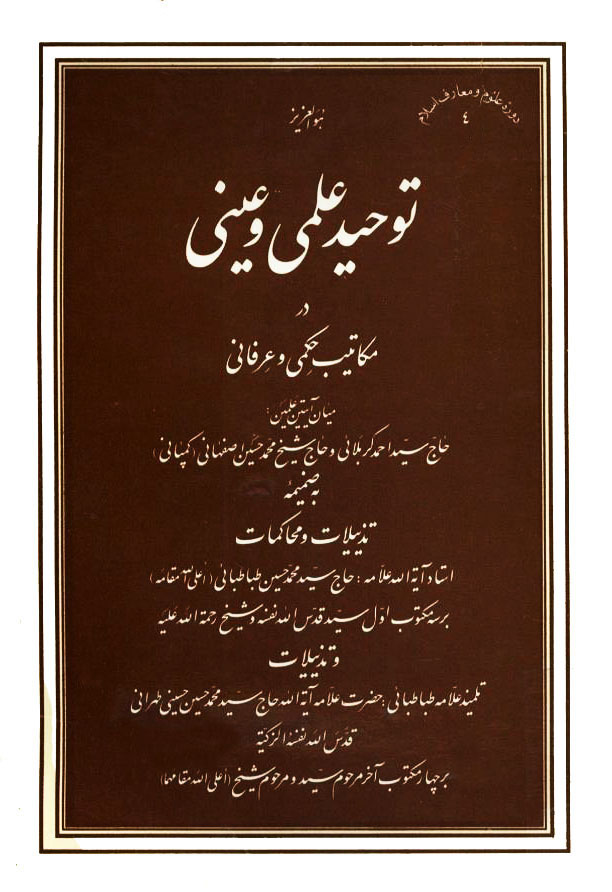
Third lecture by Ustad Soroush Mahallati on this treatise written by ‘Allamah Tabataba’i, delivered on June 17th, 2026.
In the Name of God, the Most Compassionate, the Most Merciful.
All praise belongs to God, Lord of the worlds. May God’s blessings be upon our master and prophet, Muhammad, and his pure family.
Greetings and salutations to our respected friends and dear companions. I also extend my condolences on the arrival of the month of Muharram and the mourning for Aba ʿAbdillah al-Husayn, peace be upon him.
In the previous session, we discussed the first written letter of Muhaqqiq Isfahani. Of course, this first letter consists of two sections. The first section was explained, while the second section concerns the attributes of beauty and majesty. For now, we will set aside this second section, because this second part is not pursued in the Muḥākamāt of the late ʿAllamah Tabataba’i, which is the axis of our discussion. The main and relevant discussion is that first section, and ʿAllamah Tabataba’i also follows that first section.
In summary, in the appendix that the late ʿAllamah Tabataba’i writes on this correspondence, he continues the discussion concerning the nature of multiplicity among existents. Naturally, this raises the question of what relation multiplicity and unity have to one another, and how they can be reconciled. Since this multiplicity is a multiplicity by way of gradation, and existence is one reality that possesses different levels, the late ʿAllamah pursues the discussion of gradation in this appendix.
In other words, as you observed in the previous session, Muhaqqiq Isfahani raised the issue of the limits of existence on one hand, and the purity of existence on the other. Pure existence has no limit, whereas lower levels possess limits and are limited. Since the issue of limits of existence within levels arises here, the late ʿAllamah focuses in this appendix to Isfahani’s first letter on this very question: how are existents limited, while pure existence also exists?
At the beginning of this appendix, he explains gradation: what does gradation in existence mean? He then says, “From here it becomes clear…” and draws a series of conclusions. The first conclusion is that the existential limit is a non-being respect. A few lines later, he says again, “From here it becomes clear that the higher level has no limit in relation to the lower level.” Two lines later, again: “From here it becomes clear…” Five or six lines later: “From here it becomes clear…” On the next page: “From here it becomes clear…” Again, five or six lines later: “From here it becomes clear…” Seven or eight lines later: “From here it becomes clear…” And a few lines later: “From here it becomes clear…”
After explaining the foundation of gradation, the late ʿAllamah Tabataba’i derives eight conclusions from that foundation. Each conclusion is explained in a separate section with the phrase, “From here it becomes clear.”
Based on the order and structure found in ʿAllamah Tabataba’i’s article, which is written at some length and spans four pages, several times longer than Isfahani’s first correspondence, he both explains the foundation and then lays out the conclusions.
This section is an important issue, because the entire disagreement between the gnostic and the philosopher lies in the analysis of multiplicities. Have these multiplicities occurred within the reality of existence, such that the philosopher explains the matter by saying that existence is one reality that possesses levels? Or is it not the case that these multiplicities are within the one reality, and that the one reality does not possess gradational levels?
Since the essential disagreement between the gnostic and the philosopher lies at this point, the late ʿAllamah Tabataba’i addresses this subject in his first writing. The important point is that while the late ʿAllamah accepts gradation in the levels of existence, he also accepts the personal unity of existence. This opposition is thereby brought to an end.
He is not trying to invalidate gradation in the levels of existence. Rather, he affirms it. At the same time, however, he does not place this view in opposition to the personal unity of existence. He regards it as reconcilable and compatible with personal unity.
Therefore, in the first stage, we must see how the late ʿAllamah presents gradation.
The late ʿAllamah has a discussion on this issue in an extended marginal note in the first volume of al-Asfār, near the end of the first volume where the discussion of gradation appears. There, he has a two-page marginal note on gradation. He also discusses gradation in his own book Nihāyat al-Ḥikmah, in the third chapter.
The assumption is that those who are accompanying us in these discussions, following these matters, and serving as the audience of this discussion have some familiarity with philosophical issues and have already passed through the preliminaries. Therefore, we do not need to begin every discussion from the most elementary starting points. Naturally, we will treat some matters as accepted principles that have been discussed in their proper place and that our friends are already aware of. Or we will simply indicate that these matters were studied in earlier sources.
But how should we enter the discussion of gradation?
The method of entering philosophical questions is an important matter. It is this method of entry that clarifies the issue, makes the mind more comfortable with it, and prepares the ground for acceptance and understanding.
Among the different ways of discussing gradation, some begin the discussion from gradation in existence: that existence is one gradational reality, and they pursue and establish gradation within this reality. This is the common method of the philosophers.
Among these approaches, however, our great teacher, Shaheed Mutahhari, has another method. His method is this: set aside, for the moment, the discussion of gradation in the reality of existence. First, discuss the very principle of gradation itself. Is there, in the world and in the system of being, any reality that is both one and possesses levels?
In other words, set aside the discussion of existence for now. Is the very idea that one reality can possess levels possible or not? What does it mean for a reality to be one while also possessing levels? It means that the basis of commonality and the basis of distinction are one and the same thing. The factor by which things are shared is identical to the factor by which they differ. Is such a thing possible or not?
First, we must have a clear conception of the issue of levels within one reality. For now, that one reality is not necessarily existence. It may be any reality. Is gradation and having levels possible or not?
For example, when you compare colours with one another, you say that we have white and we have whiter. White and whiter are both white. This is white, and that is white. This is pure whiteness, and that is also pure whiteness. Is this how we conceive it? Or do we conceive it in another way, namely that one is white, while the other, in addition to whiteness, contains something else that is outside whiteness?
If you say that both are truly white, but one is weak and the other is strong, and that the very thing present in the weak is also present in the strong, not that something other than whiteness has been mixed with it, then this is gradation.
In this way, whiteness has intensified in the higher level, or conversely, weakened in the lower level. It is not that some other colour has been mixed with whiteness and altered pure whiteness. That would be a different conception.
We can have the same conception in various subjects. For example, in virtues and moral dispositions, when we say that one human being is pious and another human being is more pious, what is meant by “more pious”? Does it mean that an external element has been added to the piety of the pious person, namely piety plus an addition from something other than piety? Or are both piety, and the one who has more and possesses a higher level has more in piety itself, while the one who has less has less in piety itself?
That is, the basis of commonality is piety, and the basis of distinction, namely the higher level, is also piety. If you can conceive and accept this, then the issue of gradation will be intelligible to you.
The common example that is given is not a real and literal example, but it is used to bring the matter closer to the mind. Consider light. Light has levels. There is weak light and strong light. The basis of commonality among these lights is being light. Now the one that is strong light has strength in being light. This means that its basis of distinction is also the same as its basis of commonality, namely being light. It is not that something other than light is joined to light. Rather, the one that is more luminous has a higher level in the very reality of being light, not something outside the reality of being light.
May God have mercy on the late Shaheed Mutahhari. In his discussions in the expanded commentary on Manẓūmah, when he raises the issue of gradation, he enters the discussion from this point. Before discussing the reality of existence and whether it possesses levels, he first explains how one reality can have different levels. This is a suitable and helpful explanation.
He himself points out there that this explanation, meaning this style of analyzing the issue, was not presented by Mulla Sadra, nor by the late Haji Sabzawari, nor by anyone else. It is one of his own innovations in teaching and analyzing this philosophical issue.
Now, the subject of discussion here is the reality of existence itself, which possesses levels. If we accept that it possesses levels, can this be proven or not? Is this an issue capable of proof? How can one prove that existence possesses levels?
The explanation is as follows. The difference between things and existents is of two kinds. One type of difference is diversity and multiplicity in quiddities. This is a tree, and that is a stone. This is a tree, and that is a rock. This has one quiddity, and that has another quiddity. This is a human being, and that is a horse. This has one quiddity, and that has another quiddity. We can enumerate this multiplicity and diversity in quiddities, and the source of this multiplicity is the multiplicity that exists in quiddities themselves. This is one type of difference.
The second type of difference is a difference that occurs with respect to existence itself, without a particular quiddity being involved. For example, there is a multiplicity and diversity in existence from the perspective that sometimes existence is a cause and sometimes it is an effect. This is one kind of diversity. Sometimes existence is actual, and sometimes it is potential. This is another kind of diversity. Sometimes existence is necessary, and sometimes it is contingent: necessary existence and contingent existence. These are divisions that apply to existence itself.
Our discussion is not about the first category. That is not related to the discussion of gradation. Our discussion concerns the second kind of difference. What is the nature of this second kind of difference? When the cause differs from the effect, or the Necessary differs from the contingent, this difference and diversity must be explained. What is the source of these differences?
Sometimes it is said or imagined that this difference arises because there is a part of existence in one that is not present in the other. In other words, when we say that something has levels, a strong level and a weak level, we say that the strong level possesses the original reality plus an additional part. Since our discussion concerns the reality of existence, we would say that in the higher level, a part of existence is added to it. This additional part of existence exists in the higher level but not in the lower level. This is one conception.
Of course, this kind of conception exists with respect to quiddities. Sometimes we mix or add one thing to another. We have water, then we add sugar to it, and it becomes syrup. But can we say that in the levels of existence something similar occurs, such that a part is added to the higher level?
It must be said that we cannot. Why? Because existence is a simple affair and has no parts. The proof is this: if you add one part to another part and arrive at a whole from the combination of those two parts, then here you must explain how it is possible for one part, as existence, to be added to another reality. How is this possible? Is that reality itself existence or other than existence? Other than existence is nothing. So if that reality is existence, and the part is also existence, and the whole is also existence, then how does the consideration of parthood even make sense? There is no meaning to something being a part of itself. A part is considered as something other than the whole. Therefore, we cannot say that the higher level has an additional part that is existence itself. It was already existence. This does not become an additional part that exists in one and not in the other.
Or one may say that this difference in levels is not because a part of existence has been added. Rather, there is a reality outside existence that is joined to it and brings about the higher level. When that reality outside existence is not present and not joined to it, the lower level is realized. The difference is due to this. This conception is also wrong.
Why? Because when we are discussing the reality of existence, we have no conception of a reality outside existence that could be joined to existence and produce a higher level. There is existence, and outside existence there is nothing. There is nothing opposite existence that could be joined to existence.
Therefore, the differences that occur in existence must return to existence itself. This is the meaning of gradation. They do not return to some external factor. Existence itself, which is the basis of distinction, is also the basis of commonality. The higher level is distinguished because of the intensity of existence, not because of some other matter besides existence that has been joined to existence and caused the existent to become intense and strong in existence. The assumption of another reality has no place here.
With this introduction and explanation, we will now read a portion of the statement of the late ʿAllamah Tabataba’i, may God be pleased with him. This is the first appendix by ʿAllamah to the first letter of the late Isfahani. We need to move forward somewhat and read ʿAllamah’s statement so that we can compare the view of ʿAllamah Tabataba’i with the view of his teacher, the late Shaykh Muhammad Husayn Isfahani.
Part of ʿAllamah Tabataba’i’s statement here is an explanation. Another part is investigation. The final part is a critique which, based on this investigation, is directed toward his teacher, Shaykh Muhammad Husayn Isfahani.
As I said, he first explains gradation and then derives eight matters from it. We must gradually examine these eight matters so that it becomes clear what the great researchers among the philosophers and sages meant when they placed pure existence opposite limited existence, and when they considered the levels below pure existence as accompanied by limit. What does this issue of limit, which encompasses all existents of the world, actually mean?
Isfahani raised the issue of limit briefly and said that we have existential limits, non-existential limits, and quiddative limits. Now ʿAllamah Tabataba’i, through his own explanation, will clarify that the explanation Isfahani gave, and this division, is not correct. These are preliminaries so that the matter may become clear.
ʿAllamah begins this article and first writing as follows:
“As is clear and evident from the method of reasoning and expression of the late Shaykh…”
Here, by “Shaykh” he means Shaykh Muhammad Husayn Isfahani. The students of the late Isfahani usually referred to their teacher as “the Shaykh” or “Haj Shaykh.” The late Ayatullah Milani, in his lessons, would usually transmit Isfahani’s views by saying, “Haj Shaykh.” Among those great scholars, “Haj Shaykh” meant Isfahani. Of course, when the students of the late Haj Shaykh ʿAbd al-Karim Ha’iri say “Haj Shaykh,” they mean the late Haj Shaykh ʿAbd al-Karim Ha’iri. Here, however, “Shaykh” means Shaykh Muhammad Husayn Isfahani.
“As is clear and evident from the method of reasoning and expression of the late Shaykh, the foundation of the answer rests upon the doctrine of the gradation of existence and its principiality.”
That is, the answer given by the late Isfahani is based upon the principiality of existence and the gradation of existence, and on the idea that what is principial externally is one gradational reality possessing different levels, which differ by strength and weakness, priority and posteriority, precedence and delay.
Now, what does gradation mean here? He explains the kind of difference that constitutes gradational difference:
“A difference that returns to the very basis of agreement.”
This is gradation: a difference that returns to the very basis of agreement. It is not that the difference returns to some external matter. Rather, they differ in the very thing in which they are shared, because this is what is assumed.
How is it possible for differences to return to the basis of agreement? How can the basis of commonality be identical with the basis of distinction? This is intelligible, one may say. Indeed, he says, it is not only intelligible, it is necessary. Why? Because if the difference does not return to the basis of agreement, and by the basis of agreement we mean the reality of existence itself, then to what other thing could the difference be referred? Whatever you consider as that to which the difference returns is either this very reality of existence or something other than it. The latter is false, because anything other than the reality of existence is sheer nothingness. Therefore, we must assume that the basis of difference is the very basis of agreement.
This rests on the fundamentality of existence. There is only one reality, and that is the reality of existence. You cannot refer the basis of difference to something else, because the basis of commonality is existence. Whatever is assumed besides it is either it or other than it. Other than it is false by assumption. Therefore, it must be it. This is the proof for gradation in the reality of existence.
Once, in accordance with this proof, we accept that intensity and weakness, precedence and delay, exist within existence, then one level becomes an intense level and another becomes a weak level. One becomes a higher level and another a lower level.
The higher level shares with the lower level in the original reality. This is the basis of commonality. But it also has an addition. This addition is not an addition outside the essence. Its essence is the reality of existence, and its addition is also in the reality of existence.
In the example of light, we said that the stronger light is stronger in being light, not that something other than light has been joined to it. In the case of higher piety, we said that the one who has a higher and superior degree of piety has more piety, not that the basis of commonality is piety and that piety is equal in both individuals while the one who is higher has something else in addition to piety. If it were something in addition to piety, then he would not be more pious. This superiority is within piety itself: less piety and more piety. The addition also returns to this very reality.
Therefore, the lower level, while sharing with the higher level in the original reality, does not possess the perfection that exists in the higher level, nor the addition that exists in that higher level. So the lower level has a possession, namely the original reality of existence and the shared reality. It also has a lack, and this lack is the absence of that perfection which exists in the higher level. Thus we say that in this lower level there is a composition of having and not having.
Of course, all these expressions are somewhat loose. Why? Because having and not having, existence and non-existence, cannot form a real composition with one another. They do not mix. Not having is the contradictory opposite of having. How could not having and having, existence and non-existence, combine with one another? Such a thing is impossible. What is meant is that there is existential limitation at work in the lower level. We describe this existential limitation as “not having.”
In the higher level, there is something like light with degrees. This lower degree of light, because of its limitations in comparison to the higher level, lacks what the higher one possesses. The lack itself is not a possession. Rather, it means that what it possesses is less.
ʿAllamah’s statement is as follows:
“Since the difference occurs by way of priority and posteriority, intensity and weakness, the higher level must contain the lower level and more. However, the addition is not something external to the essence of the higher level.”
The higher level has an addition, but this addition is not outside that essence, which is the shared reality.
“For the lower level lacks the perfection that exists with the higher level in the aforementioned manner. Thus, the lower level is composed of existence and the shared reality, and also of the absence of the higher level from the limit of its essence.”
In the essence of the lower level, there is both the reality of existence, which is shared, and the fact that the higher level is absent from the essence of this lower level.
“And this is what is meant by saying that the lower level is an existence mixed with non-existence.”
If it is said that the lower level possesses an existence mixed with non-existence, this is what is intended. Otherwise, you may object that non-existence is the contradictory opposite of existence and cannot combine with it at all. What is meant is that it has an existential limit, and its existence is accompanied by limitation and weakness.
“And this is what is meant by saying that the lower level is an existence mixed with non-existence. Otherwise, non-existence, being the contradictory opposite of existence, has no access to the sanctuary of its contradictory.”
From here, another point also becomes clear: what is meant by the expression “existential limit”? Does “existential limit” mean that something outside the reality of existence limits this existence? If you understand it this way, then this is no longer gradation. You have left the doctrine of gradation. In gradation, the basis of commonality and the basis of distinction must be one.
Therefore, when “existential limit” is mentioned, from the perspective of its being an existential limit, it means that the difference occurs within the very reality of existence, which is the basis of commonality. It does not mean that you attach and append the difference to existence from something other than the reality of existence. There is no attachment or addition from other than existence. It is the very same reality that is strong, and the very same reality that is weak.
This is what is meant by existential limit:
“For an existential limit is not outside the reality of existence. Otherwise, the assumption of a gradational level would entail contradiction, as is clear.”
These discussions implicitly show the problem and defect in the statement of Shaykh Muhammad Husayn Isfahani. Why? Because the late Isfahani imagined that we have existential limits and non-existential limits, treating them as two categories of limit. In reality, all these limits are existential limits. Non-existence does not make limits in such a way that it would stand beside existence. If you hold such a conception, then gradation itself comes into question and the assumption is contradicted.
The assumption in gradation is that the basis of distinction is the very basis of commonality. Therefore, it is not correct to consider a non-existential matter as independent and separate, and then make it the source of difference among various levels. The existential matter itself is limit-making, because it has different levels.
This is the initial explanation of the late ʿAllamah Tabataba’i. After this initial explanation, he begins drawing conclusions: “From here it becomes clear,” one; “from here it becomes clear,” two; “from here it becomes clear,” three; and so on, up to eight points in which he derives conclusions in this regard.
I recommend to my respected friends and dear companions that you review the third chapter of Nihāyat al-Ḥikmah. This will serve as a reminder and will be useful for understanding our discussion in Risālah al-Muḥākamāt. It is in Nihāyat al-Ḥikmah, Stage One, which concerns the general properties of existence, chapter three, titled: “On the fact that existence is a gradational reality.” Of course, ʿAllāmah has pursued these same discussions in other places as well.
Until the next session, God willing, by His power and strength.
May God send blessings and peace upon our master and prophet, Muhammad, and his pure family.